


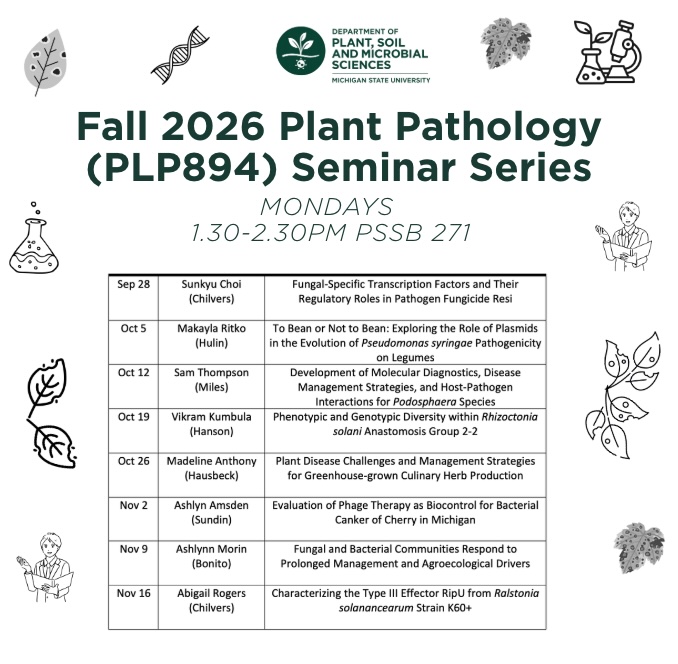
Fall 2026 Plant Pathology (PLP894) Seminar Series featuring Ashlyn Amsden
November 2, 2026 1:30PM - 2:30PM
This and every Monday in room 271 PSSB
Title: Evaluation of phage therapy as a biocontrol for bacterial canker of cherry in Michigan
Bacterial canker, caused by members of the Pseudomonas syringae species complex, is a major disease affecting cherry and other Prunus species. A lack of viable management options has driven interest in bacteriophage (phage) biocontrol. We hypothesized that surfactants could increase phage efficacy by disrupting bacterial aggregates on cherry flower stigmas and increasing phage access to cells. In a 2024 orchard cherry flower assay, P. syringae pv. syringae (Pss) populations were reduced 100-fold following phage/surfactant treatments but rebounded to control levels within 76h. In vitro population assays using Pss BY38 showed that phage treatment halted growth, while phage + Oroboost® (0.125%; Rovena Next, Cary, NC, USA), increased suppression compared to phage alone. In a bean leaf model, phage cocktail treatment (AgriPhage®, OmniLytics, Sandy, UT, USA) combined with Oroboost (0.118%) reduced the BY38 population 158-fold within 6h, and held through 48h. Oroboost alone produced a similar reduction, suggesting disruption of epiphytic aggregates negatively impacted bacterial growth on leaves. New results in the bean system show a potential increase in phage efficacy with Kinetic® (0.125%; Helena Agri-Enterprises, Collierville, TN, USA) over Oroboost. In detached cherry flower assays, two applications (4 and 24 hpi) of phage + Oroboost (0.125%) yielded an initial 100-fold reduction, but populations rebounded to control levels within 72h. Our results signal short term efficacy of phage treatments but demonstrate the need for improvement to reach sustained population suppression.

 Print
 Email