


MSU Turfgrass Field Day
August 12, 2026 8:30AM - 4:00PM
MSU Hancock Turfgrass Research Center, 4444 Farm Lane Lansing, MI 48910
There are two research tours for attendees to choose from in the morning: golf turf or lawn care/athletic fields (2 hours and MDARD credits). After lunch, take in Agronomic Alley and attend vendor demonstrations or a sprayer calibration lab (2 hours and MDARD credits).
Morning Research Tours
Golf Turf Research Tour (9-11 a.m.):
- Disease identification and management strategies for golf turf – Dr. Ruying (Wrennie) Wang and Nancy Dykema. Major diseases on golf turf will be identified and discussed, including cultural and chemical management strategies for anthracnose and dollar spot. Research evaluating best management practices for dollar spot using a weather-based prediction model and autonomous mowing technology will be highlighted.
- Evaluating wear tolerance on putting greens – Dr. Thom Nikolai will discuss a trial that examines the impact of traffic and tank mixes with and without pesticides on weeds and diseases and the possibility of increasing wear tolerance on putting greens.
- Satellite Imagery Technology in Turfgrass Management - Dr. Jackie Guevara will discuss the potential of satellite imagery technology for turfgrass management, particularly on nutrient and soil moisture management. Current studies on creeping bentgrass that validate data collected from satellite imagery will also be presented.
- Annual bluegrass weevil in Michigan: ID, monitoring, and management – Dr. Max Helmberger. Learn how to identify the newly introduced annual bluegrass weevil and learn the unique tricks for monitoring and controlling it with optimal insecticide selection and timing.
- Turfgrass physiology – Dr. Emily Holm will discuss the latest winterkill and heat/drought related physiology projects. The effects of altering mowing heights in the fall and application of plant growth regulators on turfgrass survival under ice encasement will be presented.
- Linking Soil Moisture Variability to Root Disease Complexes on Sand-Based Putting Greens – Mike Rabe and Dr. Ruying (Wrennie) Wang. Root diseases are one of the most difficult pathogens to manage. Previous research on sloped putting greens, revealed that take-all patch was more severe in some areas than others. This project combines drone-based remote sensing with field sampling to investigate how differences in soil moisture influence disease development.
- Novel methods for managing organic matter accumulation on putting greens – Dr. Kevin Frank. Golf course superintendents have used numerous cultural practices to mitigate organic matter accumulation in putting greens including sand topdressing, and several mechanical removal processes. Recently, products containing the laccase enzyme have been commercially developed to manage organic matter accumulation, other reported benefits are acting like wetting agents in reducing localized dry spot. Trials have been conducted at MSU the last three years to determine the effectiveness of reducing organic matter accumulation.
Lawn and Athletic Fields Turf Research Tour (9–11 a.m.)
- Effect of irrigation timing on disease incidence in lawn height Kentucky bluegrass – Mike Rabe and Dr. Ruying (Wrennie) Wang. Lawn irrigation scheduling is a seldom thought about topic amongst homeowners. Typically, homeowners defer to trusted professionals for their irrigation scheduling. Research conducted in 2011 and 2012 on golf course fairways showed that infrequent irrigation increased incidences of dollar spot. This project applied the same methodology to the home lawn. Attendees will learn about the impact of irrigation scheduling on home lawn quality and disease incidence.
- The effects of repeated Trinexapac-ethyl applications on traffic tolerance and recovery of Kentucky bluegrass – Ryan Bearss and Dr. Trey Rogers. Plant growth regulators are commonly applied to turfgrass systems to reduce vertical growth and mowing requirements. Applications are often scheduled according to growing degree days; however, this approach can make integration into existing weekly or bi-weekly spray programs challenging. Accordingly, research was conducted to identify weekly trinexapac-ethyl rates that could safely reduce clipping yield while maintaining turfgrass quality and allowing uninhibited recovery from simulated traffic.
- Pain in the grass: New online tool to help you identify perennial grasses – Dr. Erin Hill. Come join Dr. Erin Hill in the weed garden to learn about MSU's new perennial grass ID tool to help you or your clients with our most common lawn offenders. In addition to focusing on grasses, there will be plenty of other specimens available in the garden to test your weed ID skills and the opportunity to ask diagnostic questions. Proper identification is key to selecting the proper herbicide for control.
- Autonomous mowing frequency – Zach Flink and Dr. Trey Rogers. Zach Flink will discuss how mowing frequency influences mixed turfgrass stands maintained at a higher height of cut. Evaluating twice weekly and six-times weekly schedules with field measurements and satellite imagery used to assess turfgrass quality, density, weed encroachment and spatial uniformity.
- Pesticide trials and mechanical spot spraying – Dr. Thom Nikolai. Dr. Nikolai will discuss tank mixing herbicides to extend pre-emergent weed control and intelligent boom spaying to target weeds and diseases to reduce the amount of pesticides applied by blanket/broadcast spraying.
- Common lawn pests: What you need to know – Dr. Max Helmberger. Learn how to identify, monitor, and combat common lawn pests such as chinch bugs, billbugs, and scarabs/white grubs. Discussion will include management with and without insecticides, insecticide selection, and application timing.
Afternoon Session (1:30-3:30 p.m.)
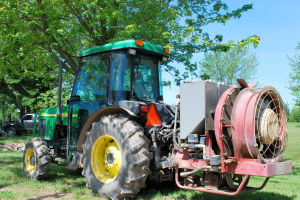
Ride-On Sprayer/Spreader Calibration: Jesse Sholl
From simply understanding the output of your ride-on spreader/sprayer to some ideas to get more value from them make this workshop great opportunity for all levels of applicator experience. Today’s products have lower application rates and enhanced formulations. Which nozzles and deposition patterns will perform better with them? Are you guessing, or knowing your rotary spreader's overlap? Remember: Michigan Standards for pesticide use require “pesticide application equipment shall be properly calibrated”.
Event Location
4444 Farm Lane, Lansing, MI 48910


 Print
Print Email
Email