


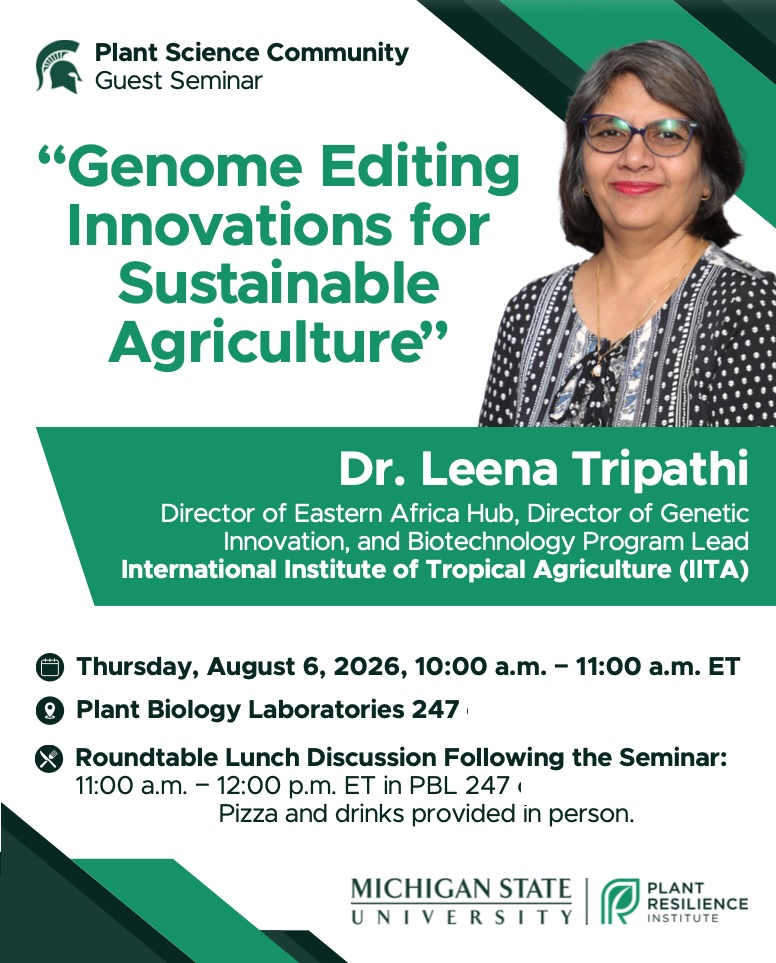
Plant Science Community Guest Seminar Dr. Leena Tripathi
August 6, 2026 10:00AM - 12:00PM
Come for pizza lunch on us!
Dr. Leena Tripathi
Dr. Leena Tripathi, FAAS, FAAAS
Director of Eastern Africa Hub
Director of Genetic Innovation Science Area
Biotechnology Program Lead
International Institute of Tropical Agriculture (IITA), Nairobi, Kenya
Email: L.Tripathi@cgiar.org
Speaker Biography:
Dr. Leena Tripathi is the Director of Eastern Africa Hub, Director of Genetic
Innovation, and Biotechnology Program Lead at the International Institute of Tropical
Agriculture (IITA), a member of One CGIAR. With more than 26 years of experience
in plant biotechnology, her focus lies in enhancing staple crops like banana/plantain,
cassava, and yam to resist diseases and pests, crucial for global food security. She
champions a "Science to Practice" approach, ensuring her research translates into
practical solutions worldwide. Dr. Tripathi’s scientific achievements have earned her
international recognition, including election as a Fellow of the American Association
for the Advancement of Science (AAAS) and the African Academy of Sciences
(AAS).
Dr. Tripathi and her team have established a robust genetic transformation platform
at IITA-Kenya to develop transgenic and gene-edited products and transfer these
technologies to national agricultural research systems in sub-Saharan Africa. She
collaborates globally with advanced labs in the United States, United Kingdom,
Europe, and Australia, as well as with national partners in Africa and various regional
partners. Beyond her role at IITA, Dr. Tripathi contributes to academia as an Adjunct
Professor at the University of Queensland, Australia, and plays advisory roles as a
member of the external advisory panel of Norwich Institute for Sustainable
Development, UK, and advisory board member of Cornell Alliance for Science (AfS).
She serves on the editorial boards of several journals such as Plant Biotechnology
Journal, Communication Biology, and Frontiers in Genome Editing.
Dr. Tripathi holds a Ph.D. in Plant Molecular Biology and an M.Sc. in Molecular Biology
and Biotechnology. She worked at the University of North Carolina at Greensboro,
USA before joining IITA. Her multidisciplinary efforts underscore her dedication to
advancing agricultural biotechnology, which is crucial for addressing global food
security challenges.“Genome Editing Innovations for
Sustainable Agriculture”
Dr. Leena Tripathi
International Institute of Tropical Agriculture (IITA), Nairobi, Kenya
Seminar Abstract:
Sustainable intensification of agriculture is vital to ensure food and nutrition security in
the face of climate change and population growth. Meeting rising food demand
requires more efficient approaches, bridging yield gaps in staple crops, and enhancing
productivity using both conventional and modern biotechnologies. Genome editing,
particularly CRISPR/Cas systems, offers a precise, efficient, and transformative tool
for crop improvement. Unlike traditional genetic modification, genome editing enables
targeted changes within a plant’s genome without introducing foreign genes. In many
countries, genome-edited crops are not regulated as GMOs, allowing faster approval
and broader public acceptance.
In Africa, genome editing is showing great promise for strengthening the resilience
and productivity of staple crops. Researchers are using genome editing to improve
African staple crops for biotic and abiotic stress resistance and improved nutritional
quality. Many products, such as disease-resistant banana, maize resistant to lethal
necrosis, and sorghum resistant to the parasitic plant Striga and enhanced quality, are
under development for African farmers. To fully harness the benefits of genome
editing, science-based, enabling regulatory frameworks are needed. Encouraging
progress has been made in several African countries. These policies can accelerate
innovation and adoption, allowing local farmers to benefit from improved crop
resilience and productivity.
This presentation highlights advances in genome editing for sustainable agriculture,
focusing on developing disease-resistant banana varieties. It will explore strategies
addressing two major threats to banana production: banana Xanthomonas wilt
(BXW) and banana streak virus (BSV). For BXW, susceptibility (S) genes identified
via comparative transcriptomic analyses are disabled to confer resistance while
preserving key agronomic traits. For BSV, genome editing targets activation sites of
endogenous viral elements, preventing disease. These transgene-free approaches
provide a powerful pathway to improve crop health and farmer resilience. The
seminar will also showcase genome-editing applications in other important African
crops, including yam, cowpea, maize, and Bambara groundnut. Genome editing
represents a critical tool for strengthening food systems, improving farmer
livelihoods, and accelerating progress toward the Sustainable Development Goals
across Africa and beyond.
 Print
Print Email
Email