


PLP Special Student-sponsored seminar guest speaker Sharon Badilla
March 30, 2026 1:30PM - 2:30PM
PSSB 271 PSM Conference room
In collaboration with: the Student Phytopathological Organization for Research and Education SPORE with Funding provided by: PSM Department and the Council of Graduate Students COGS
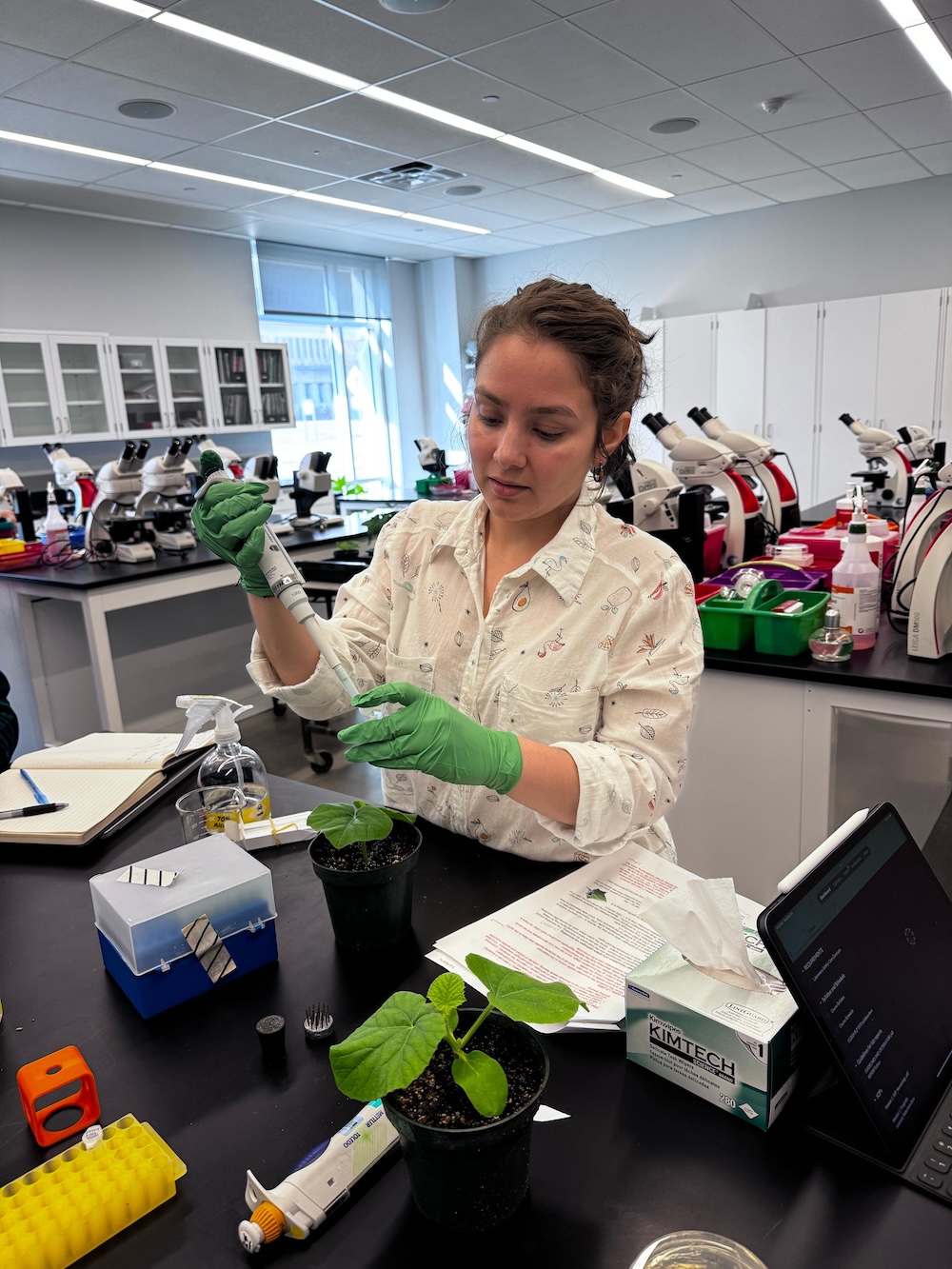
Exploring bacteriophages for control of bacterial wilt of cucurbits.
Sharon Badilla
Abstract:
Erwinia tracheiphila (Et) causes cucurbit bacterial wilt, a lethal disease that can reduce crop yield by up to 100%. This pathogen is vectored by cucumber beetles (Acalymma vittatum and Diabrotica undecimpunctata). While current management relies exclusively on controlling the insect vectors, biocontrol could contribute to better Et management. We are investigating bacteriophage for biocontrol of Et in muskmelon. We isolated 21 virulent phages from both species of vectors collected in Kentucky and Iowa. We selected nine phages to study further based on their host ranges, morphologies observed by TEM, and genome sequences. Preliminary studies have shown reduced bacterial wilt when a single phage, FBB1, was sprayed onto muskmelon leaves one or three days before Et inoculation. Wilt reduction is currently being evaluated following phage inoculation onto seeds, onto the soil, combined with a non-pathogenic bacterial carrier, and with a previously identified biocontrol bacterial candidate, Enterobacter cloacae (JL1157). We are also sequencing Randomly Barcoded-TnSeq libraries of two Et strains before and after phage exposure to identify genes related to phage resistance, including phage-targeted cell surface receptors. Collectively, these data will be used to formulate phage cocktails for Et biocontrol.

 Print
Print Email
Email