


Setting the Straits on Fire & Stewardship Naturalist Alumni Group Gathering
February 4, 2026 5:30PM - 8:00PM
Registration Deadline: February 3, 2026 - 12:00PM
University of Michigan Matthaei Botanical Gardens Auditorium 1800 N. Dixboro Road, Ann Arbor, MI 48105
Contact: Bindu Bhakta
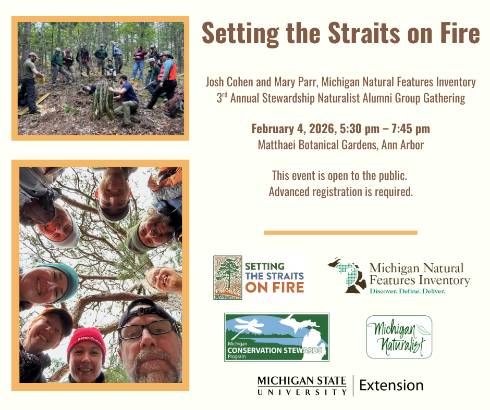
Please join alumni from the Conservation Stewards Program and the Michigan Naturalist Program as well as the greater community for this 3rd annual gathering and educational talk. Enjoy catching up with friends and meeting like-minded folks over strolling appetizers and desserts. Michigan Natural Features Inventory ecologists Josh Cohen and Mary Parr and Michigan State University Department of Forestry's Kurt Kipfmueller will be the distinguished guests of the evening who will deliver their featured presentation, "Setting the Straits on Fire," which tells the story of their work to prioritize biodiversity stewardship within the Straits region of Michigan. We’ll wrap up the evening by exploring Matthaei’s conservatory, which comes alive in the dark, cold evening hours of February!
This event FREE and open to the public.
Due to limited space, pre-register is required by February 3rd.
Detailed AGENDA:
5:30 p.m.: Strolling Appetizers - Please bring an appetizer to pass, a serving utensil and a label for those with dietary restrictions.
6:15 p.m.: Educational Talk by Josh Cohen and Mary Parr, Michigan Natural Features Inventory, and Kurt Kipfmueller, Michigan State University Department of Forestry: Setting the Straits on Fire
Through the Coastal Program, the United States Fish and Wildlife Service established a cooperative agreement with Michigan Natural Features Inventory, the Little Traverse Bay Bands of Odawa Indians, and the University of Minnesota to prioritize biodiversity stewardship within the Straits Region. This project will build upon three complementary components:
- Collating knowledge about factors that determine priority for cultural burning;
- Reconstructing fire histories of culturally significant sites through dendrochronology; and
- Developing models to identify the most ecologically and culturally important places and thereby increase the integrity of native ecosystems, improve habitat for native biodiversity, and increase opportunities for cultural expression of Indigenous communities.
In this presentation, we will share results about the reconstruction of fire history in the homeland of the Little Traverse Bay Bands of Odawa Indians.
7:15 p.m.: Dessert & Explore the Conservatory
7:45 p.m.: Adjourn
Registration for this event has closed.
Get Directions


 Print
Print Email
Email