2026 Michigan peach crop losses highlight management decisions for reduced crop orchards
 Print
Print Email
EmailNew MSU Extension bulletin helps peach growers balance input costs, canopy growth, and next season’s productivity.
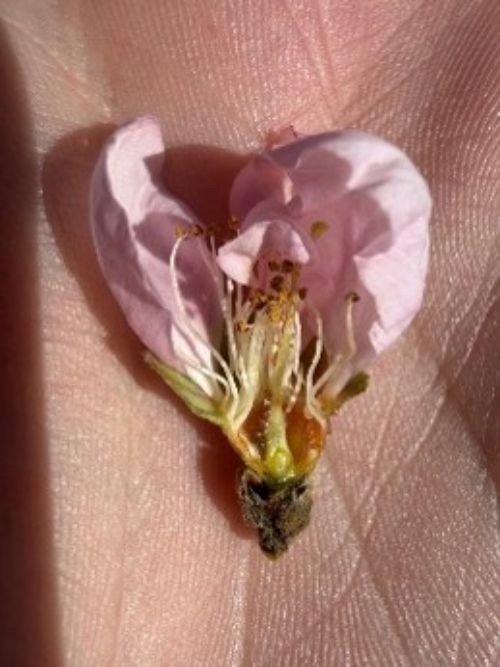
Peaches are sensitive to cold, and a season’s crop can vary dramatically depending on winter and spring weather conditions. In‑depth information on how peach trees respond to cold and frost injury, along with guidance for managing peach orchards in low- and no‑crop years, is available in this new bulletin from Michigan State University Extension, “Best Practices for Peach Orchards with Reduced Crop Load.”
While some orchards were largely unaffected by the winter of 2025-2026, crop variability ultimately depended on the specific location of each farm and individual orchard blocks.
Michigan peaches in the 2026 season
The winter of 2025-2026 was characterized more by prolonged cold persistence than by record-breaking low temperatures and would generally be considered a typical Michigan winter. In southwest Michigan, mid-winter temperatures likely caused limited direct fruit bud loss, while northern and southeast production regions likely experienced both reduced fruit set and some woody tissue injury from colder and longer-duration events. Multiple frost and freeze events in April further reduced crop potential across the state.
As a result, crop loss in 2026 should be viewed as cumulative, beginning during winter and continuing through spring frost events. Management decisions for the remainder of the season therefore depend on the amount of viable crop remaining and whether that crop is sufficient to justify continued production inputs.
Early season damage
At the end of January, temperatures plunged into the negatives across the Midwest. In southwest Michigan, temperatures reached as low as -6.4 degrees Fahrenheit in Benton Harbor to -15.1 F in Grand Junction, while temperatures ranged from -6.9 F in Hart to -16.7 F in Sparta in the west central counties. Southeast Michigan had temperatures ranging from -9.1 F in Romeo to -20.3 F in Commerce.
In general, damage is expected to fruiting buds at temperatures below -13 F and -15 F for branches. In areas that had prolonged exposure to temperatures below -13 F, much of the fruit was lost in the January cold event. In areas that did not reach -13 F but did reach double digit negatives, some reduction in fruit set was possible, though less substantial. Surveys of southwest Michigan (Allegan, Van Buren, Cass and Berrien counties) in February showed that over 90% of the peach crop was still viable at that time.
Bloom season damage
As fruit buds wake up (deacclimate) in spring, they lose hardiness, or the ability to withstand cold temperatures, rapidly. At swollen bud, which occurred in mid-March, peach buds could survive to 18 F while in bloom, three weeks later, they could not survive below 27 F. In April 2026, two frost events reached into the 20s in west central, southwest and southeast Michigan between these timings. At this time, fruit buds were more susceptible to cold, and a portion of the crop was lost in each region of the state. In areas where peach buds were in a more advanced state, more damage was observed, such as areas of southwest Michigan with advanced bloom. Additionally, more damage was observed in areas with prolonged cold, like low lying areas.
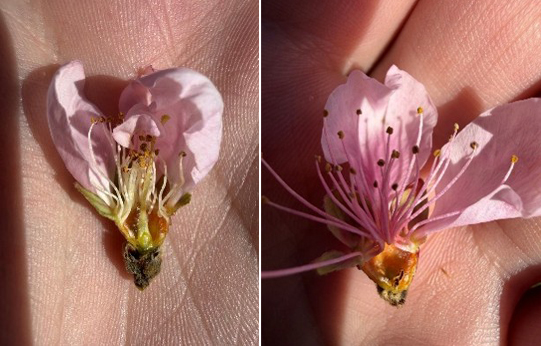
For more information on crop assessment, see the bulletin “Best Practices for Peach Orchards with Reduced Crop Load.”
What to expect next year
Peaches do not exhibit strong biennial bearing in the same way apples do, but crop load during one season can still influence return bloom and tree balance the following year. In many orchards, trees that carried little or no crop in 2026 may bloom more heavily in 2027 because large amounts of carbohydrates remained available for flower bud formation during summer.
However, heavy bloom next year is not guaranteed. The response will depend heavily on overall tree health and the severity of cold injury sustained this season. Trees with significant scaffold, trunk or cambium damage may struggle to rebuild carbohydrate reserves, produce weaker flower buds, or show delayed decline over the next several seasons.
Reduced crop years can also increase the risk of excessive vegetative growth. Strong shoot growth during summer may create dense canopies, increased shading, and poor light penetration if not managed carefully. Excessive vigor can reduce flower bud quality and complicate pruning and thinning the following season.
Winter hardiness going into 2026-2027 may also become an important concern. Trees carrying no crop often continue vegetative growth later into the season, particularly when nitrogen rates remain high. Late, succulent growth is generally less cold hardy and may acclimate poorly during fall. Maintaining balanced nutrition and controlling excessive vigor during the current season can therefore help reduce winter injury risk next year.
In blocks with severe cold injury to wood or scaffolds, some delayed symptoms may continue appearing through 2027. Trees that initially survive may later decline from canker development, vascular dysfunction or secondary insect and disease pressure. Monitoring orchard health through the remainder of this season and into next spring will remain important when making long-term management decisions. For more information, see “Managing Orchards in a No Crop Year: Protecting Tree Health for Next Season” from Penn State University.
The Michigan Peach Cost of Production Guide can help estimate the economic impact of reduced crop levels following freeze injury or tree decline. For more information on using this guide and the economics of a reduced crop, see the bulletin “Best Practices for Peach Orchards with Reduced Crop Load.”