A bold decision created a fishing success story
 Print
Print Email
EmailIntroducing salmon to the Great Lakes was one solution to a variety of problems, but it was not without risks.
Celebrating America’s 250th anniversary, this Great Lakes Fisheries Heritage trail story explores how fisheries have shaped Michigan and our country throughout history; and how these stories live on today through the people, fish, and fishing that connect our coastline, culture and Great Lakes identity.
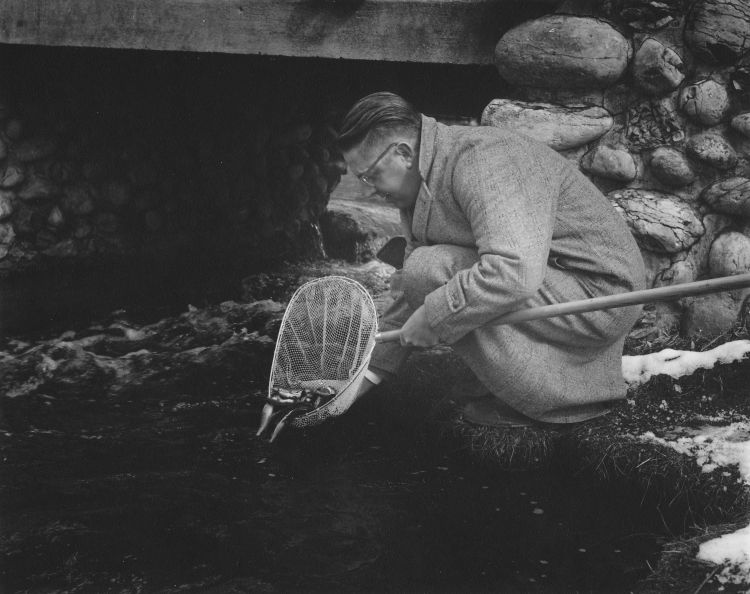
In 1964, when Dr. Howard A. Tanner stepped into his role as chief of the Michigan Department of Conservation’s Fish  Division this was the reality he faced: Native fish populations had sharply declined. Lake trout, once a dominant predator, had been decimated by invasive sea lampreys. Alewives, themselves non-native, had surged without natural controls. Tanner was not handed a simple problem to fix. He inherited a collapsed food web and a public searching for answers.
He and his colleagues made a bold decision: to introduce salmon into the Great Lakes. In the Pacific Northwest, species such as coho and Chinook salmon were well known as aggressive predators. They fed heavily on smaller forage fish and supported thriving recreational fisheries. They could also adapt from saltwater to freshwater. There were many variables to consider.
Read more about the salmon decision in the expanded story online.
Stories like Tanner’s offer an opportunity to reflect on innovation and responsibility. The introduction of salmon to the Great Lakes was not simply a fisheries management decision. It was an example of how science, policy, and public need can intersect in transformative ways.
At the same time, Tanner himself, who died at the age of 102 in 2026, acknowledged the risks involved. Introducing a non-native species required careful consideration and ongoing management. It was not a solution without trade-offs. His work reminds us that stewardship is an ongoing process, not a one-time action.
More stories
Michigan Sea Grant and Michigan State University Extension, in partnership with America250MI and the Great Lakes Fisheries Heritage Trail (GLFHT) network, offer this Great Lakes fisheries history and heritage storytelling series celebrating Michigan’s commemoration of America’s 250th anniversary. More stories of Michigan’s Great Lakes fisheries heritage are online at the Great Lakes Fisheries Heritage Trail website.
Additional resources
Explore to learn more about Great Lakes fisheries:
- Something Spectacular: My Great Lakes Salmon Story by Howard A. Tanner.
- Life of the Lakes: A Guide to the Great Lakes Fishery — produced by Michigan Sea Grant with University of Michigan Press.
- Small Fry, Big Catches: The Great Lakes Fishery — a Michigan History Magazine article published by the Historical Society of Michigan in partnership with Michigan Sea Grant.
- Learn more about America250MI: america250mi.org.
The following worked together to bring you this learning series as part of Michigan’s America250 commemoration: Great Lakes Fisheries Heritage Trail network, Michigan Sea Grant and Michigan State University Extension, Great Lakes Fishery Commission, Michigan Department of Natural Resources, Besser Museum for Northeast Michigan, Fishtown Preservation Society, and others. This series has been made possible in whole or in part by America250MI.