


Are we interpreting corn hybrid maturity ratings correctly?
 Print
Print Email
EmailCorn hybrid maturity ratings shouldn’t be confused with calendar days to maturity.
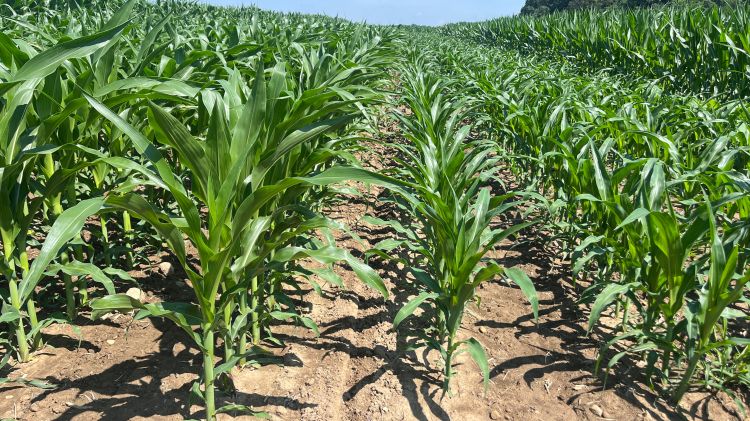
The word “days” is often loosely added to corn hybrid relative maturity (RM) ratings, which can lead to the wrong interpretation as calendar days. Seed companies assign RM ratings based on grain moisture recorded at harvest maturity for a new hybrid in comparison to that of a standard hybrid. Clearly defining the term maturity is important to improve our understanding of corn RM ratings. Additionally, data on the actual duration for corn hybrids to achieve maturity from the time of planting can guide growers to optimize hybrid RM selection and effectively plan harvest timing.
What are the definitions of maturity?
Corn maturity can be defined as the stage in corn development at which maximum kernel weight has been achieved and a visible black layer has formed. This stage is commonly referred to as physiological maturity with grain moisture content typically between 25 to 35% dependent on weather conditions. Maturity can also be defined as the stage where corn can be harvested for grain. This definition is often termed as harvest maturity with moisture typically 25% or lower.
Seed companies use the harvest maturity definition to assign RM ratings to a new hybrid. This process involves comparing harvest moisture content of the new hybrid to the standard hybrid assuming that kernels lose around 0.5% moisture per day after physiological maturity. For example, if the standard hybrid has a 100 RM rating and the new hybrid had 2% greater moisture content at harvest, this hybrid will be assigned a rating of 104 RM, which is four units higher (2 ÷ 0.5 = 4) than the standard hybrid.
Actual number of days to achieve physiological and harvest maturity
Field trials were conducted by the Michigan State University Cropping Systems Agronomy lab to estimate the actual number of days it takes for a corn hybrid to reach physiological and harvest maturity. The trials were conducted for five corn hybrids (with RM of 89, 94, 99, 104 and 109) and planted in early and late May. The trials were conducted from 2021-2023 in Lansing, Michigan.
Figure 1 shows the average number of calendar days that each hybrid RM took to reach physiological maturity. Overall, all hybrids took more actual number of days to achieve physiological maturity than the “day” value of their respective RM ratings. For example, the 99 RM planted on May 10 needed 134 days (range of 126-145 days) to reach physiological maturity. When planting was delayed to May 30, the same hybrid needed 130 days (range of 120-139 days).
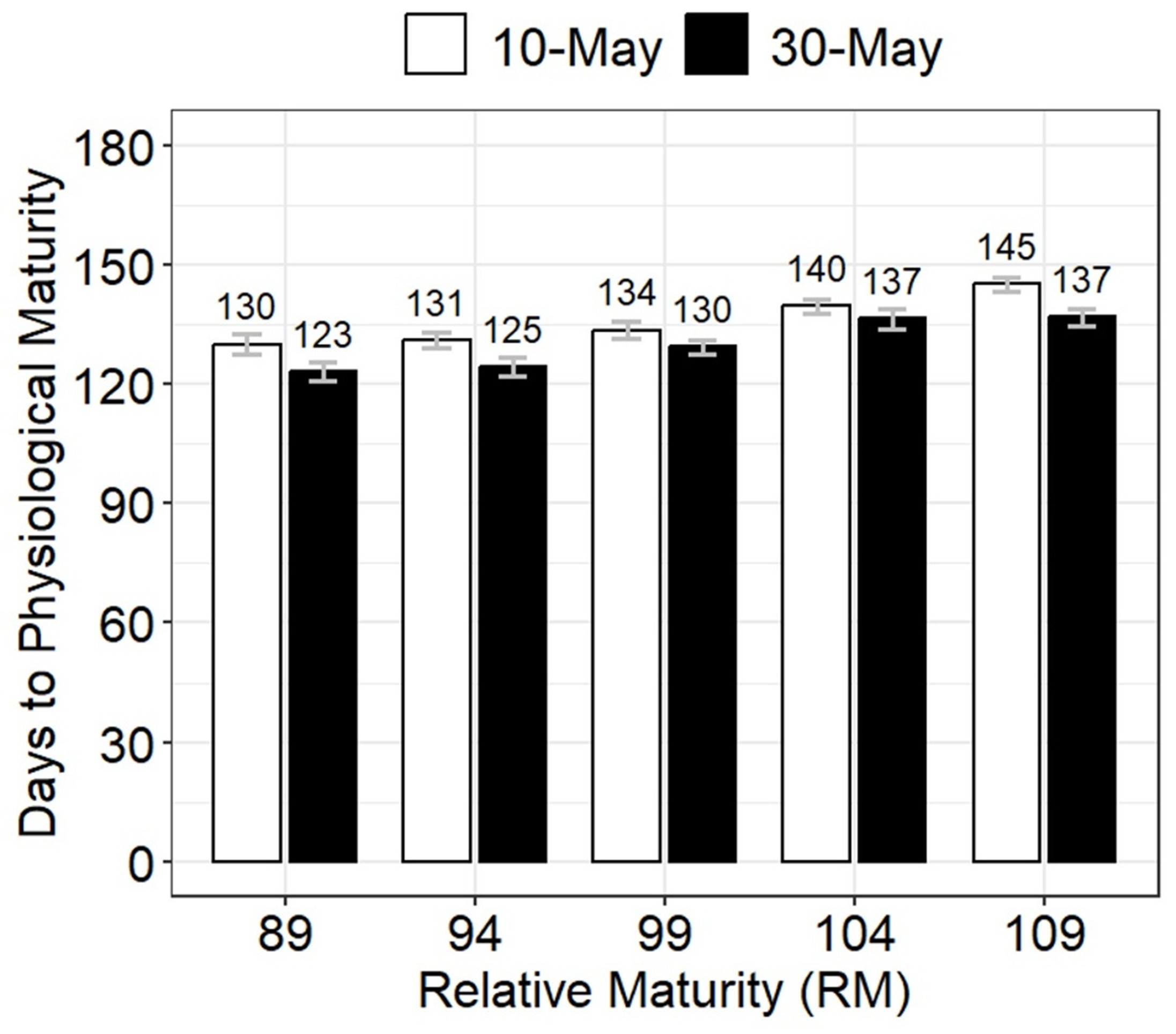
Figure 2 shows the predicted days needed to achieve harvest maturity for all the hybrids. In estimating this, we used a harvest moisture threshold of 20% and a daily dry down rate of 0.5% per day. Additionally, we assumed that grain moisture for all the hybrids at physiological maturity averaged 30%, which was relatively similar to moisture content we observed for these hybrids in our field trials. Overall, each hybrid RM needed 20 extra days to reach harvest maturity (20% moisture in this scenario). For example, 99 RM hybrid planted on May 10 and May 30 needed 154 days (range of 146-165 days) and 150 days (range of 140-159 days), respectively, to reach 20% moisture.
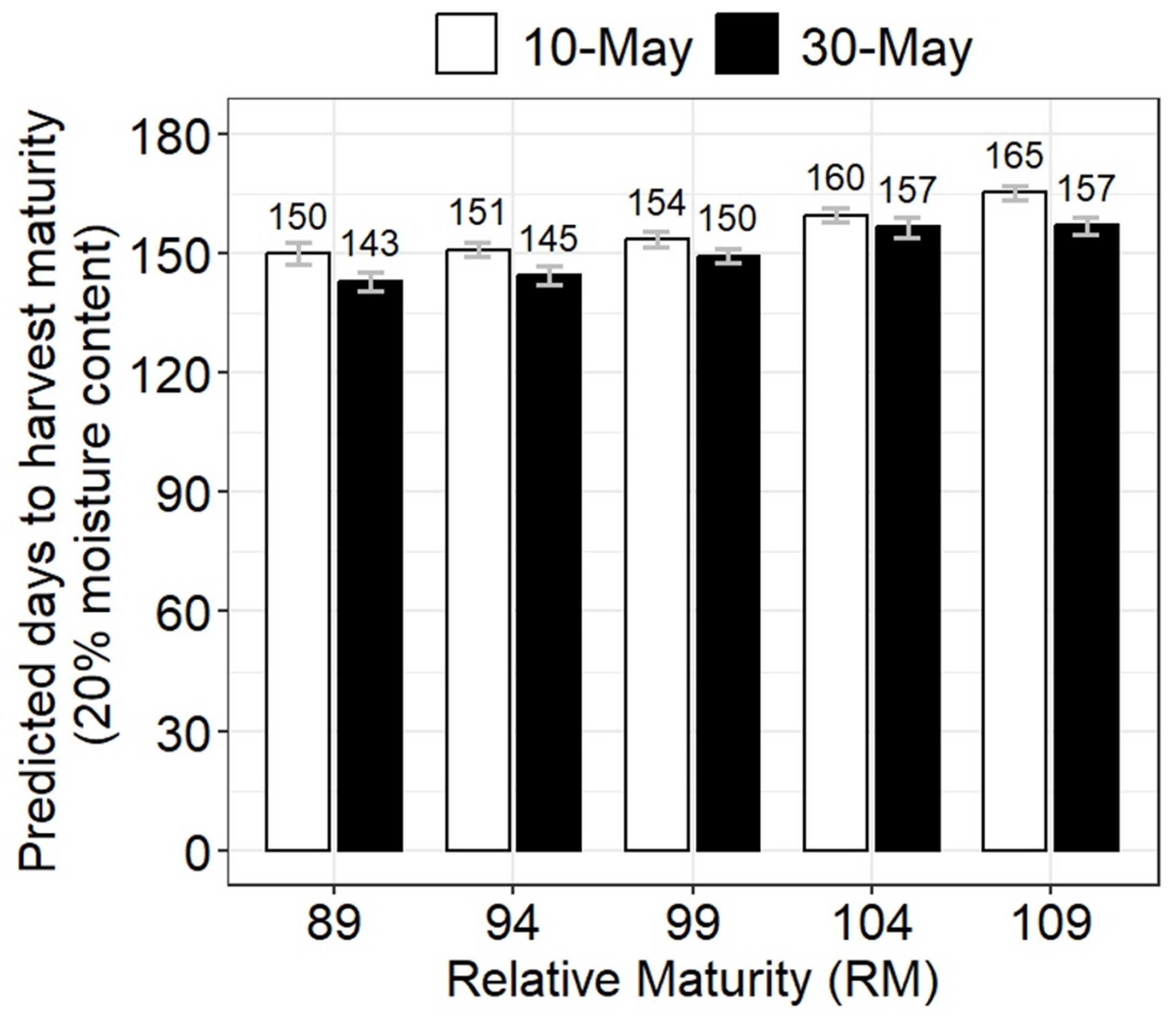
It is important to mention that harvest moisture could be less than 25% and dry down rate can be as high as 1% per day, based on weather, planting date and hybrid RM. Therefore, the number of days required to achieve harvest maturity can vary a lot. Nonetheless, our data provides a general guide on the actual duration of different corn hybrid RMs across planting dates. Growers can use this as a guide in hybrid maturity selection and planning of harvest timing.
Our data also showed that hybrids needed around six fewer days (range of four to eight days) to mature under delayed planting (Figure 1). This indicates that delayed planting shortened the duration from planting to maturity across hybrids. Michigan State University Extension recommends taking this into account in maturity selection and harvest planning.
Corn hybrid RM selection can be improved by using more accurate descriptors such as growing degree day (GDD) accumulation. Unlike RM ratings, GDD ratings account for growing season conditions that directly influence corn growth and development. In an upcoming article, we will discuss how GDD ratings can be used in making informed decisions on hybrid maturity selection and effective utilization of the growing season.
Key takeaways
- Corn hybrid RM ratings are not the same as calendar days.
- Typical corn RMs in mid-Michigan need a minimum of 130 calendar days to reach physiological maturity and 150 days to reach 20% moisture when planted in early May.
- If you plant a 99 RM hybrid around May 10 in mid-Michigan, expect to harvest around early to mid-October.
- The actual number of days needed to achieve physiological and harvest maturity decrease with delayed planting.