Beyond ready to code: Part 2
 Print
Print Email
EmailHow did coding start and who is the queen of computing?
The work world is shifting, and digital literacy is an essential skill in almost every career sector. Today, it is every bit as essential as reading, public speaking, written communication, math, leadership, teamwork and problem solving.
Participation in 4-H coding and robotics activities is a great way for youth to discover and develop their own niche in the world of technology. Michigan State University Extension and 4-H have a long history of creating experiences that will help youth develop skill sets to become Beyond Ready, and technology is no exception. If you are a leader or volunteer with no coding experience that thinks you can’t provide youth in your county with valuable guidance in technology, Part 1 of these series provided some great ways to get started!
But how did computing itself all start? It all seems so complex, with processors, CPU (central processing unit) and RAM (random access memory), graphics, coding languages: C and C++, Java and HTML and Python, and now AI! Going back through history helps to de-mystify some of that technology and reminds us that even though computers are much faster and more complex than ever, they are still based on the same systems that were developed mid-century.
Computers work in a language known as binary, which means they speak only in the numbers zero and one. This is an advantage, because the simplicity means computers can quickly determine things like “off” and “on” and “yes” and “no.” Computers can also count, just like we do in our Arabic system, but instead of using ten digits (zero through nine) computers use only two. Zero is written the same in binary and Arabic, and so is the number one. But to write the number two in binary, you can’t write “2”, because that numeral doesn’t exist. You need to go over a place, add a one, and then start over. So “10” is “2” in binary and “11” is “3”…… pretty mind bending!
Counting and calculating are things that computers do really well – today’s fast, modern supercomputers can perform a quintillion calculations per second. That might explain why mathematicians and scientists were the first set of individuals to embrace technology! But humans want to do more than count and do calculations, and that’s really all that computers CAN do – count and calculate! So, unless you are a theoretical mathematician, you need a way to translate your questions about shopping carts, cats, recipes, who won the game last night, and map locations of the closest ice cream shoppe into zeros and ones.
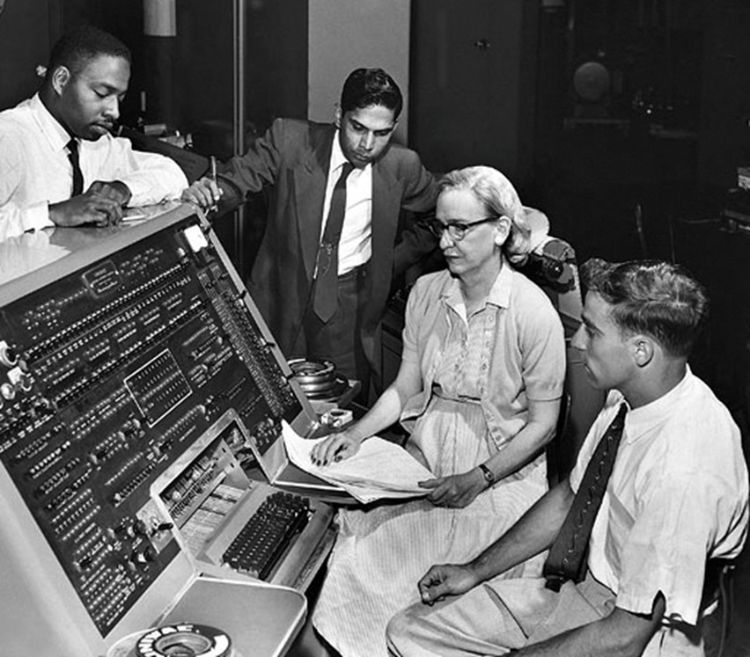
Dr. Grace Hopper was a Ph.D. mathematician who joined the Navy Reserve during World War II and became a computer programmer. She believed that the true power of computers depended on simplifying the language that was used to direct the computer. As such, Hopper worked to design what she called a “linker” (what we now call a compiler: a computer language that converts English words into binary that computers can understand). At first, compilers were designed for specific computers. But a consortium of computer scientists with Hopper at the helm created COBOL in 1959, a machine-independent programming language based on the English language.
While COBOL was the first compiler created, it was not the last. Today, there are many different compilers because there are many different needs for computing power. When one says they are “coding in Python,” what they really mean is they are using a Python compiler to convert questions into computer code. Python and Java are more modern compilers, but COBOL, the original compiler designed by Hopper, is still in use in financial systems.
Hopper is quoted in the Lynn Gilbert book, “Grace Murray Hopper: Women of Wisdom,” as saying: “The most important thing I’ve accomplished, other than building the compiler, is training young people. They come to me and say, ‘Do you think we can do this?’ I say, ‘Try it.’ And I back ‘em up. They need that. I keep track of them as they get older and I stir ‘em up at intervals so they don’t forget to take chances.”
MSU Extension encourages you to embrace your inner Grace Hopper by taking some chances and engaging youth in coding activities: you’ll be opening up a whole new world for them!
Continue your code exploration in Part 3 of this series.