Bridging science and justice: Jahi Johnson-Chappell on transforming food systems
 Print
Print Email
EmailIn the final seminar of the Spring 2026 HRT/PSM Seminar Series, Director of the Center for Regional Food Systems, Professor, and W.K. Kellogg Endowed Chair will present "Thinking and acting critically toward Good Food.”
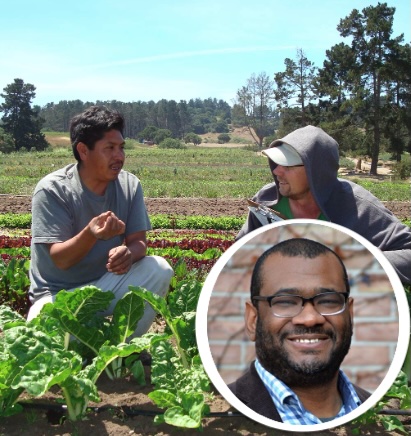
Dr Johnson-Chappell has built his career at the intersection of science, equity, and transformation of food systems. He began his academic journey at the University of Michigan, earning a Bachelor’s degree in Chemical Engineering and a Ph.D. in Ecology and Evolutionary Biology. Even as a graduate student, however, he recognized that a traditional academic path alone would not satisfy his drive. “I found my curiosity pushing me in different directions,” he reflects, “and I wanted to do direct service.”
Over the past 20 years, Johnson-Chappell has worked across international, national, and local contexts to advance participatory, socially just, and ecologically sustainable agrifood systems. His career spans both academia and the nonprofit sector: Associate Professor of Agroecology at Coventry University in the United Kingdom and Assistant Professor of Environmental Science and Justice at Washington State University Vancouver, where he also served as Associate Director of the Center for Social and Environmental Justice. He has also served as Executive Director of Food First and Senior Scientist and Director of Agroecology and Agricultural Policy at the Institute for Agriculture and Trade Policy, and contributed to global movements as a founding board member of the Open Source Seed Initiative and through leadership within the Agroecology Fund and Thousand Currents.
Central to his work is a reframing of how we understand hunger: challenging notions that hunger is a problem of food production and emphasizing that addressing hunger requires grappling with broader systems such as access to safe water and sanitation, gender equity in education, dietary diversity, and the policies that shape who benefits from food systems. “Scientists and practitioners alike have a responsibility to engage with this complexity and to ensure that accurate information reaches the public—that is, information that draws on both academic research and communities’ wisdom and lived experience."
For students, Johnson-Chappell advocates an interdisciplinary mindset: "Combining natural and social sciences is essential,” he says. "Developing this fluency now provides our future leaders with knowledge to ask better questions and to understand how and why decisions are made."
He also offers a broader perspective on change itself. Drawing on history, he reminds students that even in moments when progress seemed impossible, individuals and movements laid the groundwork for transformative breakthroughs. “MLK Jr famously said that 'The arc of the moral universe is long, but it bends toward justice.’ We must understand the context of his words, and look at the immense organizing and efforts he and others undertook. I believe MLK Jr meant us to understand that progress is neither automatic nor guaranteed. It depends on sustained effort, courage, and a willingness to take risks, even in the face of uncertainty or opposition."
Overall, Dr Johnson-Chappell's message is based in persistence and responsibility: meaningful change rarely happens quickly, and success is never assured. Yet each action contributes to a larger trajectory. “The only way things change,” he emphasizes, “is because we keep at it.”
The Michigan State University Center for Regional Food Systems (CRFS) engages the people of Michigan, the United States and the world in developing regionally integrated sustainable food systems. CRFS extends MSU’s pioneering legacy of applied research, education and outreach by catalyzing collaboration and fostering innovation among the diverse range of people, processes and places involved in regional food systems. Our vision is a thriving economy, equity and sustainability for Michigan, the country and the planet through food systems rooted in local regions and centered on Good Food: food that is healthy, green, fair and affordable. Learn more at foodsystems.msu.edu and connect on Facebook, Instagram, and Linkedin. @MSUCRFS.Thank you for reading this far! Be the first reader to contact me bonitopa@msu.edu and win two scoops at the MSU Dairy Store!