Cold weather is coming, but is it too cold for fruit? Likely not.
 Print
Print Email
EmailCold temperatures are forecast late this week, but should not damage fruit buds for the majority of Michigan.
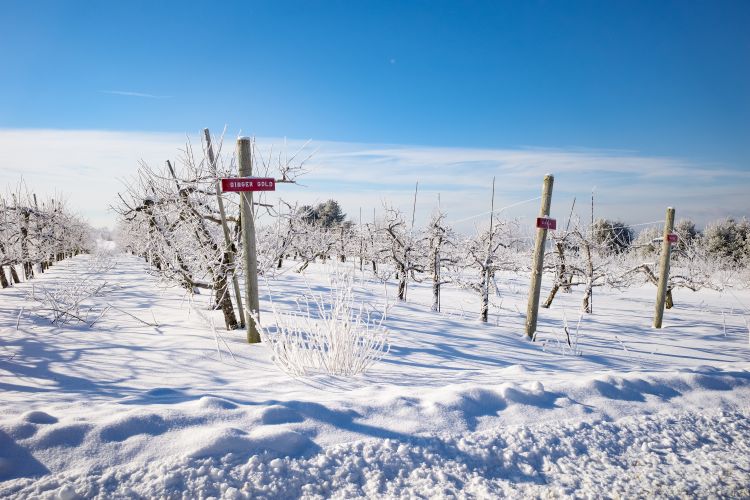
A significant cold event is forecast for Friday and Saturday mornings, Jan. 23 and 24, with overnight low temperatures projected to fall well below normal across much of Michigan. In some areas, forecasts indicate minimum temperatures approaching or exceeding -10 degrees Fahrenheit. Events like this understandably raise concerns about potential short-term injury to fruit buds and long-term impacts on the upcoming seasons.
Cold injury in perennial fruit crops, however, does not occur gradually. Buds and woody tissues tolerate cold down to specific temperature thresholds, below which injury can occur rapidly. These thresholds vary by crop, variety and stage of dormancy. Understanding where forecast temperatures fall relative to known lethal temperature ranges is the most useful way to assess risk.
Approximate lethal temperatures for dormant fruit buds (mid-winter conditions)
The following table provides approximate lethal temperatures for dormant buds of common fruit crops under mid-winter conditions in Michigan. These values represent temperatures at which significant bud mortality may occur when plants are fully acclimated in Michigan.
| Fruit Type | Temperature (°F) | Temperature (°C) |
|---|---|---|
| Peach | -13 | -25 |
| Apricot | -25 | -32 |
| Sweet cherry | -15 | -26 |
| Tart cherry | -20 | -29 |
| Apple | -30 | -34 |
| Pear | -25 | -32 |
| Plum (European) | -15 | -26 |
| Plum (Japanese) | -10 | -23 |
| Grape (Concord-type) | -25 | -32 |
| Grape (vinifera) | -8 to -15 | -22 to -26 |
| Blueberry (highbush) | -25 | -32 |
| Raspberry / Blackberry | -17 | -27 |
For the most cold-hardy fruit crops, dormant buds and woody tissues can tolerate temperatures below -25 F, conditions that are uncommon in Michigan even during severe Arctic outbreaks. Apples, pears, tart cherries, highbush blueberries and Concord-type grapes typically remain within their historical survival range under most winter conditions.
In contrast, more cold-sensitive crops such as peach, sweet cherry, Japanese plum and vinifera grapes approach their lethal temperature thresholds at substantially warmer values. For these crops, overnight lows near or below -10 F warrant closer attention, particularly in sites with limited snow cover or reduced cold air drainage.
As temperatures move toward these thresholds, the likelihood of bud injury increases rapidly rather than gradually, emphasizing the importance of evaluating forecast lows relative to crop-specific tolerance rather than absolute temperature alone.
Visualizing the cold
To help visualize how forecast temperatures may vary across the region, the National Weather Service provides forecast minimum temperature maps that display expected overnight lows spatially rather than at individual weather stations. These maps can be useful for identifying areas where forecast temperatures may approach or cross critical thresholds for a given crop.
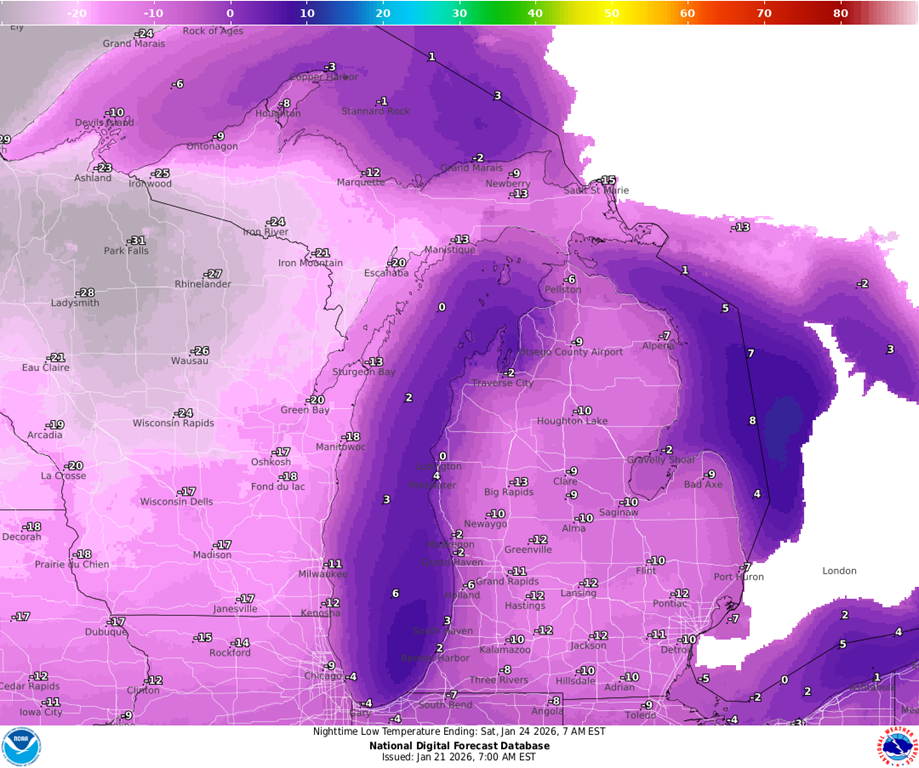
Viewing the forecast map:
- Click the forecast low temperature link for the night of interest.
- Click on the map to zoom to your location.
So… should I be worried or not?
At this time, widespread injury is not expected for most fruit crops, as buds across Michigan remain dormant. Forecast temperatures, while notable, generally fall within the historical tolerance range for fruit crops under mid-winter conditions. However, localized injury may be possible in colder areas, especially in sites with poor cold air drainage.
Growers should also be familiar with methods for evaluating bud and wood injury following the cold event. Guidance on assessing cold damage in peaches, including bud dissection and symptom interpretation, and additional information about lethal temperatures for each fruit crop is available through Michigan State University Extension at “Cold damage to peaches.”
After the cold event has passed, the minimum temperature reached at nearby weather stations can be reviewed using the Michigan State University Enviroweather overnight temperature summary, which provides a useful reference for comparing observed lows with known crop tolerance thresholds.
More information and reports on normal weather conditions and departures from normal can be found on the NOAA Climate Prediction Center website, NOAA U.S. Climate Normals website, NOAA Climate Normals Quick Access Page (which may be searched by region) and Midwest Regional Climate Center website.