Congratulations Mohit Mahey (Eric Patterson and Lundquist Labs)
 Print
Print Email
EmailSuccessfully defended his thesis: Understanding site of action of indaziflam and resistance Mechanism of poa annua to indaziflam 8 April 2026
When Mohit arrived in 2021 from Punjab Agricultural University, he brought a strong foundation in biotechnology and botany—but little exposure to weed science. Within his first two years at Michigan State University, he dove headfirst into microscopy, root biology, and anything else he could get his hands on.
"Then he realized that he wanted more out of his experience here at Michigan State. Peter and I agreed that there was a lot more to do on this project so together with his advisors,” Dr. Eric Patterson (PSM) said, "we made the leap—skipping a master’s defense and launching straight into a PhD in 2023.
As Mohit has been co-mentored across two labs at Michigan State University, his PhD journey has been anything but typical. “When I asked How, how do you feel about this, Mohit?” Co-advisor Dr. Peter Lundquist (Biochemistry & Molecular Biology) said. “And he didn't really hesitate. He was like, "I wanna learn this! and I wanna learn that." He didn't hem and haw, so that's really worked well for him, I would say. And here we are celebrating years of hard work coming together in this dissertation: Understanding site of action of indaziflam and resistance Mechanism of poa annua to indaziflam, because Herbicide resistance is a growing problem in agriculture."
Poa annua (annual bluegrass) is a widespread and highly adaptable weed that has evolved resistance to multiple herbicidal modes of action. Indaziflam is a cellulose biosynthesis inhibitor used commonly as a pre-emergence herbicide to control Poa annua. However, in less than decade of use, resistance has emerged.
This study introduces several key advances in understanding how indaziflam works in the plant, including vesicle trafficking and particularly Golgi–ER transport, as a likely new site of action. This study also shows that indaziflam acts specifically on plants, with no effect on fungi or algae tested.
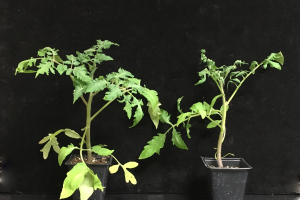
In indaziflam-resistant Poa annua, a CYP450 gene (CYP81A91_A) was found to be consistently upregulated, providing new insight into resistance mechanisms. However, heterologous transformation revealed that this gene alone does not confer resistance to indaziflam, suggesting resistance likely involves multiple genes or pathways. The gene did, however, increase tolerance to another widely used PSII inhibitor herbicide known as Simazine.
Overall, this work advances knowledge of a new mode of action, confirms plant-specific effects, and reveals that herbicide resistance is more complex than a single-gene mechanism. “Curiosity and perseverance have brought Mohit this far,” Peter said, "and we’re curious to see where it takes him next.”
If you read to this point congratulations! Be the first to send me an email and win coupons for two scoops of ice cream of your choice at the MSU Dairy Store! bonitopa@msu.edu THANK YOU CONNOR PURVIS He claimed the ice cream coupons at 8:35 am Monday 13 April!