Congratulations PSM graduates spring 2026!
 Print
Print Email
EmailEnjoy these brief bios of some of our new graduates
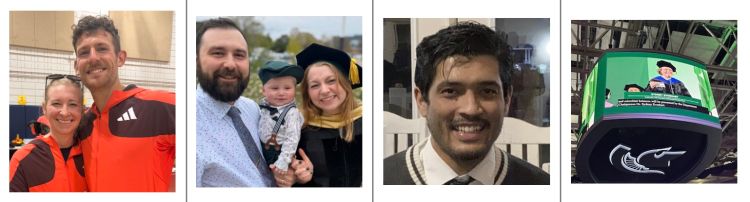
Congratulations PSM graduates! It was a milestone weekend for our graduates as they gathered with friends and family to celebrate this milestone. Kyle Elizalde MS, Jordyn Weedon MS, Kaela Panicucci MS, Mason Rutgers MS, Blair Van Agen MS, Ethan Wachendorf MS, and Antryg Benedict MS, as well as Benjamin Agyei Mohit Mahey Shatrughan Shiva - Gradiating with a PhD in Entomology (CoPI with David Mota Sanchez in Ent) Nick Johnson - Graduating in Genetics & Genome Sciences Program with a PhD and of course, Rabin KC PhD, Katherine Dougherty PhD, ,Lexi Hegel PhD,and Sydney Everhart on the jumbotron (Thank you Sarah Lebeis and Thom Nikolai for the photo!)
Here we feature comments from a few of our grads this semester:
"I feel like I really shoved a lot of work into 5 years: projects, conversations, organizations, chaos!" Says Lexi Heger (Tim Miles lab). Originally from Cincinnati, Ohio, Lexi did her undergraduate degree at OSU before coming to MSU. "I know I’ve learned a lot - like I now know how to ask the questions I didn’t before. I feel proud of my work and my time here, and very grateful for those around me who got me to this point. I really have many mentors and friends who have supported my journey and helped me succeed. I love the campus. It’s perfect for a walk or run to wander around to see all the different gardens, buildings, people." Lexi and her husband are moving to Fort Collins, CO where she will work as a postdoc working on tree fruit diseases at Colorado State University with Dr. Jane Stewart! "We’re really excited to live somewhere new (that isn’t the Midwest) and explore what the area has to offer."
Rabin KC is originally from Nepal. "Khatri Chhetri is my last name," he says, "but my birth certificates and documents say KC. It is common to abbreviate surnames in Nepal." As a child Rabin KC enjoyed playing soccer, Rubik's cube, swimming, and daydreaming of joining the British Army as one of 300 Gurkha soldiers they every year to serve their monarch. "I chose MSU over others because of the Kellogg Biological Station, my adviser and shero, Dr. Sieg Snapp, and the awesome Spartan logo.” In the thick of it, Rabin was challenged taking advanced stats and remote sensing courses while actively collecting data and reviewing literature. He recalls his most productive semester was 2025 Fall: "PSM awarded me with the DCF fellowship, and I did not have to worry about a stipend. I had time to write my dissertation and attend the Tri societies meeting to talk about my remaining PhD chapters." Ironically, Rabin says, "these six years have made me feel like I still need to learn a lot, and now I have an insatiable urge to back up everything I say with evidence."
Katherine 'Kat' Olive Dougherty (George Sundin lab) hails from Texas, but she is from a “Navy family” she says, "so I lived in a lot of coastal states and had the opportunity to see some really cool nature. I always loved collecting seashells and rocks, and even snails and bugs!" Kat moved to MSU right after finishing her bachelor's at Texas A&M and started her PhD program "when covid restrictions were still a thing," she says. "It took quite a while to get to know my cohort and even the members of my lab since we were working in shifts. I eventually found my stride and started gaining more confidence in my projects!" Besides the enjoying campus in the springtime, Kat says what she loves most is the resources and agriculture here at MSU. "Working in all the orchards right near campus has been such a blessing for my research," rKat says. "These last 6 years went by quickly, but when I think about who I was when I started here in 2020, it feels like a lifetime ago. I think getting married and having a baby also made the time fly as well."
And Blair Van Agen (MS Spring 2026) is graduating with some good news: she has published a significant chapter of her thesis on the long-term effects of regenerative agriculture practices on yield stability. "Using over 15 years of data from commercial fields in Michigan, we found that while average yields didn’t change significantly, regenerative practices (no-till + cover crops) led to more stable yields over time—reducing variability and converting previously unstable areas into consistently productive zones," Blair says. "Thank you to Bruno Basso and co-authors Susana Albarenque, Tommaso Tadiello, Neville Millar, and Richard Price for helping to get this across the finish line!"
See the Full paper here