Connect Fire, Land and Global Supply Chains through Telecoupling
 Print
Print Email
EmailFormer CSIS postdoctoral fellow James Millington returned to share how telecoupling and human-centered modeling can reveal connections among fire, land use, global supply chains, and environmental change.
James Millington, a former member of the Center for Systems Integration and Sustainability (CSIS) and now Professor of Environmental Geography at King’s College London, recently visited CSIS with a talk “Agents and Telecoupling: Modelling Fire and Land Use.” His presentation explored how human decisions—from managing fire and farmland to investing in companies and trading commodities—can shape environmental change across local and distant places.
A central theme of Millington’s presentation was the importance of human agency in understanding telecoupled systems. Telecoupling connects distant human and natural systems through flows and interactions, but those connections ultimately depend on the decisions of people and organizations, including farmers, land managers, companies, traders, and financial institutions, that influence land use, fire, and other environmental outcomes both nearby and far away. Understanding who makes those decisions, what influences them, and how their actions affect other actors and places can therefore provide important insights into sustainability challenges.
Connect people, land and fire
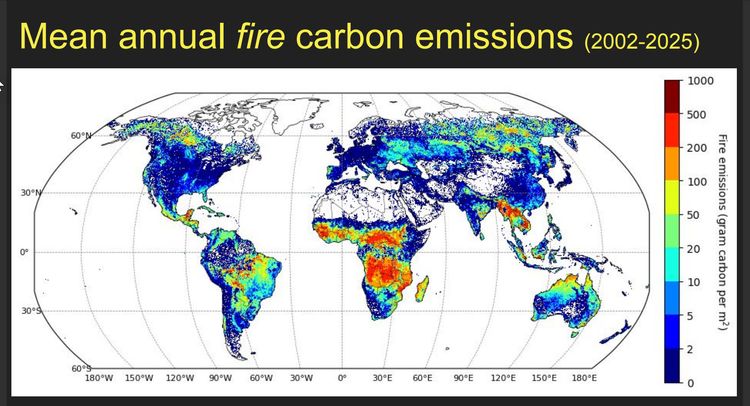
Millington first illustrated this challenge through research on human influences on fire. He presented the Wildfire Human Agency Model (WHAM!), developed with Ol Perkins and colleagues, which represents different types of human agents, such as pastoralists and state foresters, and their characteristic effects on burned areas, fire frequency, wildfire occurrence, and fire suppression.
The work draws on global evidence about how people use and manage fire under different land-use systems. Millington and colleagues compiled information on fire use, suppression, and policies in the Database of Anthropogenic Fire Impacts (DAFI) and used these data to help characterize different land-fire systems around the world.
WHAM! is also being coupled with a global vegetation and fire model, allowing socioeconomic drivers of fire to be represented alongside biophysical drivers and their interactions. This provides a way to examine how changing human activities and socioeconomic conditions may interact with environmental processes to shape future fire patterns.
Follow telecoupling through global supply chains
The second part of Millington’s talk brought telecoupling directly into the world of global supply chains. Products such as agricultural commodities connect producers and landscapes in sending systems with traders, companies, financial institutions, markets, and consumers elsewhere. Understanding environmental outcomes therefore requires looking beyond the places where production occurs to the network of actors influencing decisions across the supply chain.
Millington and Viera Ukropcova are developing the Market-based Environmental Fuzzy Cognitive Agents and Producers Model (MEFCAP) to examine these relationships. The model represents connections among producers, traders, buyers, companies, and financial institutions across sending and receiving systems.
Their work highlights the importance of feedbacks among telecoupled actors. Company strategies, for example, can be influenced by market demand, regulation, environmental risks, and financial decisions such as investment and divestment. Financial institutions may in turn respond to company strategies, environmental and financial performance, reputation, regulation, and the behavior of other financial institutions.
The modeling shows that changing environmentally important behavior may require multiple interacting levers rather than action by any single actor. Financial institutions can influence company behavior, but their effects can vary depending on other conditions, such as the availability of capital.
Advance telecoupling through human-centered modeling
Across the fire and supply-chain applications, Millington emphasized a common challenge: incorporating realistic human behavior and decision-making into models of environmental change.
Human-behavior data are essential but often sparse, inconsistent, and difficult to collect at large spatial scales. Approaches such as fuzzy cognitive mapping can help researchers capture interactions and feedbacks among different actors, while clear theoretical frameworks are needed to determine how complex human behavior should be represented in models.
Millington’s talk demonstrated how telecoupling research can go beyond documenting connections between distant places to investigate the agents, decisions, interactions, and feedbacks that create those connections. From fire management and land use to commodity supply chains and financial institutions, understanding human agency can help reveal how local decisions become connected to environmental changes across the globe.
His return to CSIS highlighted the continuing evolution of telecoupling research—from understanding flows among distant systems to developing models that capture the people and organizations behind those flows and the feedback that connect their decisions across places.