'DASH' divers help lake residents manage aquatic invasive species
 Print
Print Email
EmailLearn how divers can survey for and reduce the amount of aquatic invasive species in Michigan lakes.
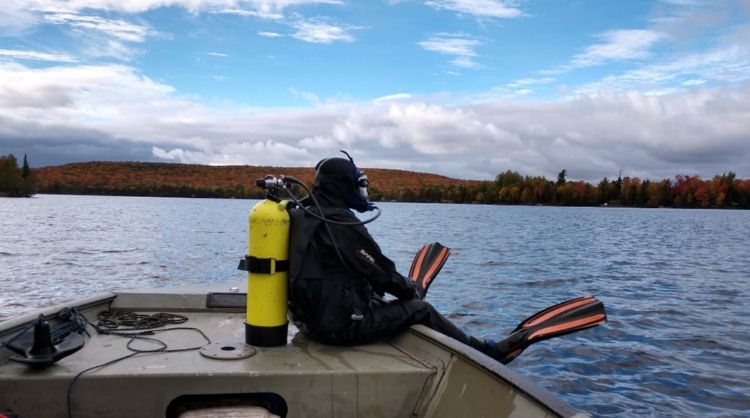
Michigan Sea Grant often receives questions from the public about lake management techniques. Recently we received questions about diver-assisted suction harvesting (DASH) and how it can be used to manage aquatic invasive species. We spoke with Barb Gajewski about her experiences. Gajewski grew up in Gogebic County in the western Upper Peninsula and spent summers fishing, canoeing, and swimming in local lakes. Now she works with lake groups to monitor lake health and manage aquatic plants and water quality issues.
Tell us about the lakes you work with.
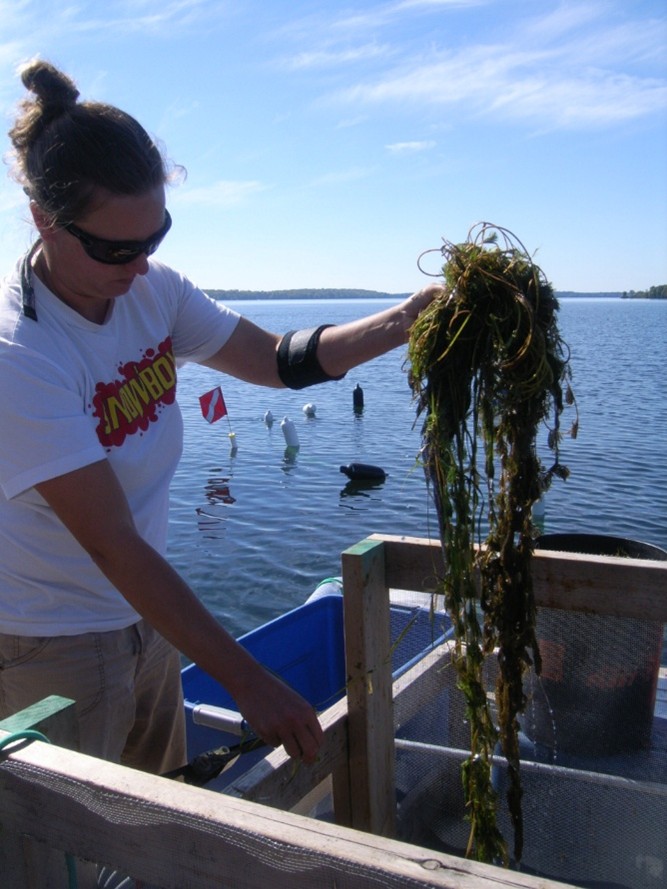
I grew up on a lake that discovered Eurasian water milfoil, an aquatic invasive plant, in 2001. I was just out of college, and the lake owners hired me to survey for new locations and hand-pull any plants I found. Now our company, Many Waters, works mainly with inland lakes in the western Upper Peninsula and northeastern Wisconsin. The sizes vary from a few hundred acres to more than 4,000 acres.
How did you help residents identify problems in their lakes?
I listen closely to lake residents to better understand their issues and needs. Then, I complete lake inventories, which can involve:
- Monitoring to detect new aquatic invasive species.
- Mapping current invasive species locations within the lake.
- Producing detailed assessments of native and invasive aquatic plants in entire lakes.
- Encouraging lake residents to participate in volunteer water quality monitoring programs, like Michigan’s MiCorps.
- Assessing shoreland habitats to identify high-quality zones and areas with issues that could affect lake health (such as erosion, runoff, nearshore habitat manipulation/removal).
What options do you provide lake owners for managing invasive species?
If the species can be managed, I’ll ask or determine whether the plant was already widespread or a new introduction in the lake. We engage with lake owners about their goals: are they trying to manage nuisance plants near a boat launch? Are they trying to reduce spread to nearby lakes? Are they trying to control the population of the plant in their lake? Depending on the answers, I recommend monitoring and evaluation, hand-pulling, or aquatic herbicide.
Describe your current work with lake owners and how it helps them manage invasive species.
We help lake owners identify the problem through baseline surveys and inventories. These results help set relevant and realistic management goals. Management goals need to be flexible and adaptive to changing conditions. By evaluating along the way, we can help lake owners gauge when management strategies may have to change. We encourage volunteer monitoring and tracking of new aquatic plant locations and encourage partnering with local groups on prevention efforts through education.
How do you track progress on invasive species management work?
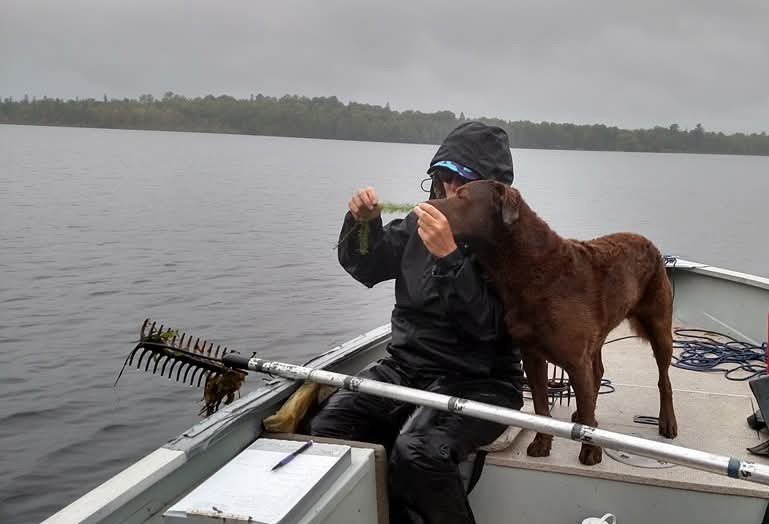
We track our work by annually assessing management to determine how successful it is. This may include assessing all the plants in a lake, looking at the number and health of plants, or focusing on a single species to determine if it is spreading. These results guide and inform next steps for management.
What are your future plans?
I plan to continue our current work. I am interested in adding more management tools to our invasive species tool box. I hope to engage with other folks in Michigan working on burlap benthic barriers as a non-chemical control alternative to manage Eurasian water milfoil in the Upper Peninsula.
What advice would you give lake residents about using diving for invasive species management?
Make sure you have the correct size of lake and size of invasive plant population to use diving as a management tool. Getting volunteers involved is a great way to provide surface support to divers but does take some coordination. Hand removal is tedious work, and it is important to keep your expectations realistic.
Learn more about identifying and reporting aquatic invasive species through the free MI Paddle Stewards course. The course includes detailed instructions for using apps to report species you encounter, as well as information about aquatic invasive species in Michigan and local organizations near you who work on managing them.
Michigan Sea Grant helps to foster economic growth and protect Michigan’s coastal, Great Lakes resources through education, research and outreach. A collaborative effort of the University of Michigan and Michigan State University and its MSU Extension, Michigan Sea Grant is part of the NOAA-National Sea Grant network of 34 university-based programs.
This article was prepared by Michigan Sea Grant under award NA24OARX417C0157-T1-01 from the National Oceanic and Atmospheric Administration, U.S. Department of Commerce through the Regents of the University of Michigan. The statement, findings, conclusions, and recommendations are those of the author(s) and do not necessarily reflect the views of the National Oceanic and Atmospheric Administration, the Department of Commerce, or the Regents of the University of Michigan.