Dirt to Glass: Michigan’s quality platform, built by industry, powered by science
 Print
Print Email
EmailDirt to Glass has grown into Michigan’s statewide platform connecting growers, winemakers, researchers and industry leaders to drive measurable improvements from vineyard to glass. Registration is open for the Aug. 20–21, 2026 conference in Traverse City.
Michigan’s grape and wine industry is in a defining moment. Market expectations are rising, climate variability is sharpening production risk, and quality increasingly means consistency, not just isolated success driven only by good vintages. In that landscape, Dirt to GlassTM (DTG) has become more than an annual conference, it is Michigan’s statewide coordination platform for aligning growers, winemakers, researchers, educators and market leaders around measurable improvements from vineyard to glass.
What makes DTG distinctive is not only the ambition of its topics, but the engine behind the program: a planning process led by growers, winemakers, industry partners and industry associations paired with the research rigor and accountability of Michigan State University (MSU). Stakeholders help define the real bottlenecks and opportunities, while MSU ensures the discussion is grounded in evidence: clear hypotheses, measurable indicators and decision tools that can be tested in Michigan vineyards and wineries.
In practice, this structure turns the conference from a one-time event into a coordinated year-after-year system, where industry priorities shape research and Extension programming, and research results come back as actionable practices that improve consistency, sustainability and wine quality. Sapientia est ordinare.
Why Dirt to Glass exists: filling a critical statewide gap
When the Michigan Grape and Wine Industry Council transitioned into the Michigan Craft Beverage Council, the grape and wine industry lost a single, dedicated annual event designed specifically around its technical and strategic needs. Consequently, both the industry members and MSU researchers also lost a clear compass for coordinated research programming and a shared set of research and Extension priorities.
Without an annual, statewide forum to align needs, resources and outcomes, the community drifted into a familiar trap: every problem, every challenge and every urgent request became “the most important one,” making it harder to concentrate effort on the few levers that deliver the biggest gains in vineyard performance, wine quality and long-term resilience. “If you don’t know where you are going, any road will take you there.” – Lewis Carroll.
Dirt to Glass was created in direct response to a strategic Michigan State University Extension meeting in 2021, where industry leaders called for a high-level, statewide conference that could unify regions, raise technical standards and accelerate innovation. From the beginning, the goal was not simply to share information, but to align the industry around clear quality targets and a practical pathway to reach them. As Master of Wine Ray O’Connor described in explaining Provence’s quality strategy, the most effective regions “work on understanding where they want to end up, color, aromatics, texture, stability, market and work backwards from there.”
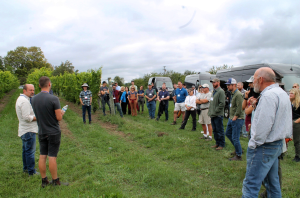
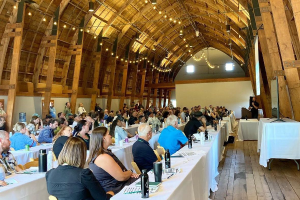
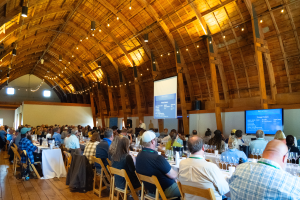
For this reason, DTG was conceived as a two-day model: a high-technical indoor program paired with a field-based day that makes ideas testable and practical, because adoption happens faster when people can see, discuss and compare in real vineyards. “The education program did a great job of linking what happens in the vineyard to what is enjoyed in a glass of Michigan wine,” Tom Jaenicke of Straits Area Grape Growers Association said.
To emphasize why the conference pairs high-level technical sessions with hands-on field learning, we can refer to Émile Peynaud, the French enologist and researcher widely credited with revolutionizing modern winemaking in the second half of the 20th century. Often described as a founding figure of modern enology, Peynaud consistently argued that the most important decisions depend on careful observation and disciplined measurement in the vineyard, summarized with “growers should relentlessly assess the ripening of the grapes, and only pick when ripe.”
For DTG, the meaning is clear: quality is not achieved through slogans or marketing campaigns, but through a repeatable, evidence-based method, then connecting those decisions to fruit composition and wine sensory outcomes. That connection is not theoretical: it is reinforced in every edition of DTG through direct, structured interaction between growers and wine sensory specialists, ensuring vineyard choices are evaluated by metrics and how they ultimately express themselves in the glass.
A conference built with the industry, not for the industry
Dirt to Glass is intentionally constructed through a planning process that brings growers, vineyard managers, winemakers, educators, wine sensory experts and market-facing stakeholders into the same room with MSU faculty, Extension specialists and educators. Each year’s agenda is informed by feedback, but priorities are not set through anonymous surveys. Instead, they emerge from multiple structured planning meetings, discussions and email exchanges. In these settings, representatives from grower associations, independent growers, winemakers and wine experts volunteer their time to collaborate, listen across regions and business models, and challenge assumptions. Together, they work to identify priorities that may not be any one person’s top concern, but represent the most strategic needs for Michigan as a whole.
After six years of building and refining this process, one trend has become increasingly clear: more people are asking to join the planning effort, an unmistakable signal that the industry recognizes the need to work collectively and intentionally for its future. Others are still on the sidelines, waiting for the right moment to engage, and we hope they will join soon. As in any growing movement, some do not yet fully see the purpose, but the momentum itself reflects a maturing industry learning that the path forward depends on shared priorities, shared responsibility and shared leadership.
This pattern mirrors what Roger Boulton, PhD, Distinguished Professor Emeritus of enology at UC Davis, explained in his 2012 American Society for Enology and Viticulture merit award, “Discovery, Innovation, and the Role of Research.” Boulton applied Everett Rogers’ adoption curve to innovation in the wine sector: industries contain innovators and technology enthusiasts and early adopters and visionaries, followed by an early majority and late majority, and finally laggards and skeptics. Critically, Boulton notes that the first groups adopt quickly because they seek technology and performance, while the majority tends to wait for solutions and convenience, creating an adoption chasm that slows broad change.
Over the past five years, the DTG planning process has naturally mirrored the adoption dynamics described by Rogers and highlighted by Boulton. We began by working closely with the industry’s early adopters and visionaries, the people willing to test new ideas, take risks and help define what “better” looks like in Michigan. Each year since, more members of the early majority and even the late majority have stepped forward to join the effort, not because they were asked repeatedly, but because they increasingly recognize that Michigan’s future depends on coordinated, evidence-based progress rather than isolated solutions.
The last five years of programs show a steady and growing commitment from Michigan industry professionals who volunteer their time to build sessions, contribute experience, lead discussions and openly present vineyard and cellar work for the benefit of the broader community. While some stakeholders are still waiting for the right moment to engage, and others may not yet see the purpose, the direction is clear: as the shared value of the work becomes undeniable, even today’s laggards and skeptics will ultimately be drawn in by the consensus and credibility established by those who stepped forward first.
In that context, DTG’s planning model is not just governance, it is an adoption strategy. By forcing cross-sector dialogue and shared priority-setting, it helps move ideas from the early-adopter circle into practical, field-ready solutions for the wider industry. In many cases, this process creates first-time, cross-sector engagement in Michigan, with stakeholders who rarely plan together now co-designing the technical direction of the conference.
The research backbone: what Michigan State University brings to the table
Dirt to Glass is credible because it is grounded in the land-grant research-to-adoption cycle: industry defines the constraints that matter most, MSU helps translate those needs into testable research questions and decision tools, and DTG becomes the annual checkpoint where Michigan’s grape and wine community compares outcomes, recalibrates goals, and agrees on next steps. In that way, the conference does not simply share information, it strengthens a continuous loop from priorities to evidence, to practice and back again.
Importantly, this work is further sharpened by contributions from national and international speakers whose experience provides external benchmarks and proven approaches that can be adapted to Michigan conditions. This approach works because research and Extension are most effective when the questions are defined with the people who must implement the answers.
The broader literature on stakeholder participation consistently shows that deeper involvement improves relevance and accelerates adoption, especially when the goal is real-world innovation rather than one-way information transfer. As Robert Mondavi famously noted, “I am a great believer in research and innovation,” a reminder that excellence in our industry is not accidental; it is built through shared commitment, disciplined learning and continuous improvement.
That research rigor shows up in the conference’s core themes, because the themes reflect the strongest scientific levers for quality.
Terroir to sensory outcomes (soil × climate × winemaking). Modern terroir science is clear: soil shapes vine performance through temperature, water supply and mineral nutrition, with direct consequences for phenology, ripening and composition. DTG began with soil identification and fertility to establish a shared technical foundation for quality discussions, then pushed the conversation one step further: how those site signals translate into sensory outcomes (aroma intensity, flavor development, texture, balance) and how winemaking choices can amplify or mask vineyard-derived differences.
In other words, DTG treats terroir as a measurable pathway from site conditions: 1) fruit chemistry, 2) wine chemistry, and 3) sensory expression, not as a slogan.
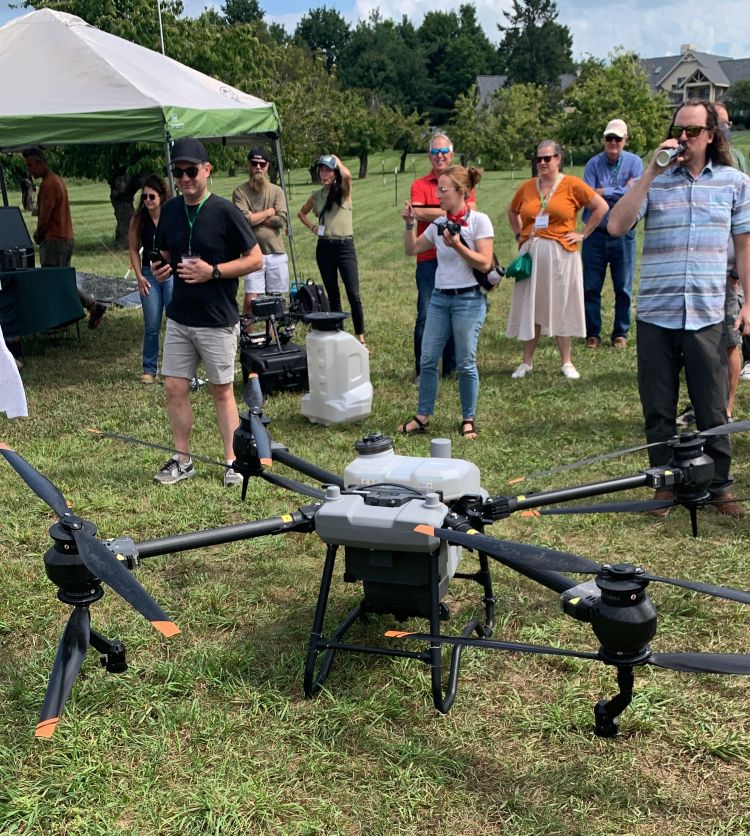
Precision viticulture as an operational decision-making system. Precision viticulture approaches are no longer “future tech;” they are an operational pathway to identify variability, target inputs and improve uniformity and fruit composition where it matters most. DTG increasingly emphasizes the translation from data to decisions: what to measure, how to interpret it, and how to act without overcomplicating operations. In this way, precision tools become management leverage, not just maps and imagery.
Cultivar strategy, resilience and next-generation disease resistance. Across global viticulture, climate and sustainability pressures are driving renewed focus on cultivar strategy. The peer-reviewed literature describes a coming “paradigm shift” where disease-resistant varieties (often referred to as PIWI) become central to climate-adapted, low-input production systems. DTG has created a statewide forum for Michigan to evaluate these opportunities rigorously, linking genetics, disease pressure, spray programs, fruit composition and wine outcomes. It is also helping to bring these cultivars into Michigan through coordinated trials and shared evaluation frameworks.
Market intelligence, economic impact and value-chain accountability. Quality improvements matter most when they are connected to economic outcomes: grape value, winery margins, brand reputation and market access. DTG therefore elevates “marker” work, using measurable indicators (sensory benchmarks, chemical signatures, viticultural metrics) alongside economic and market intelligence to identify what truly differentiates Michigan wines, where quality investments deliver the highest return, and how the industry can communicate that differentiation credibly. This is where scientific rigor meets business reality: not only what works but what pays, and how to demonstrate it to buyers, consumers and strategic partners.
As Jancis Robinson noted in a value-chain context, “If what everyone says is true, that the wine is made in the vineyard, then the vineyard is where that quality comes from and the grower should share in the profitability that comes from that quality.”
A short timeline of growth and achievements for Dirt to Glass
2022: Launching a soil-to-quality framework
Dirt to Glass debuted in Traverse City, Michigan, in 2022 as a first-of-its-kind Michigan conference built around a simple but rigorous premise: wine quality begins with the site, and the site begins with the soil. The inaugural program deliberately centered on soil health, soil identification and soil fertility, not as background agronomy but as the starting point for understanding vine function, canopy balance, ripening trajectory and ultimately fruit composition.
Topic selection was guided through an educational needs assessment and direct stakeholder engagement, ensuring the first edition addressed the most foundational knowledge gaps shared across regions. By establishing a common technical language around the physical properties of soil, water-holding capacity, rooting constraints and nutrient dynamics, DTG created a shared platform for more advanced discussions in subsequent years, where terroir could be treated as a measurable set of mechanisms and management decisions rather than a subjective concept.
“The dirt, the terroir, is where everything comes from.” – Bryan Ulbrich, Left Foot Charley
2023: Bringing global standards and opening a direct line to MSU leadership
The second edition of DTG explicitly aimed to bring the highest international standards to Michigan growers and producers, using outside expertise not as a showcase, but as a benchmark. The intent was to compare Michigan’s practices against proven approaches from leading regions, identify where small changes can deliver measurable gains, and accelerate innovation that fits our cool-climate constraints.
A defining milestone was the meet and listen session, which created a structured, two-way dialogue between Michigan’s grape and wine stakeholders and leadership from the MSU College of Agriculture and Natural Resources. That session moved beyond a traditional conference format: it gave the industry a formal space to communicate priorities, constraints and opportunities directly to university leadership, while also clarifying how research, MSU Extension and industry can align resources around shared, statewide goals for quality, sustainability and competitiveness.
2024: Statewide association alignment and scale
In 2024, DTG achieved something Michigan has long needed: visible, active alignment across major grape and wine associations and multiple regions, bringing diverse grower and winery voices into a single, quality-focused conversation. That collaboration was not symbolic. It shaped the agenda, strengthened participation and helped ensure that the conference addressed statewide priorities rather than isolated local interests.
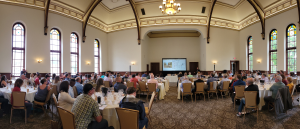
With attendance exceeding 200 participants, DTG clearly established itself as Michigan’s annual hub for technical learning, networking and coordinated strategy, where growers, winemakers, educators and market-facing leaders could benchmark ideas, challenge assumptions and leave with shared direction.
2025: From ideas to action, with measurable direction-setting
In 2025, the program formally pivoted from intention to impact, marking a deliberate shift from discussion to execution. The emphasis moved toward implementable practices and measurable change, supported by panels built by industry members for industry members, ensuring the conversation reflected real operational constraints, real business decisions and real tradeoffs.
A defining feature was using an interactive closing format designed to translate the day’s learning into a practical roadmap: distilling the most urgent priorities, identifying where the industry is ready to move now, and clarifying the next steps that can be carried forward into research, Extension programming, and on-farm adoption across Michigan. Finis coronat opus.
Why Dirt to Glass changes outcomes, not just conversations
1) It builds a shared statewide quality language
Quality is not a single metric, it is an aligned set of choices across site, cultivar, canopy, crop load, harvest timing and cellar strategy. DTG creates the rare space where those choices can be discussed across roles and regions, building a shared framework rather than fragmented opinions.
2) It connects farming decisions to market realities
The conference intentionally includes market-facing stakeholders because Michigan’s future depends on translating quality into recognition and demand. “Dirt to Glass boosts the visibility and quality of Michigan wines by fostering a deeper connection between local vineyards and consumers,” Paul Hannah, regional wine specialist for Meijer, said.
3) It turns “vineyard-to-glass” from a slogan into a method
A familiar refrain in wine is that “wine is made in the vineyard.” The real challenge, and the real opportunity, is turning that idea into a working method: choosing specific practices, measuring their effects, and tracing them all the way through to fruit composition and wine character.
Jean-Michel Comme, vineyard manager and technical director at Château Pontet-Canet (Pauillac), captures that discipline in one sentence: “The best fertilizer is the farmer’s footprint.” In other words, quality improves when observation, timing and daily decisions are intentional and consistent.
Dirt to Glass is Michigan’s annual mechanism for doing exactly that, creating a shared place to test which practices truly move the needle under Michigan soils, climate, disease pressure and production constraints.
“The main aspect of Dirt to Glass is elevating the Michigan wine industry by creating a reputation for quality,” – Marcel Lenz, PhD, Leelanau Cellars
4) It validates Michigan’s trajectory through outside eyes
International participation matters because it gives Michigan something that is hard to generate from within a single region: credible external benchmarks and direct, honest comparison. When experienced professionals and researchers from major wine regions engage with Michigan growers and winemakers, they help answer practical questions that matter for competitiveness: How do our vineyard standards compare? Are our quality targets aligned with what the market rewards? Which practices are considered “baseline” elsewhere, and which are emerging as the next frontier?
That outside perspective is especially valuable because it pushes us to be precise, moving from general impressions to measurable criteria. At the same time, it’s also helping us avoid reinventing solutions that have already been tested in other climates and business contexts.
Dirt to Glass is designed so that global expertise does not become generic advice. Visiting speakers are intentionally paired with Michigan producers and field-based MSU members so every concept is immediately discussed in terms of Michigan sites, Michigan seasons, Michigan cultivars and Michigan constraints. In other words, the goal is not to copy another region, but to learn from proven approaches and then adapt them to what Michigan uniquely is and can become. This balance—global standards with local relevance—is why international guests often recognize DTG as more than a conference.
As one visiting academic put it, Michigan has developed an “efficient synergy among university, Extension service and stakeholders,” highlighting a model in which research, education and industry leadership work together to define priorities, test solutions and translate knowledge into practice.
The deeper significance: a Michigan model for the next decade
Michigan’s best strategy is not to imitate another region. It is to define and defend its own identity, grounded in glacial soils, cool-climate structure and food-friendly styles while improving the reliability and clarity of quality year after year. DTG accelerates that future because it functions as a multi-stakeholder platform where coordination happens. Research priorities, extension delivery, grower innovation and wineries need to move in the same direction. As Maxwell Eichberg, Stranger Wine Company, noted, “What DTG has become is nothing short of marvelous. It is going to make a difference in the long run.”
This is also where the scientific rigor of MSU Extension’s grape team becomes decisive. The team ensures Michigan’s next steps remain grounded in measurable physiology and systems science. Decisions about soils, canopy management, crop load, disease strategies and cultivar selection are not just best guesses, but evidence-based pathways toward quality and resilience. Qui bene distinguit, bene docet.
A call to action: keep building it together
Dirt to Glass is already proving what Michigan can accomplish when grower leadership, grower associations and MSU’s mission are aligned: a stronger technical culture, better statewide coordination and a clear commitment to measurable progress. The next decade will reward regions that can adapt to climate variability with smart cultivar and water strategies, reduce disease risk while protecting wine style and identity, use data to manage variability rather than react to it, and build markets through consistency and collaboration.
Dirt to Glass is one of Michigan’s strongest tools to do exactly that, because it is not a single organization’s event. It is a shared, stakeholder-built, research-driven commitment to the future of Michigan wine.
Registration
Registration is open for the 2026 Dirt to Glass conference on Aug. 20–21 in Traverse City, Michigan. Discounted registration is available for the first 50 registrants for days one and two, after which regular pricing applies.