


Do your cattle roll their tongue?
 Print
 Email
Displays of non-nutritive oral behaviors in cattle may be due to a lack of dietary fiber.
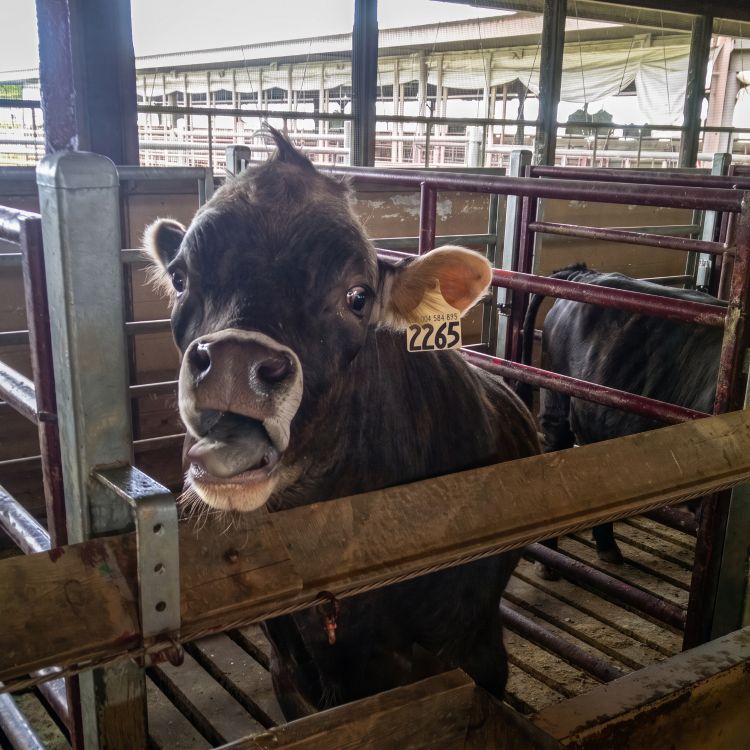
You might think of this as an odd question. However, if you have ever seen cattle rolling their tongue, you might not find this all too odd, rather, you might be curious why someone might be writing about tongue rolling in cattle. Tongue rolling is recognized as a non-nutritive oral behavior or a stereotypical behavior for cattle. Greater displays of non-nutritive oral behaviors by your cattle may be an indication of a lack of dietary fiber intake.
Cattle are ruminants, animals with a four-chambered stomach complex. The first compartment, the rumen, is a large fermentation vat. Microbial fermentation in the rumen allows cattle to digest feedstuffs, such as fibrous forages, that other simple-stomached animals cannot digest. As ruminants, cattle regurgitate recently eaten feed to chew it again, further breaking it down into smaller, more digestible particles. This action of “chewing the cud” is known as rumination and is a sign of healthy nutritive behavior for ruminants, such as cattle. Research has shown there is a positive relationship between the amount of fibrous forage consumed and time spent ruminating in cattle.
Modern cattle production systems span a variety of environments and utilize a variety of available feed resources. As a result, not all cattle rely on active grazing to meet their nutritional needs. Therefore, the overall time budget of cattle raised in confinement is altered, as they need less time to consume feed than cattle that graze. As a result, some behavioral experts believe alterations to the overall time budget of cattle raised in confinement and consuming grain-based diets with low fiber content can lead to the expression of stereotypical behaviors.
While cattle can be raised in confinement structures regardless of the production sector of the cattle industry, not all cattle production sectors rely on feeding grain-based diets to meet the nutritional requirements of the animal. The most common cattle sectors that raise cattle in confinement and supply diets with minimal forage or fiber include dairy calves and finishing cattle. Both sectors utilize grain-based diets. For dairy calves, grain-based diets are used to stimulate rumen development and growth, while in finishing cattle, they are fed for rapid and efficient growth that promotes fattening.
A review of the dietary effects on non-nutritive oral behaviors in cattle was conducted by Ridge and others from Texas A&M University in 2020 . Results from 15 out of 27 (63%) studies indicated diet was associated with non-nutritive oral behavior activity (i.e., tongue rolling, bar licking, allo-grooming, self-grooming, object licking, ground licking, cross suckling). All seven studies evaluating roughage inclusion reported a difference in non-nutritive behavior expression, with the addition of roughage decreasing non-nutritive behaviors and the removal or lack of roughage availability increasing non-nutritive behaviors of cattle.
To date, few studies have investigated the effects of diet or roughage inclusion on non-nutritive oral behaviors in feedlot cattle. However, a recent study conducted by Daigle and others from Texas A&M University investigated cornstalk inclusion (5, 10, or 15% on a dry matter basis) in the finishing diet of beef steers. Unexpectedly, steers consuming the 10% cornstalk diet had greater bar licking and tongue rolling bouts and durations than steers consuming the 15% cornstalk diet, while steers consuming the 5% cornstalk diet were intermediate. The researchers believe all three diets may have had insufficient roughage or fiber to explain differences in the expression of non-nutritive oral behaviors in feedlot beef steers, as the comparison included no positive control diet with higher forage or fiber concentrations.
Additionally, other research aims to study other factors that may influence stereotypical cattle behavior. Research from UC Davis discovered innate factors, such as breed, can lead to differences in the expression of some non-nutritive oral behaviors. Recently, Jersey heifers were found to engage in more non-nutritive oral behaviors, such as tongue rolling, tongue flicking, and licking or chewing bedding, the feed bin, or other non-nutritive surfaces, while Holstein heifers spent more time allo- or self-grooming. Future research with different roughage sources and concentrations may be needed to further understand the influence of fiber’s effectiveness on feedlot cattle behaviors. If you are looking for more information on beef cattle, reach out to the Michigan State University Extension Beef Team or check out their website for the latest educational articles.