Does row spacing and seeding rate recommendations differ for short vs. tall corn hybrids?
 Print
Print Email
EmailPlanting short corn in narrow row spacings and under higher seeding rate can improve yield, dependent on the environment.
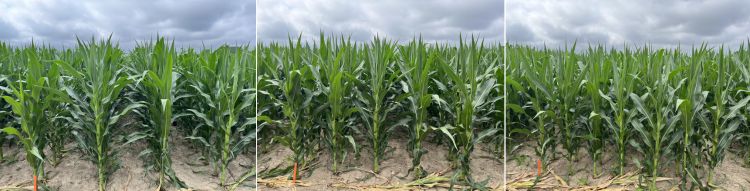
Short-stature corn is gaining the attention of growers as a potential way to improve standability, reduce lodging risk and increase management flexibility. These hybrids are shorter than conventional corn, generally less than 7 feet tall, and maintain high yield potential. Since this is a new technology, one big question remains: Should short-stature corn be managed differently than traditional tall hybrids?
To help answer this question, we evaluated key agronomic management practices including row spacings and seeding rates for two short corn hybrids across two Michigan environments. Field trials were conducted in Lansing and Richville during the 2024 and 2025 growing seasons. Two short-stature corn hybrids from Bayer Crop Science were planted in three row spacings (30, 22 and 15 inches), and four seeding rates (26,000, 34,000, 42,000 and 50,000 seeds per acre). We also included two traditional tall hybrids with similar other traits for comparison.
Impact of row spacing on grain yield
Planting short corn in narrow rows paid off at Lansing 2025, with 15-inch rows yielding 7% more than 30-inch rows (Figure 1). At Richville 2025, row spacing yield differences were not significant but showed a trend of yield increase (3%) in 15-rows compared to 30-inch row spacing, indicating a modest yield benefit of narrow rows for short corn even under high-yield conditions at this location.
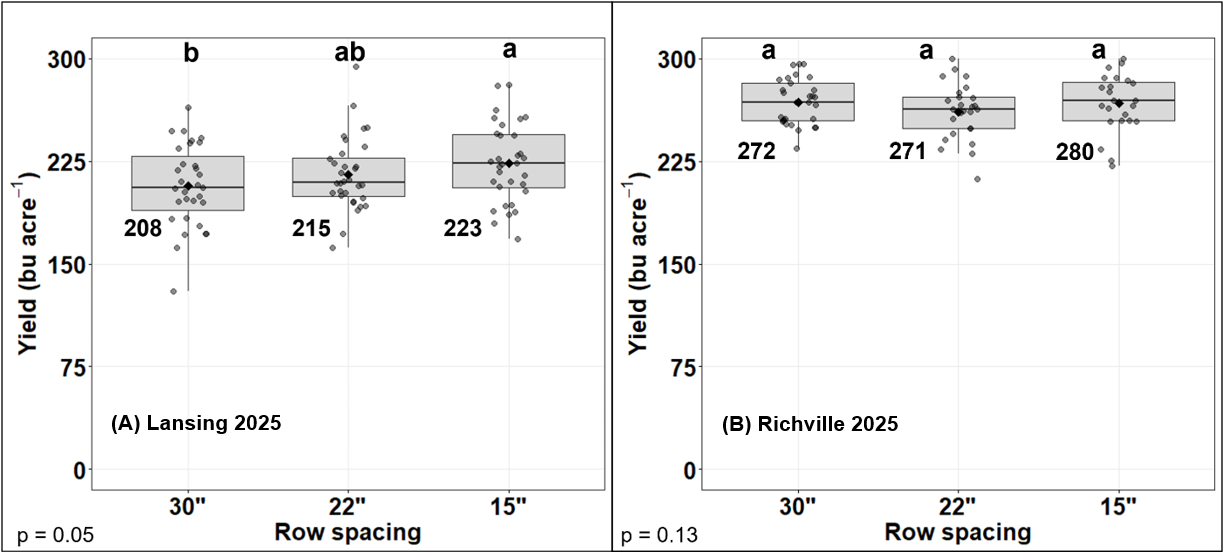
Similar patterns were found in 2024 with both trials conducted in Lansing (data not shown). A 12% yield increase was found when switching from 30- to 22-inch row spacing in the first trial, and a 4% increase from 30- to 15-inch rows in the second trial.
Additionally, there was no significant interaction between row spacing and seeding rates on short corn grain yield at any site-year. This means that the yield benefit of narrow row spacing was observed regardless of the seeding rate.
Tall-stature hybrids tested in this study did not show any yield increase from narrow rows at any of our location in 2024 or 2025.
Impact of seeding rate on grain yield
Short-stature corn did respond to increasing seeding rate, although the magnitude of the response varied (Figure 2). At Lansing 2025, yield differences among seeding rates were not significant, but the numeric trend was clear. Yield improved by 3.7% by increasing seeding rate from 26,000 to 34,000 seeds per acre. The highest yield (223 bushels per acre) occurred at 42,000 seeds per acre, a 7.6% increase over the lowest rate.
Seeding rate response was significant at Richville 2025. Yield improved by 8% by increasing seeding rate from 26,000 to 34,000 seeds per acre. Yields continued to increase at higher populations, reaching 288 bushels per acre at 42,000 seeds per acre, a 13% increase compared with the lowest seeding rate with no further decline even at the highest rate. High yield environment at this site year can explain this strong response to seeding rate.
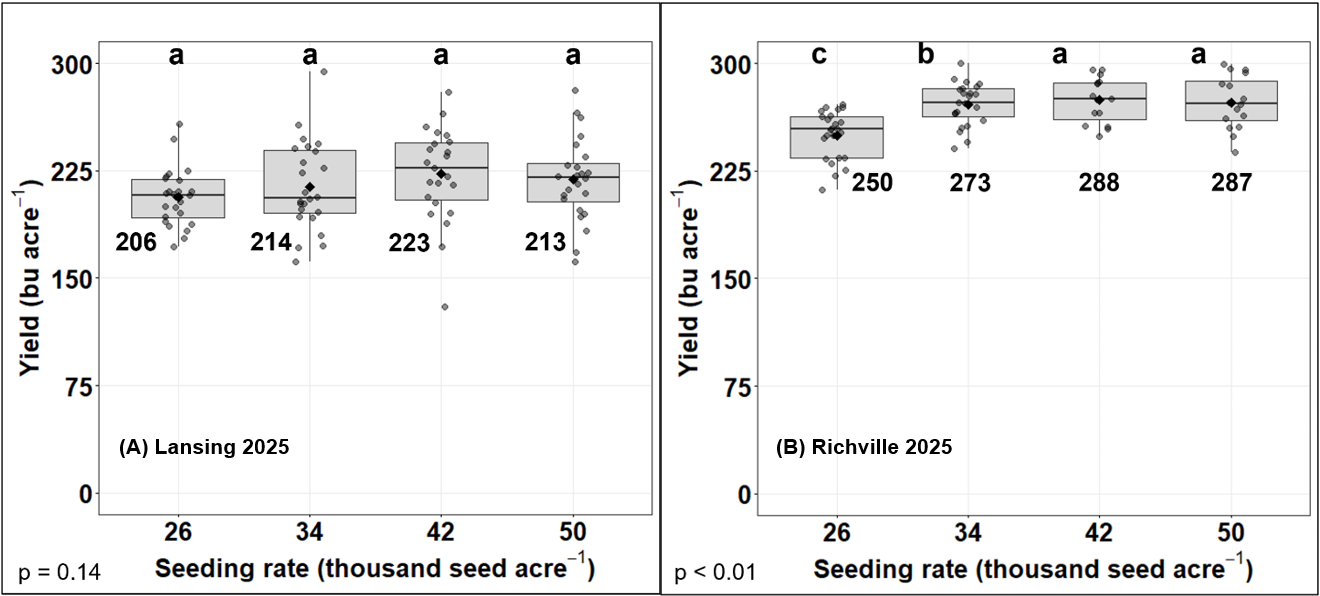
Results from Lansing in 2024 told a similar story (data not shown). Yield increased 10% when the seeding rate was bumped from 26,000 to 34,000 seeds per acre, with the latter yielding similar to 42,000 seeds per acre in both fields, and a slight decline at our highest rate.
Similar to row spacing results, tall-stature hybrids tested in this study did not show a yield increase from seeding rates above 34,000 seeds per acre at any of our locations in 2024 or 2025.
Overall, our preliminary data indicates that the short-stature corn hybrid technology responded more positively to narrow rows and increased seeding rates than the traditional tall hybrids. Results recently published by Purdue University on short-stature corn hybrids agreed with our results.
Environmental conditions made the difference
Weather conditions played an important role in how corn responded to management. In 2025, Lansing experienced dry conditions right after silking, with only about 1 inch of rainfall in August. On the other hand, Richville received over 3 inches during the same period. Additionally, the soil at the Lansing location (sandy loam) is more prone to drought stress compared to Richville (clay loam). These differences may explain why yield responses were greater in some environments than others, and why management decisions don’t always pay off the same way at every location or year.
Other factors
Additional analyses are underway to determine the seeding rates that not only maximize yield but also profits (accounting for seed cost). Yield components (number and weight of kernels) and grain quality data will also help clarify how management changes impacted these responses.
One concern with short-stature corn is the potential for harvest loss if ears are positioned closer to the ground. In our study, we did not observe significant differences in harvest losses between short and tall hybrids. The short-stature hybrids tested in this study originated from the breeding trait, where shortening of the stalk happens below ear leaf. As newer hybrids (including genetically modified short corn) become available for testing and enter the market, continued research will be needed to identify optimum agronomic recommendations for this new technology.
Key takeaways
- Narrow rows improved yield in short-stature corn, but the response was dependent on the environment. Our 15-inch row spacing treatment yielded up to 7% more than conventional 30-inch rows.
- Increased seeding rates generally improved yield in short-stature corn. Yield gains of 4% and 5% were observed when seeding rate increased from 26,000 to 34,000 seeds per acre, and of 4% and 8% from 34,000 to 42,000 seeds per acre, depending on the environment.
- Short-stature corn hybrids often increased yield at greater plant populations, but pushing populations too high may not always pay.
- Tall-stature hybrids tested in this study showed no benefit of narrow rows (less than 30-inch) or seeding rates above 34,000 seeds per acre.