Efficient sprinkler management can improve dairy cow cooling and water use
 Print
Print Email
EmailSmart soaking systems can help dairy producers provide effective heat abatement while reducing water use and unnecessary runoff.
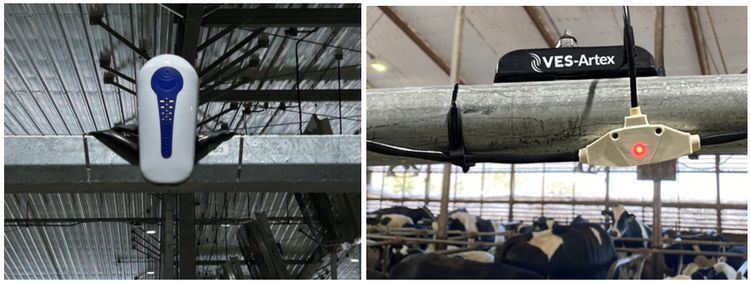
During hot and humid weather, keeping dairy cows cool is important for maintaining cow comfort, health and productivity. Sprinklers, or soaker systems, can be an effective cooling tool, particularly when used with adequate airflow and shade. Applying water to the cow’s skin promotes evaporative cooling as water evaporates from the body and removes heat.
While sprinklers can provide effective cooling, proper management is important to avoid unnecessary water use and excessive runoff. Traditional soaker systems are commonly controlled by timers that turn water on and off at set intervals. For example, feedline sprinklers may operate for one to three minutes every 12-15 minutes when temperature and humidity conditions are high.
Although these systems may be activated based on air temperature, they generally operate regardless of whether cows are present. This can result in unnecessary water use and excessive water on the floor, potentially contributing to slippery surfaces, contaminated feed, flooded scrape alleys and increased runoff.
Some soaker systems can use more than 63 gallons of water per cow per day. Smart soaking sprinkler systems offer another approach by automatically applying water based on both environmental conditions and cow presence. These systems use sensors to detect when a cow is present and can be programmed to activate when temperature and humidity conditions indicate that cooling is needed.
A recent University of Florida study compared smart soakers with conventional fixed-cycle soakers for cooling dry, pregnant Holstein cows experiencing heat stress. The study found that smart soakers used approximately 60% less water than conventional systems; 9.5 gallons per cow per day compared with 48.7 liters per cow per day.
Both systems provided similar cooling and animal welfare outcomes, while the smart soaker system substantially reduced water use. Because individual smart soakers operate independently, water is applied only where and when it is needed.
For example, if a cow moves out of the sensor's range and another cow enters the area, the system can reset and provide cooling to the next cow based on the programmed settings. This differs from conventional systems, where all sprinklers may operate on the same fixed cycle regardless of cow presence.
Another potential benefit is the ability to adjust water application during a cow's time at the feed bunk. Once a cow is thoroughly soaked, additional water may run off the animal and onto the floor. Smart systems can be programmed to adjust subsequent soaking cycles, allowing periods of soaking and drying while the cow remains in the area.
Effective sprinkler management involves more than simply turning the system on. Nozzles should provide enough water to thoroughly wet the cows while minimizing excessive runoff and standing water.
For example, consider a dairy operation with 1,000 cows. If a smart soaker system uses approximately 9.5 gallons of water per cow per day, compared with 48.7 gallons per cow per day for regular soaker systems reported in University of Florida research, the operation could save approximately 39.2 gallons per cow per day. Over a 90-day period, this would amount to approximately 3.53 million gallons of water saved.
Reducing the amount of water used for cow cooling can be particularly important for manure management, as less water entering the system can help reduce the volume that must be stored and managed.
By combining appropriate sprinkler timing, proper application rates, adequate airflow, shade and routine system maintenance, dairy producers can support cow comfort while making more efficient use of water resources. Smart soaking technology may provide another tool for farms looking to maintain effective heat abatement while improving water use.