Essential concepts for managing Xanthomonas in Begonia — Part 3
 Print
Print Email
EmailHow to approach phytosanitary control in a begonia crop with Xanthomonas.
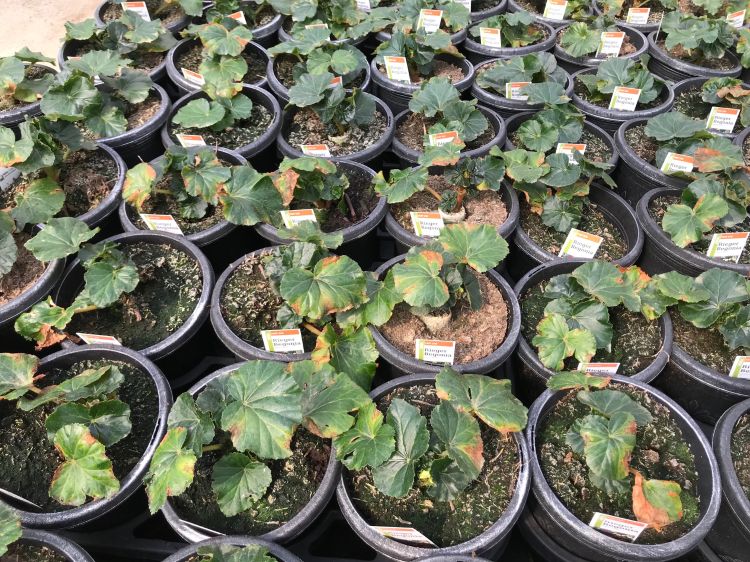
In Part 1, we covered what Xanthomonas is, how it infects plants, its potential impact on a crop and its diagnosis. In Part 2, we covered cultural practices to reduce disease pressure and chemical treatment options. Unfortunately, disposing infected and possibly-infected plants requires some tough decisions by the greenhouse growers or owners. In this final article in the series, Michigan State University Extension answers some commonly asked questions about how to approach plant disposal in order to minimize losses in the crop.
Once a positive diagnosis for Xanthomonas is received, how should I proceed?
Since there is no cure for begonias infected with Xanthomonas, all symptomatic plants should be discarded as soon as possible. Scout the crop for symptomatic plants and dispose of those that are within splash distance of infected plants. Remember that there is a time lag between when plants are infected and when they develop visible symptoms. As a result, treat plants that are within splash distance of symptomatic plants as infected and discard them.
How should I approach scouting the crop and determining what to rogue out?
When considering how to dispose of plant material, take note of the location of symptomatic plants and the prevalence of the infection. In situations where a low percentage of the crop is symptomatic, scouting and rogueing may be practical. However, in cases where a larger portion of the crop is infected, consider destroying entire portions of the crop.
How should I dispose of infected plant material?
Dispose of infected plants when foliage is dry to prevent spread to those nearby. Wear disposable gloves and disposable coats or bleach-able aprons. Do not compost the diseased plant material or reuse pots that contained infected plants.
How should I document my losses?
Have a diagnostic report confirming the pathogen. Take photos of the symptoms of the infected plants and number of plants affected. Using a smart phone or tablet to record a walking video with a timestamp is one way to document the situation.
How do I sanitize the greenhouse after having Xanthomonas-infected begonias?
All symptomatic plants must be removed from the greenhouse along with plant debris on and under benches, aisles and trays. Soil and other debris should be washed off surfaces prior to sanitizing. Surfaces in the production facility should be cleaned with quaternary ammonia or other commercially available sanitizing agents.
To read more about greenhouse sanitation, refer to the Purdue Bulletin, “Sanitation for Greenhouse Disease and Pest Management.” Porous surfaces such as black weed mats are hard to clean and sanitize and should be replaced after a disease problem.
Additional resources
For additional information and insight from plant disease experts, start here:
- Essential concepts for managing Xanthomonas in Begonia – Part 1
- Essential concepts for managing Xanthomonas in Begonia – Part 2
- e-GRO Alert 7.23 on Bacterial Leaf Spot and Blight on Begonia by Nora Catlin, Cornell Cooperative Extension, and W. Garrett Owen, MSU Extension
- Bacterial Diseases of Plants by Sarah D. Williams, Michael J. Boehm and Francesca Peduto Hand—this is a series of fact sheets on plant pathology produced by Ohio State University Extension.