Fast Fonz Facts: Dectes discovery, earworms increasing
 Print
Print Email
EmailFast Fonz Facts outlining a new insect discovery and earworm trapping.

The following summer Fast Fonz Facts by Chris DinFonzo, PhD, a field crops entomology specialist with Michigan State University Extension, highlights a new pest to our region and earworm flights.
Earworm flight
Ander Huseth, MSU Extension specialist in the Department of Entomology, reports that earworm catches in his pheromone traps tripled in the last six days, and that perhaps we are at the beginning of a flight from the south. This is good time to scout crops like late-planted sweet corn that are susceptible to earworm infestation. To learn more about scouting and treatment, read the MSU Extension article “Identifying late-season caterpillars feeding in corn ears.”
Discovery of Dectes stem borer damage
The following details the discovery of the first (to my knowledge) Dectes stem borer infestation documented in Michigan. I don’t know a lot about this insect, but I’ve summarized the following and provided pictures. Keep an eye out for this pest and damage over the next six weeks as you conduct field calls or troubleshoot poor stands. If you find it, email me at difonzo@msu.edu with a few pictures and a location so that we can understand its distribution. Dectes is likely another example of a southern pest shifting northward as the climate steadily warms.
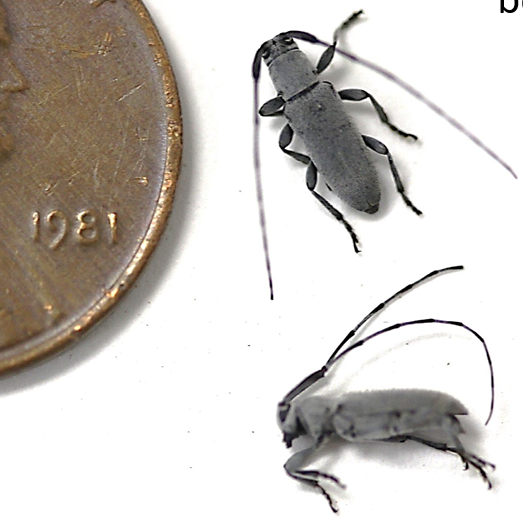
Last week, I received a text with pictures of a mystery caterpillar-looking larva found in a soybean field west of St. Johns, Michigan. I recognized the larva as Dectes stem borer (Dectes texanus texanus) — not a caterpillar, but a longhorn beetle. For years I’ve listened to entomologists from the south discuss this pest, which is found on the High Plains in Kansas, Oklahoma and Texas as well as the southern U.S. up into Missouri and Kentucky.
In 30 years at MSU, I’ve encountered only a few adult beetles while sweeping beans and I’ve never seen larvae or damage. The insect collection at MSU has only two beetle specimens, both dating to the 1970s, and no larvae. My field crops colleagues at Ohio State and Purdue also have never seen an infestation. It is no surprise, however, that Dectes is spreading northward since the 1970s, with millions of soybean acres, more no-till production and warmer winters.
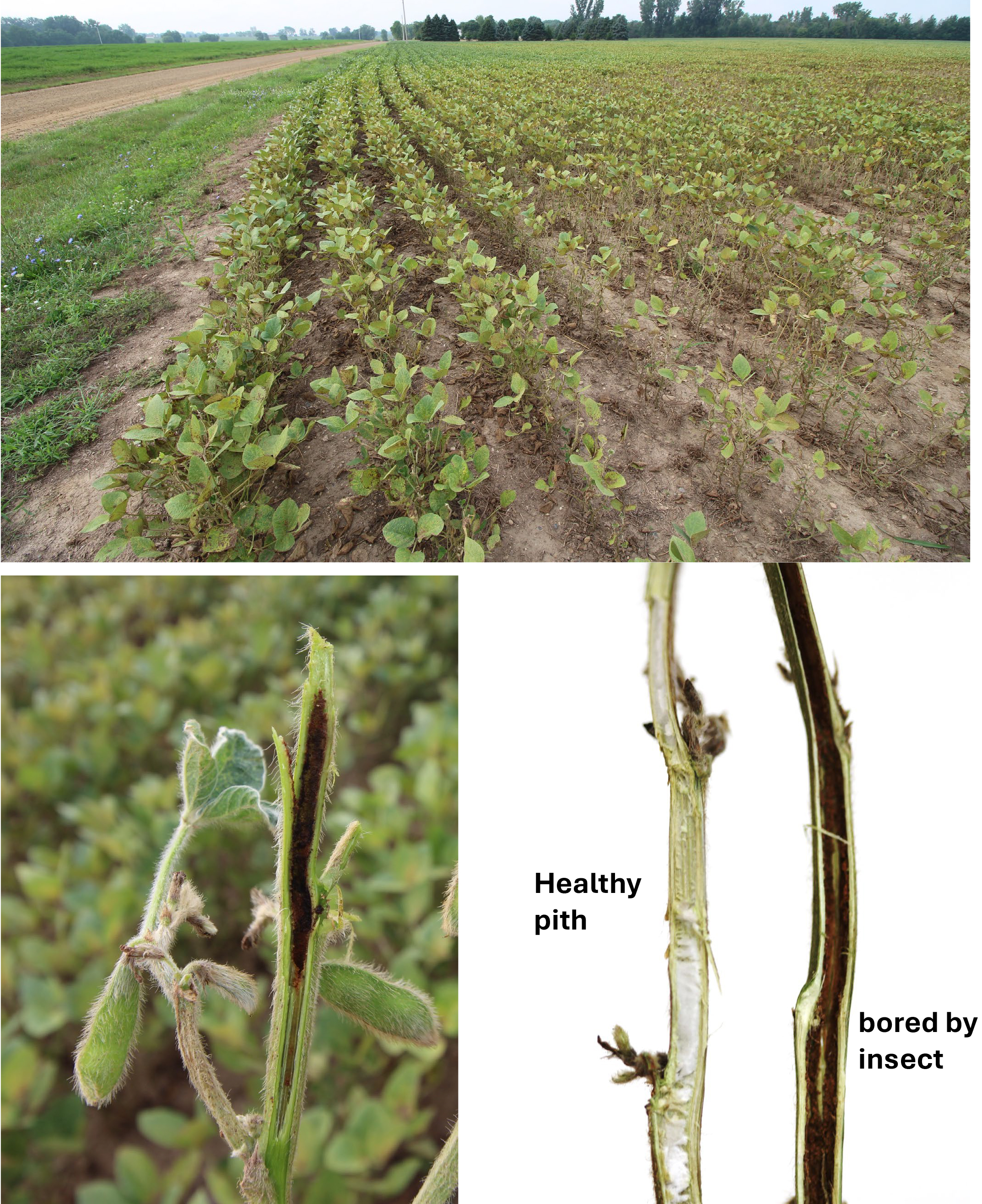
The farmer who texted me checked a field edge that was yellowing and dropping leaves. In addition to spider mite (expected with the dry weather), she noticed stems that were brown on the inside, but the symptoms were different from stem rot. And, she found an insect. Her observations were spot-on. With stem rot, the pith in the stem is brown but intact. In this case, the pith was gone and the inside of the stem was dark, reddish-brown. Dectes larvae bored into and ate the pith, leaving dark frass behind.
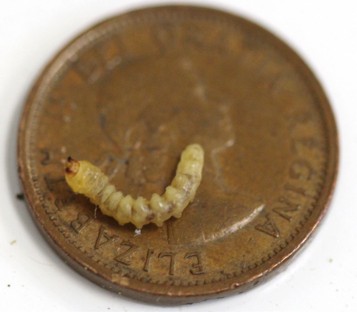
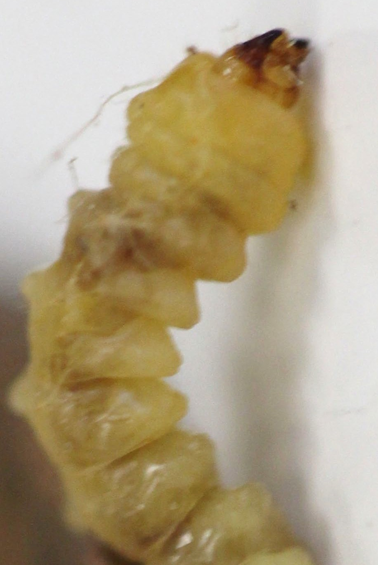
The infestation wasn’t just a plant or two on the edge. It was fairly easy to find larvae when we split stems (Figures 1-4). The farmer and I went in separate directions to check the edges of other fields and found more locations. This tells me that the original field edge wasn’t a random one-off.
I suspect that Dectes is simmering under the radar, we just haven’t recognized its symptoms.
Some tidbits about Dectes life cycle and damage
Adult beetles emerge in mid-summer from the base of last year’s hosts. It favors sunflower but also infests soybeans plus ragweed and cocklebur. In tilled fields, infestations are often limited to field edges because adults emerge from weed hosts in the ditch or field margin.
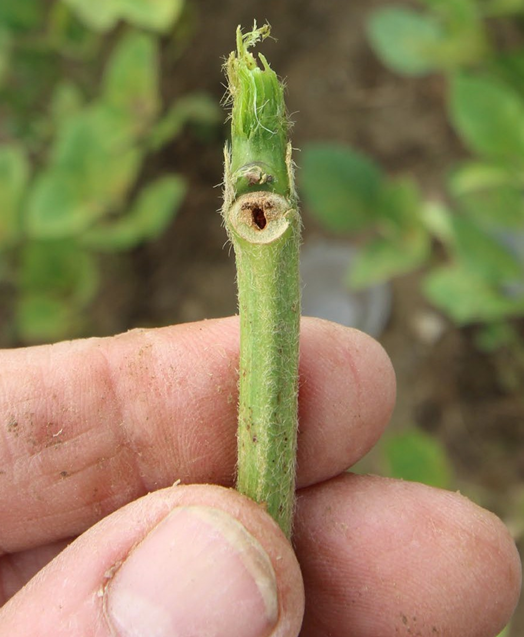
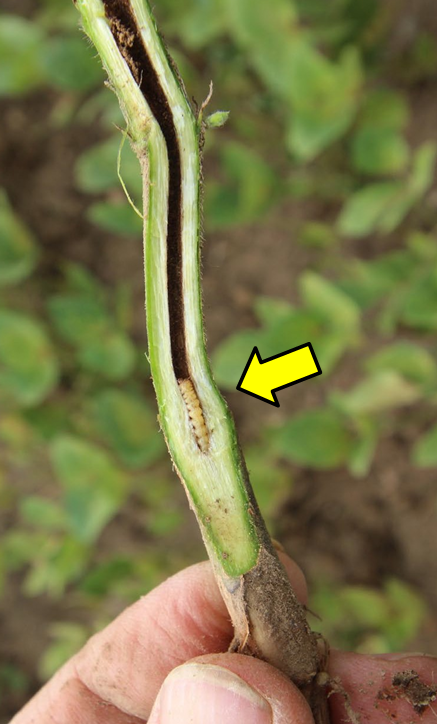
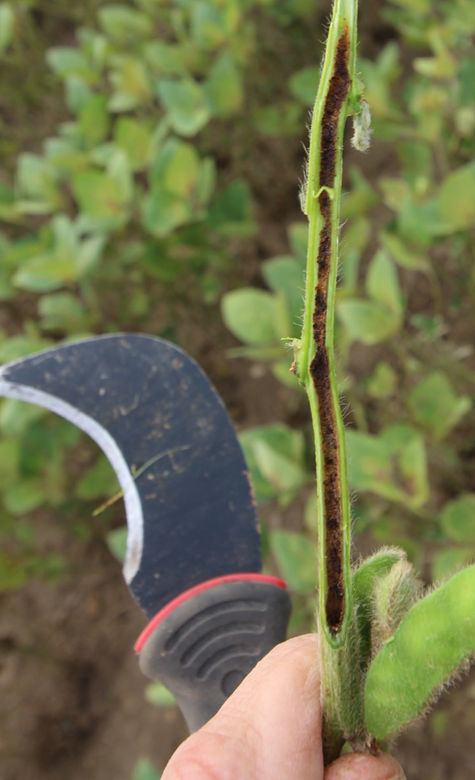
On soybeans, females lay eggs on upper petioles in mid-summer. Tiny larvae bore into the petiole to feed, killing that leaf. Then they tunnel into the main stem, moving up and down to feed on the pith (in the St. Johns field, larvae were found at the top and very bottom in the stem, see Figures 5-6).
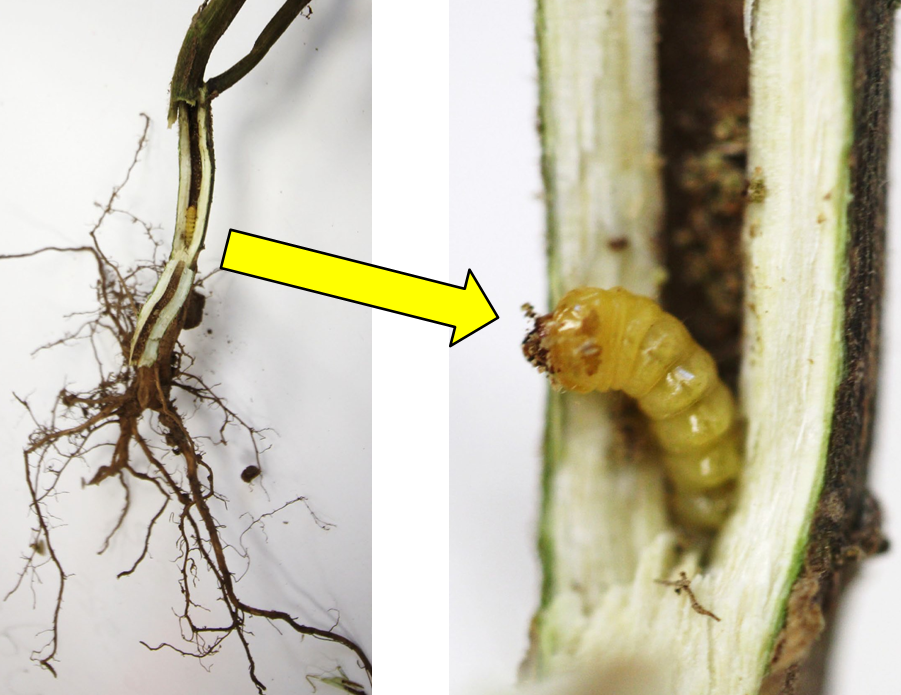
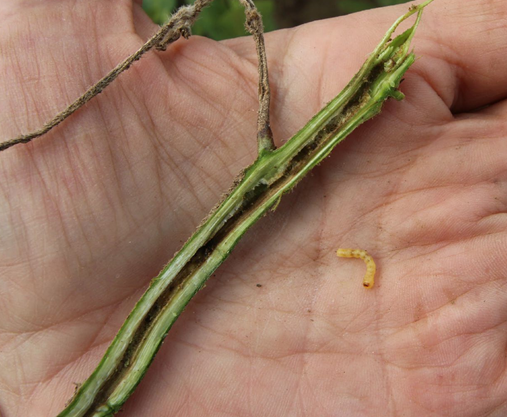
Dectes larvae are creamy-white and legless with a broad head typical of longhorn beetle larvae. They have big forward-pointing mandibles to tunnel into the pith (Figures 7-9). Larvae can move quickly up and down the tunnel to escape a person with a knife. Larvae eat each other so there is only one per stem.
At the end of the season, the larva moves to the base of the plant, girdles the stem, and makes an overwintering chamber. This chamber has to remain intact (i.e., no-till, weeds on field edges) for winter survival, pupation and beetle emergence the next spring.
Impacts of Dectes
Larvae feed on the pith in the middle of the stem and girdle the stem near the soil line. Extension publications from other states estimate yield loss from tunneling at 2% to 10%. For the most part, the xylem and phloem tissue remain intact to move nutrients and water around the plant. Plants may not show the signs of infestation unless they lodge or break off before harvest (think something like corn rootworm in continuous corn). This loss is much higher than the effect of stem boring and can impact specific parts of fields (edges) significantly.
For more information on Dectes, read “Biology and Management of Dectes Stem Borer” from the University of Missouri Extension.
The bottom line is that Dectes is here and has probably been here for a while (adults aren’t great movers, so they disperse slowly). I don’t know how widespread they are or the timing of its life cycle in our northern production system.
If you find a suspect case in the next several months, contact me so I can map the finds. I’ll do some reading this fall and develop information for winter meetings.
This work is supported by the Crop Protection and Pest Management Program (grant no 2024-70006-43569) from the USDA National Institute of Food and Agriculture. Any opinions, findings, conclusions, or recommendations expressed in this publication are those of the author(s) and do not necessarily reflect the view of the U.S. Department of Agriculture.