What if you have poor control of alfalfa weevil?
 Print
Print Email
EmailThere are many reasons why alfalfa weevil control is poor this season.
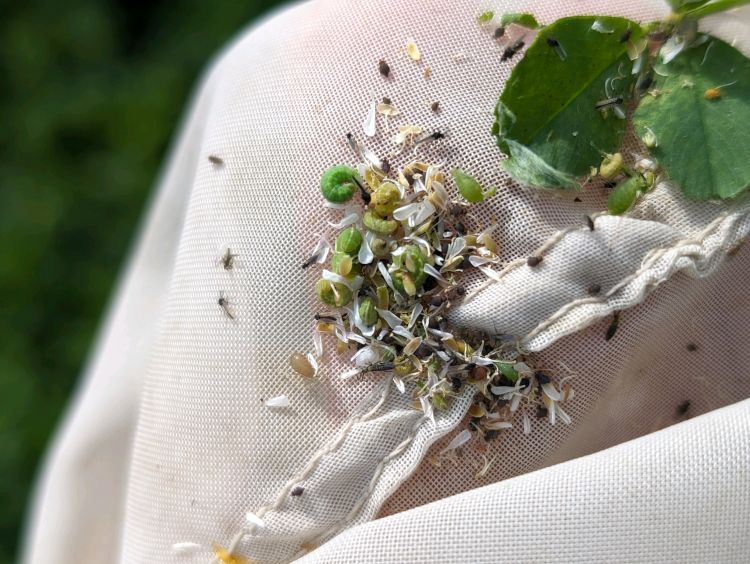
There have been several calls this spring about poor control after spraying various pyrethroids for alfalfa weevil. “Is this resistance to pyrethroids?” is the common question. In the western U.S., there are populations of weevils that are resistant to pyrethroids. In the last few seasons, nearby states like Pennsylvania and Wisconsin reported diminished control in some locations. What’s going on? Here are a few things to consider.
Resistance can happen. Most field crops insect pests in Michigan mix around in the landscape or fly in from the south. In contrast, alfalfa weevil reflects the history of what’s been done to it on a local farm or a group of livestock operations in a region. Alfalfa weevil feeds on alfalfa and some clovers, so it’s tied to places growing these crops. Once it infests a field, most of the population overwinters nearby. When an alfalfa stand is replaced, they move into newer plantings in the same area. Spraying pyrethroids before first cutting, year after year, in the same fields, can generate a truly resistant population of weevils on a farm or in a region with a concentration of livestock production.
Impacts on biocontrol. For 100 years, the U.S. Department of Agriculture sponsored programs to release parasitoids for alfalfa weevil control. In Michigan, this program was active in the 1960s and 70s, and it established several parasitoid wasps that significantly reduced weevil populations. Infestations that did occur often could be managed by cutting a few days early. A reduction in sprays in first-cutting alfalfa in turn meant that natural enemies like lady bugs could develop in alfalfa fields early in the season. (I like to think of alfalfa as an early-season nursery for beneficial insects that move into neighboring fields later in the spring.)
The delicate balance of biocontrol is easy to mess up. In the last 20 years, there has been a persistent trend in many field crops to add a “cheap” pyrethroid to the spray tank when going over a field for another reason. This saves time and spray costs and is viewed as insurance against potential future infestation. Roundup Ready crops kicked open the “cheap insurance” door because it is tempting to add a few dollars of insecticide to a post-glyphosate spray. Ditto fungicide applications on wheat in the spring or on corn at R1—inexpensive to add insecticide to the tank.
There is a cost in reducing or killing biocontrol. This reduction is especially advantageous for alfalfa weevil since its parasitoids only attack alfalfa weevil and are tied to the same locations. Where do new wasps come from if they are wiped out across a livestock farm? The next season, there is less biocontrol, more weevils, and another round of sprays to first cutting—the classic pesticide treadmill.
Poor timing. Calls from southwest Michigan about poor weevil control came several weeks ago during the cool spell in late April. At the time of the calls, Michigan State University’s Enviroweather predicted weevil egg hatch and small larvae in the region. Indeed, Nicolle Ritchie, the Michigan State University Extension educator in that area, was barely finding feeding at that point. With the cool spell, egg laying may have occurred over a wide period. The sprays made days or a week prior were probably too early to hit the peak population and spray residue would be gone for later-hatching larvae. On cool days, larvae are not at the top of the plant. Instead, they hunker down low in the canopy. Perhaps some of the spray issues relate to poor timing (too early), lack of residue when larvae are present, or poor coverage lower down on the plant.
In the cases of poor control reported this spring, I don’t know which of the reasons are at play, and all can happen at the same time. Resistant populations are created by repeated spraying, which in alfalfa usually involves annual insurance applications. Spraying at a convenient but early or wrong time can expose larvae to low, survivable levels of residue, which also drives resistance. This is why I always harp on scouting to make decisions and spraying only if a field is over threshold for weevil defoliation and can’t be harvested early.
Once a farm is stuck in a resistance hole, there aren’t many alternatives to pyrethroids for alfalfa weevil control. The main option is indoxacarb, also known as Steward, which has a different mode of action than pyrethroids. Steward is used with success in California on resistant alfalfa weevil populations. Obviously, we don’t want to insurance-spray this active ingredient into oblivion, so my comments on scouting and integrated pest management still apply.
Older alternatives are carbaryl/Sevin, which kills bees and can damage new growth, and the old OP methomyl/Lannate, which has Danger signal word. Both have short residual and seem like last resorts compared to Steward.
Additional information around insect control can be found in the MSU Extension Field Crops Insect guide. Guidance on scouting and sweeping for stand evaluation is outlined in this article.