FCCP co-authors report quantifying climate-smart forest management in Oregon with American Forests
 Print
Print Email
EmailFCCP co-authors report quantifying climate-smart forest management in Oregon with American Forests, Oregon Department of Forestry, Natural Resources Canada, and the USDA Forest Service.
The Michigan State University Department of Forestry Forest Carbon and Climate Program co-authored a report alongside American Forests, the Northern Institute of Applied Climate Science (NIACS), Natural Resources Canada Forest Service Carbon Accounting Team, and the Oregon Department of Forestry that quantifies the climate mitigation potential of climate-smart forestry, wood utilization, and other emission reduction strategies. 
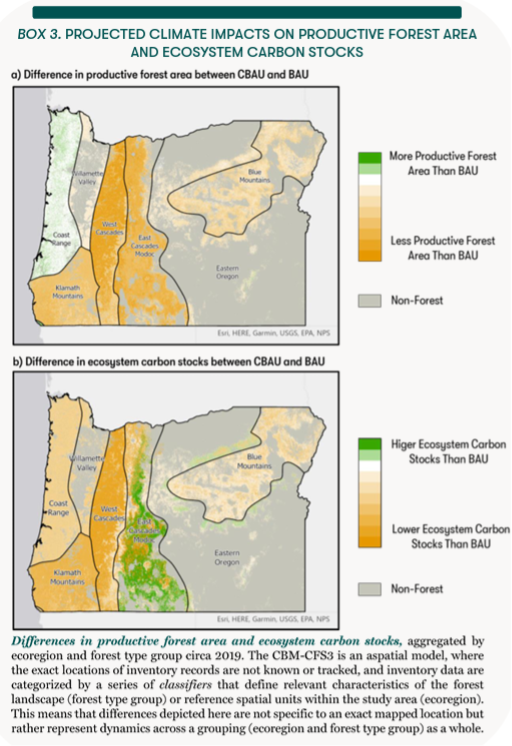
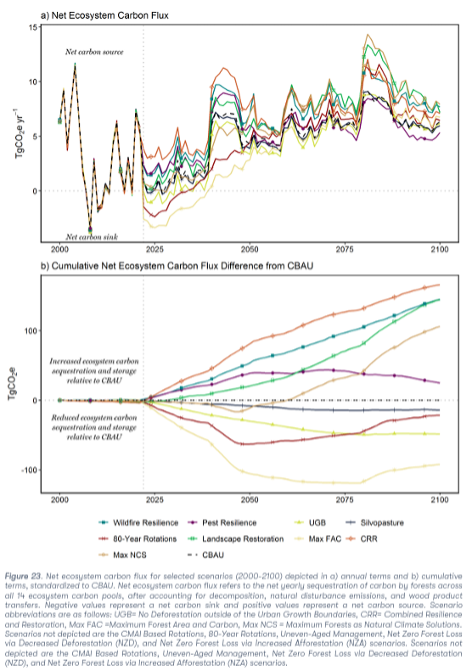
This study used participatory methods working directly with local experts to identify forest management priorities, concerns, and goals and the CBM-CFS3 modeling framework to estimate potential changes in forest carbon and harvest wood product dynamics. Key findings show that actions such as addressing post-fire regeneration failures, reducing the impact and severity of future pest outbreaks through thinning and prescribed burning, innovative wood use, increasing efficiency of the forest products sector, reducing the rate of forest loss, and preparing for future impacts of climate change can have substantial effects on the future mitigation potential of Oregon’s forests.
This report is a part of our larger state-level forest carbon and wood product modeling project, which is a collaboration between US and Canadian institutions exploring how climate=smart forestry can support forests as natural climate solutions to meet greenhouse gas emission reduction goals. To learn more about this project, visit here.