FCCP Team Publishes Review in Journal of Forestry
 Print
 Email
Along with colleagues, FCCP Director Dr. Chad Papa and Program Associate Evan Beresford published a review article in the Journal of Forestry titled “Identifying Research Priorities for the Development of High-Integrity Forest Carbon Credits”.

FCCP Director Dr. Chad Papa and Program Associate Evan Beresford collaborated with a team consisting of leading academics, non-profit organizations, and forestry professionals to publish “Identifying Research Priorities for the Development of High-Integrity Forest Carbon Credits” in the Journal of Forestry. Subject matter experts were convened and presented during the 2025 Learning Exchange Series. This review is a culmination of the LES, identifying key challenges to implementing high-integrity carbon projects, as well as research priorities and actionable steps to scaling voluntary forest carbon markets.
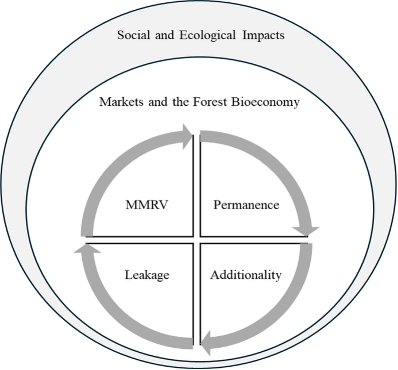
Learning Exchange Series discussions highlighted a number of emerging priorities to support the integrity of forest carbon projects. Moreover, they illustrated how project standards, forest land conditions, people, and markets are intertwined when generating forest carbon credits. Authors identified three focal areas where future research and collaboration would help to increase the integrity of forest carbon credits. These areas are: carbon science and methodological research priorities; policy research priorities; and forest management research priorities.
For full findings, see the paper available here.