High nitrogen prices spawn interest in fertigation
 Print
Print Email
EmailIrrigation offers producers mid-season options for nitrogen application.
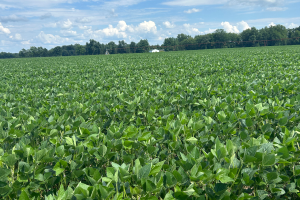
High nitrogen (N) fertilizer prices have many producers looking to change their nitrogen management program. Moving a portion of your planned N application into late June or even early July offers a lower risk of N loss to heavy rains and the opportunity to take advantage of any price reduction that may happen through May and June. Typically, local fertilizer dealers will discount their liquid nitrogen in late June and early July to reduce carryover supplies into the next season.
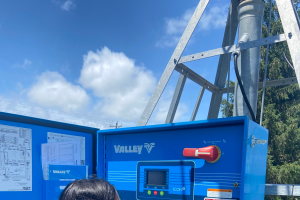
Irrigated production has the advantage of fertigation as an option in nitrogen management. Fertigation is the process of applying fertilizer through irrigation water. Liquid 28% nitrogen is the most common product for fertigation, but urea and micro-nutrient solutions are also available to meet crop nutrient needs, with proper equipment.
Fertigation is often the last step in a three split nitrogen management plan, following starter and side dress applications. Starter allows quick access to nutrients to the newly germinated plants. Side dress applications usually account for the greatest portion of N budget, feeding the plant just prior to the rapid growth phase. Depending upon the equipment used, side-dressing can also aerate soil and improve water infiltration. Fertigation makes up the remainder of the budget supplying nitrogen to the crop just prior to tassel emergence. For efficient use, nitrogen applications need to be made prior to tasseling to ensure that the nitrogen applied is in an available form for the plant to uptake and use during early grain formation.
From a management standpoint, fertigation allows producers the opportunity to evaluate crop stands, calculate N losses due to wet conditions or heavy rains, and account for the current market situation. This gives producers more control of their nitrogen plan since they have a longer application window, allowing them to meet the crops’ needs and maximize profitability.
As an example, let’s say a producer has a 270-bushel yield goal on an irrigated field that calls for 230 pounds of nitrogen in their plan. At planting, they apply 30 pounds of nitrogen, followed by 120 pounds applied at cultivation in early June. This leaves a nitrogen need of 80 pounds. The producer decides to apply the remaining 80 pounds split into two 40-pound applications through the irrigation. We get about 3.1 pounds of actual nitrogen for each gallon of 28% N applied. The producer calculates that they need to apply just short of 13 gallons per acre. Knowing that their system irrigates 2 acres per hour at a given setting, the producer calculates that they need to inject 26 gallons of the fertilizer per hour.
Knowing the actual amount of fertilizer the equipment will inject is essential. It is also important to know that the system applies water uniformly across the field. Center pivot systems of good design and repair will have uniformity co-efficient of greater than 85%. Many systems have uniformity co-efficient in the 70 to 75% range allowing the misapplication of a quarter of the water and fertilizer going through them. See more on testing and improving center pivot uniformity in the Michigan State University Extension article, “The Importance of checking irrigation system uniformity.”
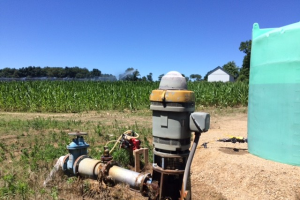
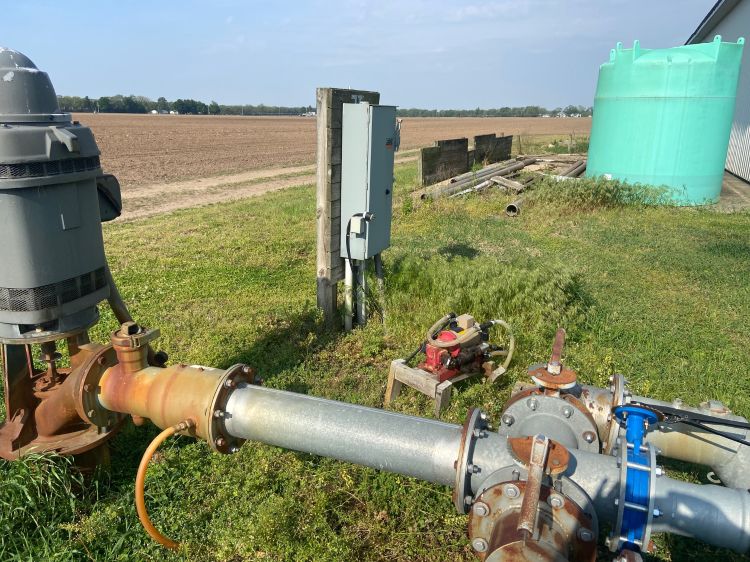
The inherent risk of injecting fertilizer into a water system dictates the need for backflow protection. Indiana and Michigan have resource protection rules that require using chemigation valves for protecting both surface and ground water sources. Chemigation valves create an air gap in the pipeline downstream from the pump when the pump is shut down. The air gap breaks the suction created by water and allows it to retreat to groundwater or surface water. Chemigation valves for most irrigation applications are available from local irrigation dealers for less than $700. Installation cost is much less at the time of pump installation and should be included in almost all new irrigation pumping installations.
The placement of pumps, the chemigation backflow valve, and fertilizer storage at the pump site allows the same equipment to service multiple distribution systems but increases the risk of well contamination from fertilizer/chemical storage near the site. Minimizing storage risk near the pump site can be accomplished by using temporary tanks or not delivering the fertilizer to the site until irrigation begins and removing any leftover fertilizer/chemicals at the end of the process.
In some situations, producers may choose to dribble or broadcast nitrogen on the field by air or tractor and use the irrigation to incorporate the nitrogen if dry weather follows. This technique is quick, requiring no irrigation equipment modification, but is dependent on the availability of aerial applicators or in-row high clearance application equipment.
Detailed information on injection pumps, backflow protection, safety interlocks and procedures for calibrating an injection system is available in bulletin E-2099 Using Chemigation Safely and Effectively from Michigan State University.