Extreme cold event advisory: Field observations and bud hardiness status in northwest Michigan vineyards
 Print
Print Email
EmailA midwinter update on bud cold hardiness, freeze injury risk by variety, and emerging prediction tools for northwest Michigan vineyards.
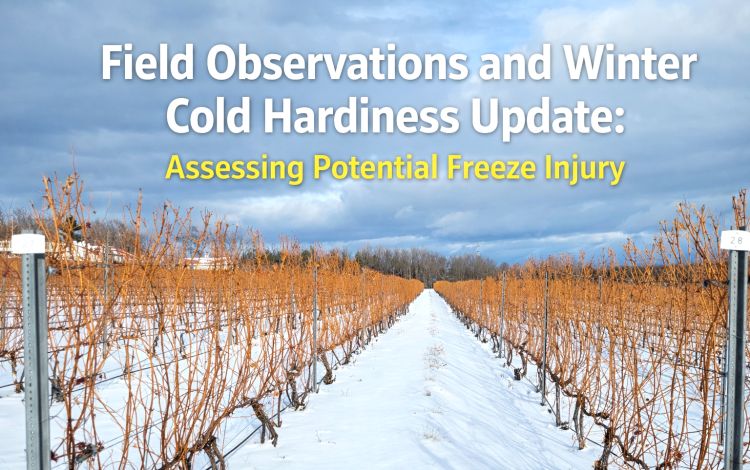
Winter cold remains one of the most important limiting factors for grape production in northwest Michigan. Grapevines in this region need to withstand prolonged freezing conditions each year. The ability of vines to survive low midwinter temperatures often determines vineyard productivity and long-term vine health.
Cold hardiness is commonly evaluated using the lethal temperature 50% (LT50), which represents the temperature at which 50% of primary buds are killed. The lower (more negative) the LT50 value, the greater the vine’s tolerance to freezing conditions. Monitoring LT50 values throughout the dormant season provides growers with valuable insight into freeze risk and supports management decisions post-event injury assessment and pruning strategy. In particular, a two-pass/double pruning (rough pruning in winter followed by final pruning after the last highest freeze-risk period), pruning later (delayed pruning) in higher-risk blocks (site-specific scheduling), and leaving extra nodes or longer canes early, then adjusting after injury assessment.
This midwinter update provides an overview of grapevine dormancy physiology, the major factors influencing cold hardiness, current field observations from this extreme cold event, and emerging prediction tools that may assist growers in managing winter injury risk.
Winter grapevine physiology and dormancy
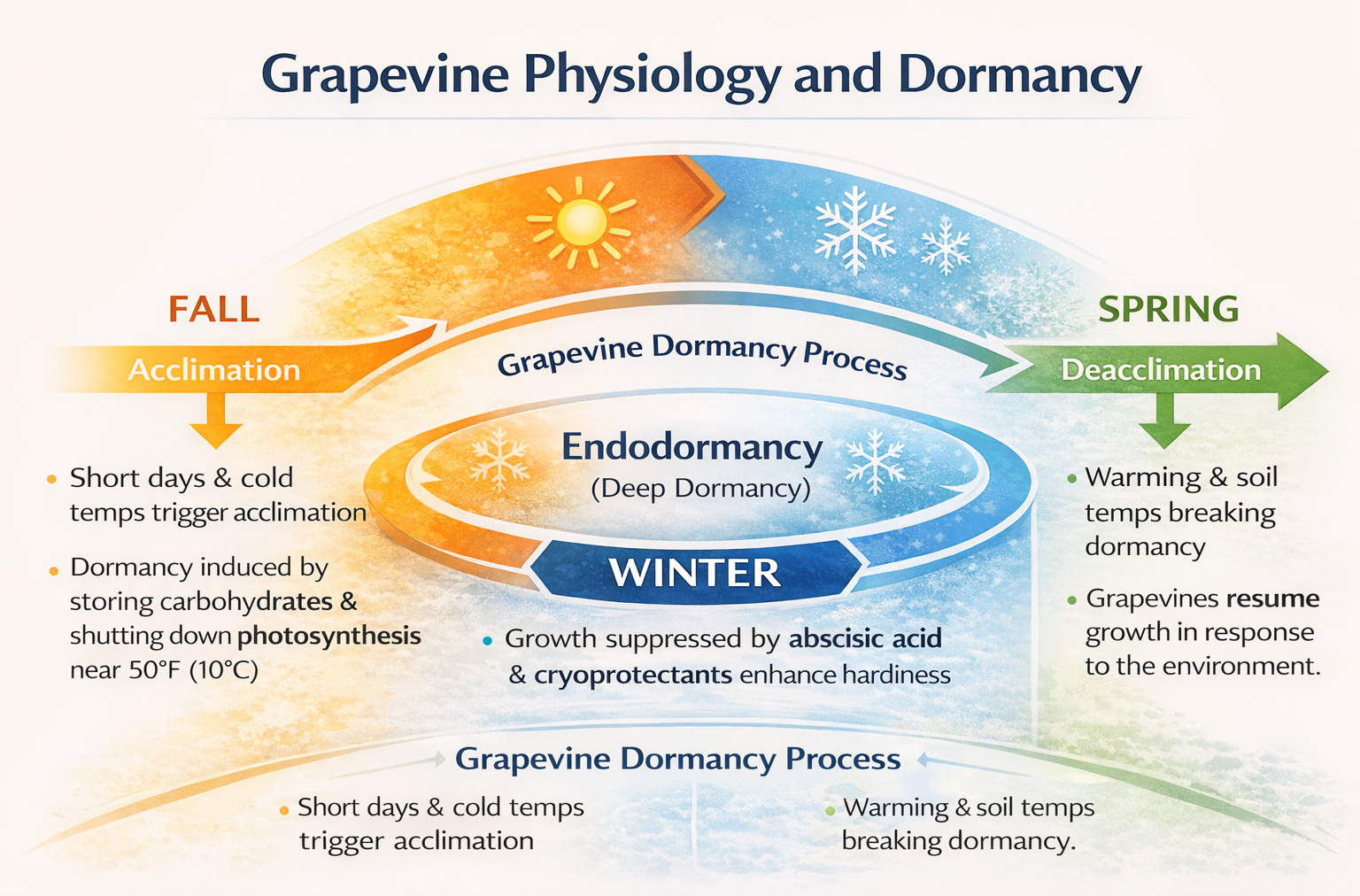
As grapevines transition into dormancy during fall, shortening day length and declining temperatures trigger a coordinated series of physiological adjustments that allow vines to survive freezing conditions. Active shoot growth ceases, grapevine and meristematic metabolic activity slows, and photosynthesis shuts down near 10 degrees Celsius (50 degrees Fahrenheit). During this period, carbohydrates and nutrients produced during the growing season are relocated from leaves to trunks, cordons and roots from and stored as starch. These reserves are critical not only for spring growth but also for winter survival. Periderm (cane) maturation is also occurring while the most important change is changes in bud physiology (endodormancy induction) for increased freeze tolerance via cold acclimation mechanisms (Figure 1).
Dormant buds undergo cold acclimation. Bud tissues dehydrate, and vines accumulate cryoprotective compounds such as soluble sugars that improve freezing tolerance. Maximum cold hardiness is typically reached between late December and January, when vines are in deep endodormancy. During this stage, bud growth is internally suppressed by hormonal regulation, and buds are generally less responsive to short-term temperature fluctuations.
However, cold hardiness is very dynamic. As winter progresses and chilling requirements are met, vines transition into ecodormancy and become increasingly sensitive to environmental cues. Midwinter warm spells when chilling hours are satisfied for grapevines can initiate the bud deacclimation processes, resulting in a rapid decline in hardiness even before visible bud growth occurs. If warm periods are followed by sharp freezes, partially deacclimated buds become substantially more vulnerable to injury. For this reason, the timing and rate of temperature change are often just as important as the minimum temperature itself.
Factors influencing cold injury and hardiness levels
Multiple interacting factors determine how well grapevines tolerate winter stress in a given year. Temperature variability remains one of the most significant drivers. Gradual cooling supports acclimation, whereas sudden warm-cold swings can increase injury risk by reducing bud hardiness prematurely.
Rapid temperature drops can also cause direct physical injury, including trunk splitting. These cracks not only damage conductive tissues but may also create entry points for pathogens such as crown gall. In addition, the duration of extreme cold events plays an important role. Longer exposures to very low temperatures can lead to cumulative damage, especially in vines weakened by stress.
Vine health entering dormancy strongly influences winter survival. Vines that experienced late-season disease pressure, nutrient deficiencies, drought stress, excessive crop load, severe under-cropping or virus infections often enter winter with reduced carbohydrate reserves and diminished cold tolerance. Balanced vines with well-matured canes and adequate reserves consistently show improved winter resilience.
Cold hardiness is also highly cultivar dependent. Vinifera cultivars differ widely in midwinter tolerance, and variety selection remains one of the most important long-term strategies for reducing winter injury risk in colder sites.
Finally, site and microclimate effects are critical in northwest Michigan. Low-lying areas where cold air settles often experience deeper freezes, while proximity to Lake Michigan can moderate winter extremes, an effect that becomes especially important during midwinter cold snaps.
Field observation summary: Pre–cold snap LT50 hardiness and variety risk assessment (Old Mission Peninsula, Jan. 21)
Northwest Michigan recently experienced a significant cold snap, with air temperatures dropping to around -2 F (-19 C) and overnight lows near 0–2 F (-18 to -17 C).
To assess potential freeze injury risk, researchers with Michigan State University Extension collected field-based LT50 cold hardiness measurements in the Old Mission Peninsula on Jan. 21, 2026, immediately prior to the cold snap. LT50 values estimate the temperature at which about 50% of primary buds are expected to be injured, and they are a practical way to compare cold hardiness across varieties at a given time (Table 1).
Table 1 summarizes these pre-event LT50 measurements and translates them into a risk level for the cold snap based on how close each variety’s LT50 was to the expected minimum air temperatures (injury threshold near -21 C/-6 F). Varieties with a larger safety margin are listed as low risk, while those with minimal buffer are categorized as high risk.
Table 1. Field-based LT50 cold hardiness observations and freeze injury risk assessment following the Jan. 21 cold snap (Old Mission Peninsula, MI).
|
Variety |
LT50 (C) |
LT50 (F) |
Risk Level |
Status |
|---|---|---|---|---|
|
Merlot |
–24.5 |
–12.1 |
Low |
Excellent buffer |
|
Gamay |
–24.2 |
–11.6 |
Low |
Well acclimated |
|
Riesling |
–24.1 |
–11.4 |
Low |
Strong hardiness |
|
Teroldego |
–24.0 |
–11.2 |
Low |
Very safe |
|
Pinot Gris |
–23.9 |
–11.0 |
Low–Moderate |
Monitor recommended |
|
Gewürztraminer |
–23.0 |
–9.4 |
Moderate |
Buffer narrowing |
|
Chardonnay |
–22.9 |
–9.2 |
Moderate |
Typical midwinter hardiness |
|
Cabernet Franc |
–22.6 |
–8.7 |
Moderate |
<2 C buffer |
|
Pinot Blanc |
–22.6 |
–8.7 |
Moderate |
<2 C buffer |
|
Refosco |
–22.3 |
–8.1 |
High |
Very close to ambient temps |
|
Pinot Noir |
–21.9 |
–7.4 |
High |
Highest risk, <1 C buffer |
Management considerations following this event
It is important to note that LT50 values reflect the basal five buds. Distal buds on long canes are often less mature and more vulnerable, meaning tip bud mortality may be higher than these values suggest.
Growers are strongly encouraged to delay pruning until after temperatures stabilize. Once the cold snap passes, bud dissections should be conducted in higher-risk blocks, particularly Pinot Noir and Refosco, to assess primary bud survival. If damage levels exceed 20–30%, pruning strategies can be adjusted by retaining additional buds to compensate for potential crop loss.
MGFT model predictions (emerging tool)
In addition to laboratory-based Differential Thermal Analysis (DTA) measurements, Michigan State University (MSU) is developing the Michigan Grapevine Freezing Tolerance (MGFT) model, a Michigan-specific prediction tool designed to estimate bud hardiness in real time using weather data and variety-specific algorithms (Table 2).
As this model becomes integrated into MSU Enviroweather, it will provide growers with an additional decision-support resource to compare predicted LT50 trends with measured field values. Model predictions will complement lab testing and help growers anticipate periods when vine hardiness may approach dangerous thresholds.
Table 2. MGFT-based cold hardiness assessment: Current LT50 and Feb. 1 predictions.
|
Variety |
Model’s Current Cold Hardiness (LT50, C/F) |
Feb 1 LT50 Prediction (C/F) |
|---|---|---|
|
Gewürztraminer |
-12.3 F (-24.6 C) |
-13 F (-25 C) |
|
Pinot Blanc |
-13.9 F (-25.5 C) |
-14.8 F (-26 C) |
|
Merlot |
-12.6 F (-24.8 C) |
-12.5 F (-24.7 C) |
|
Pinot Gris |
-12.8 F (-24.9 C) |
-13.9 F (-25.5 C) |
|
Riesling |
-13.9 F (-25.5 C) |
-14.3 F (-25.7 C) |
|
Chardonnay |
-14.3 F (-25.7 C) |
-14.3 F (-26.1 C) |
|
Pinot Noir |
-13.2 F (-25.1 C) |
-14.1 F (-25.6 C) |
|
Cabernet Franc |
-12.1 F (-24.5 C) |
-12.3 F (-24.5 C) |
Lake Michigan ice coverage: A growing concern
An additional factor to watch closely this winter is the development of ice coverage on Lake Michigan. Under typical conditions, the lake plays a major moderating role in northwest Michigan’s winter climate. Because open water retains heat and releases it gradually into the surrounding air, Lake Michigan often reduces the severity of extreme cold events along the lakeshore and helps buffer vineyard sites from the coldest inland temperatures.
However, this protective lake effect can weaken substantially once ice begins forming on the lake surface. Even a relatively thin layer of ice acts as an insulating barrier, limiting heat exchange between the water and the atmosphere. As ice coverage expands, the lake’s ability to release stored warmth declines, and nearby vineyard regions may lose an important source of midwinter temperature moderation.
This becomes particularly important during late winter, when grapevine cold hardiness is no longer increasing and may begin to decline due to deacclimation. If vines experience a midwinter warm spell followed by another sharp Arctic outbreak, especially under conditions of increased lake ice, future cold snaps may become more severe, less moderated and potentially more damaging than expected.
In years when ice coverage persists or expands, growers may face heightened vulnerability even in traditionally protected lakeshore sites. For this reason, monitoring not only air temperature forecasts but also lake ice development will remain an important part of assessing freeze risk in the coming weeks. Continued vigilance is warranted, particularly if additional extreme cold events occur later this winter when vine hardiness margins may be narrower.
Midwinter is typically the period when grapevines in Michigan reach their maximum level of cold hardiness, and most varieties in northwest Michigan remain near their seasonal peak as this extreme cold event unfolds. Fortunately, many cultivars currently maintain a reasonable safety margin; however, varieties with narrower buffers, particularly Pinot Noir and Refosco, may face an elevated risk of primary bud injury if temperatures decline further or if cold conditions persist.
Growers are encouraged to delay pruning until after vine damage can be evaluated. Following this cold window, bud survival assessments will be essential, especially in higher-risk blocks, to determine the extent of injury and guide any necessary adjustments in pruning strategy. Combining field observations with LT50 testing and emerging decision-support tools such as the MGFT model offers the most effective approach for minimizing winter injury and protecting crop potential.