Five lamprey species are found in the Great Lakes – only one is invasive
 Print
Print Email
EmailNew poster offers detailed comparison of these ancient jawless fish.
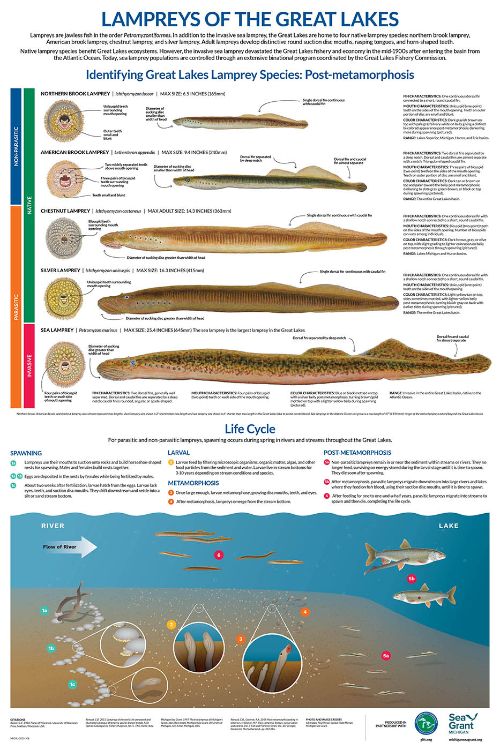
The Great Lakes are home to a fascinating array of aquatic life, and among the most ancient and misunderstood are the lampreys — jawless fish that have survived for hundreds of millions of years. While the invasive sea lamprey often steals the spotlight due to its impact on native fish populations, it’s just one of five distinct lamprey species found in the Great Lakes region – and one of about 40 species worldwide! Each plays a unique role in the ecosystem, and thanks to educational tools, learning about these species has never been easier — or more visually engaging!
Michigan Sea Grant and the Great Lakes Fishery Commission have teamed up to provide a new lamprey educational product. The “Lampreys of the Great Lakes” poster brings lamprey biodiversity to life with stunning illustrations and detailed comparisons. The poster is divided into two key sections:
- Identifying Great Lakes lamprey species (post-metamorphosis): Features full-body and oral disc illustrations of each species — northern brook lamprey, American brook lamprey, chestnut lamprey, silver lamprey, and sea lamprey — along with key traits for identification.
- Life cycle: Visually traces development from larvae to spawning adult, emphasizing their habitat transitions and ecological functions while offering insight into their reproductive strategies.
The new poster, available at the Michigan Sea Grant website, is designed to support biodiversity education and help audiences distinguish between native lamprey species (both parasitic and non-parasitic) and the invasive parasitic sea lamprey. Understanding these differences is crucial for appreciating the ecological balance of the Great Lakes and supporting conservation efforts. Native Great Lakes lampreys serve a beneficial role in the ecosystem, just as the invasive sea lamprey does in its native environment of the Atlantic Ocean.
Why biodiversity matters
Both parasitic and non-parasitic native Great Lakes lampreys are a natural and important part of the diverse Great Lakes ecosystem. They serve as indicators of healthy water systems and contribute to nutrient cycling. Despite being parasitic during part of their life cycle, silver and chestnut lampreys rarely cause life-threatening damage to host fish due to their smaller size and years of co-evolution with Great Lakes fish – a very different story than that of the invasive sea lamprey. Promoting awareness of these native species helps shift the narrative from one of pest control to one of ecological appreciation.
Lamprey-focused education and outreach resources continue to explore the life history of the invasive sea lamprey whose introduction has significantly changed the Great Lakes fisheries as we know them today while also celebrating the rich biodiversity of our freshwater ecosystems.
Explore, learn, and share
Whether you're an educator looking for classroom materials, a fisheries professional, or simply a Great Lakes enthusiast, here are some additional tools from the Great Lakes Fishery Commission offering ways to engage with the underwater world.
- “Lampreys of the Great Lakes” fact sheet offers a concise overview of the five lamprey species, highlighting their life cycles, ecological roles, and identifying features. It’s a perfect resource for educators, students, and curious naturalists.
- “Lampreys: Friend or Foe?” Let’s look at the facts. That toothy mouth may look troubling, but most lampreys are not harmful. Help protect lampreys in their native ranges and control non-native sea lamprey in the Great Lakes basin and Lake Champlain by sharing what you learn.
- “Sea Lamprey: The Battle Continues to Protect Our Great Lakes Fishery.” Understanding the sea lamprey’s life cycle helps scientists deliver an effective control program.
- “The Fish Thief: A Great Lakes Mystery.” An award-winning documentary takes a journey through time to highlight the herculean effort to find the cause of one of the most significant ecological crises in the history of the Great Lakes.
Michigan Sea Grant is committed to research, education, and outreach through partnerships with people and organizations to foster healthy Great Lakes coastal ecosystems, communities, and economies. A collaborative effort of the University of Michigan and Michigan State University and its MSU Extension, Michigan Sea Grant is part of the NOAA-National Sea Grant network of 34 university-based programs.
The Great Lakes Fishery Commission is an international organization established by the United States and Canada through the 1954 Convention on Great Lakes Fisheries. The commission has the responsibility to support fisheries research, control the invasive sea lamprey in the Great Lakes, and facilitate implementation of A Joint Strategic Plan for Management of Great Lakes Fisheries, a provincial, state, and Tribal fisheries management agreement.
This article was prepared by Michigan Sea Grant under award NA24OARX417C0157-T1-01 from the National Oceanic and Atmospheric Administration, U.S. Department of Commerce through the Regents of the University of Michigan. The statement, findings, conclusions, and recommendations are those of the author(s) and do not necessarily reflect the views of the National Oceanic and Atmospheric Administration, the Department of Commerce, or the Regents of the University of Michigan.