From Van Life to Forest Life
 Print
Print Email
EmailForestry undergraduate student Christin Toney took to the woods of Michigan during a time where the world was filled with uncertainty.
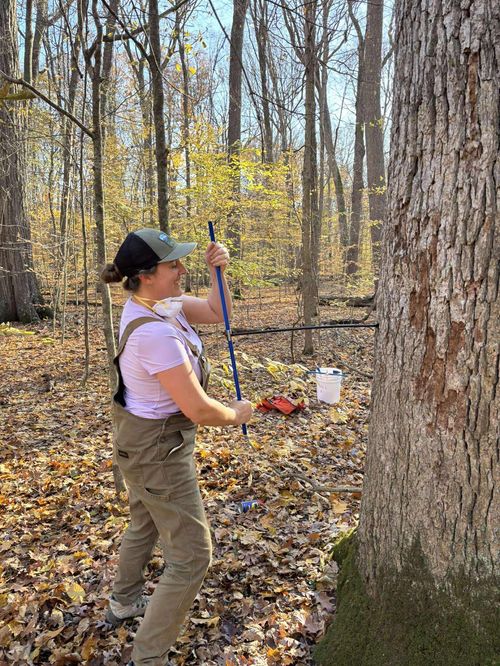
Forestry undergraduate student Christin Toney took to the woods of Michigan during a time where the world was filled with uncertainty. In 2020, she had been touring the country for 10 years in her van, selling minerals at music festivals and trade shows. When the Covid-19 pandemic shut down these events, she decided to hunker down in Michigan. This is when she realized that her true passion was not found out on the road, but instead, in the woods. She decided to shift her career away from sales and instead poured her focus into forestry, with dendrochronology, ecology, and GIS being her main interests.
Within two weeks of beginning the forestry program, Christin was hired onto Professor David Rothstein’s team, assisting him and graduate student Joe Young with various research projects. "I’m glad Dr. Rothstein put his trust and faith in me to do this work. It is an absolute delight working with David. Not only is he an amazing person, he’s a great person to have in my corner. Both him and Joe are encyclopedias of knowledge, and they both have given their extra time to share some of that knowledge with me. I couldn’t ask for a better outcome, coming to MSU and jumping right into this team," said Christin.
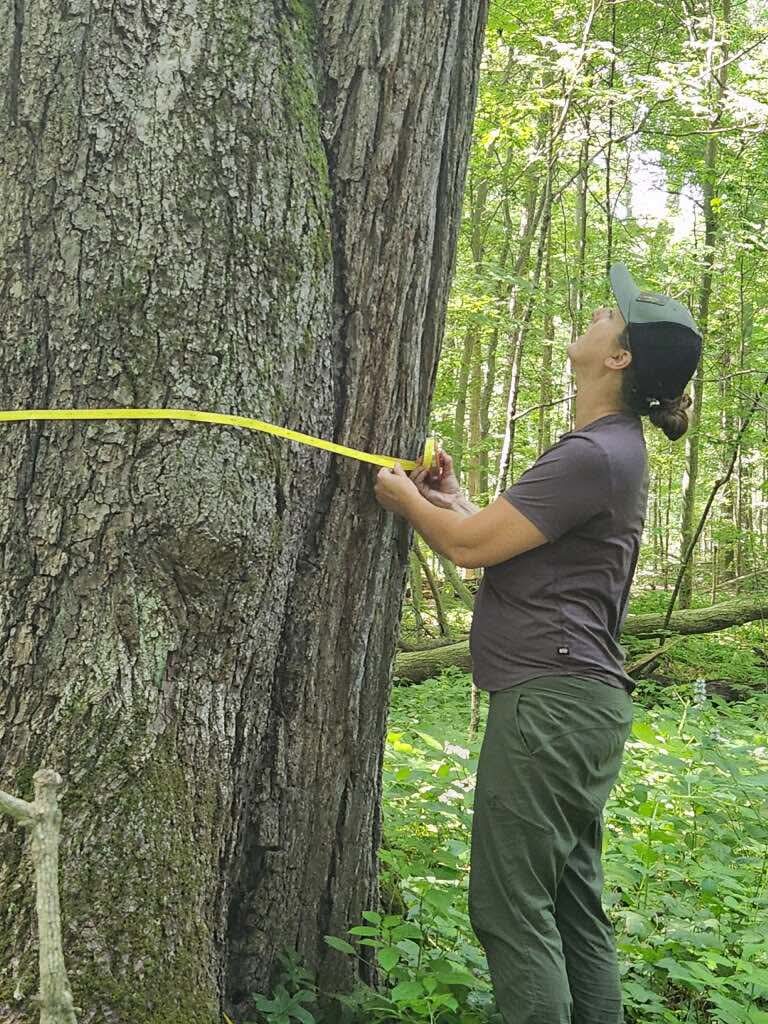 During the summer of 2025, David presented a special opportunity for Christin to take on her own research project at Newton Woods of MSU’s Fred Russ Experimental Forest in Decatur, MI. Christin felt as if this was the perfect project for her, as it gave her the opportunity to expand her knowledge and field experience using dendrochronology, forest measurements, GIS, and field ecology as tools to better understand Newton Woods as a whole. "When I took on the Newton Woods project, I was incredibly excited because it gave me the opportunity to leave a legacy behind in a place that means so much to me. I grew up in Southwest Michigan, have spent countless hours hiking and foraging in Berrien and Cass counties, and most of my family lives here. I fell in love with the forest here, so it feels deeply personal for me to be able to do research here and contribute something more to this community," said Christin.
Until 2024, Newton Woods was dominated by large white oaks, including one that they were able to use dendrochronological analysis on to determine that it had established in 1716, making it over 300 years old. Unfortunately in 2024, over 95% of the large white oaks perished for some unknown reason. One of MSU’s forest pathologists, Pratima Devkota, suspected it was due to Armillaria fungus, but when her, David, and Christin went to Newton Woods to investigate this prediction, they weren’t able to find conclusive evidence.
The white oaks that perished were salvaged, and samples were taken from the stumps, where they were processed in the forestry woodshop to determine their age and growing conditions. Additionally, standing dead white oaks, wind thrown maples and black oaks, and living red and white oaks were cored. The dendrochronological data, coupled with historical records of the Indigenous peoples of the area, and of the Newton family, as well as soil and ground flora data were used to more clearly understand the history of Newton Woods.
Finally, they searched for physical evidence of that history by looking for fire scars in old trees. While they haven’t found definitive fire scar evidence yet, the abundance of mature white oaks strongly suggests the landscape was influenced by Indigenous stewardship.
Across Michigan, many oak forests historically existed as oak savannas, and were actively managed and shaped by Indigenous peoples using repetitive burning, sometimes on a yearly basis. Oaks are fire adaptive species because of their thick, fire resistant bark. Additionally, fire reduced competition from shade tolerant species and exposed mineral soil for successful acorn germination, and reduced forest floor litter, making it ideal habitat for deer and other species. That Newton Woods was once dominated by white oaks, as well as historical field observations taken by general land office surveyors, suggests that it was once oak savanna. 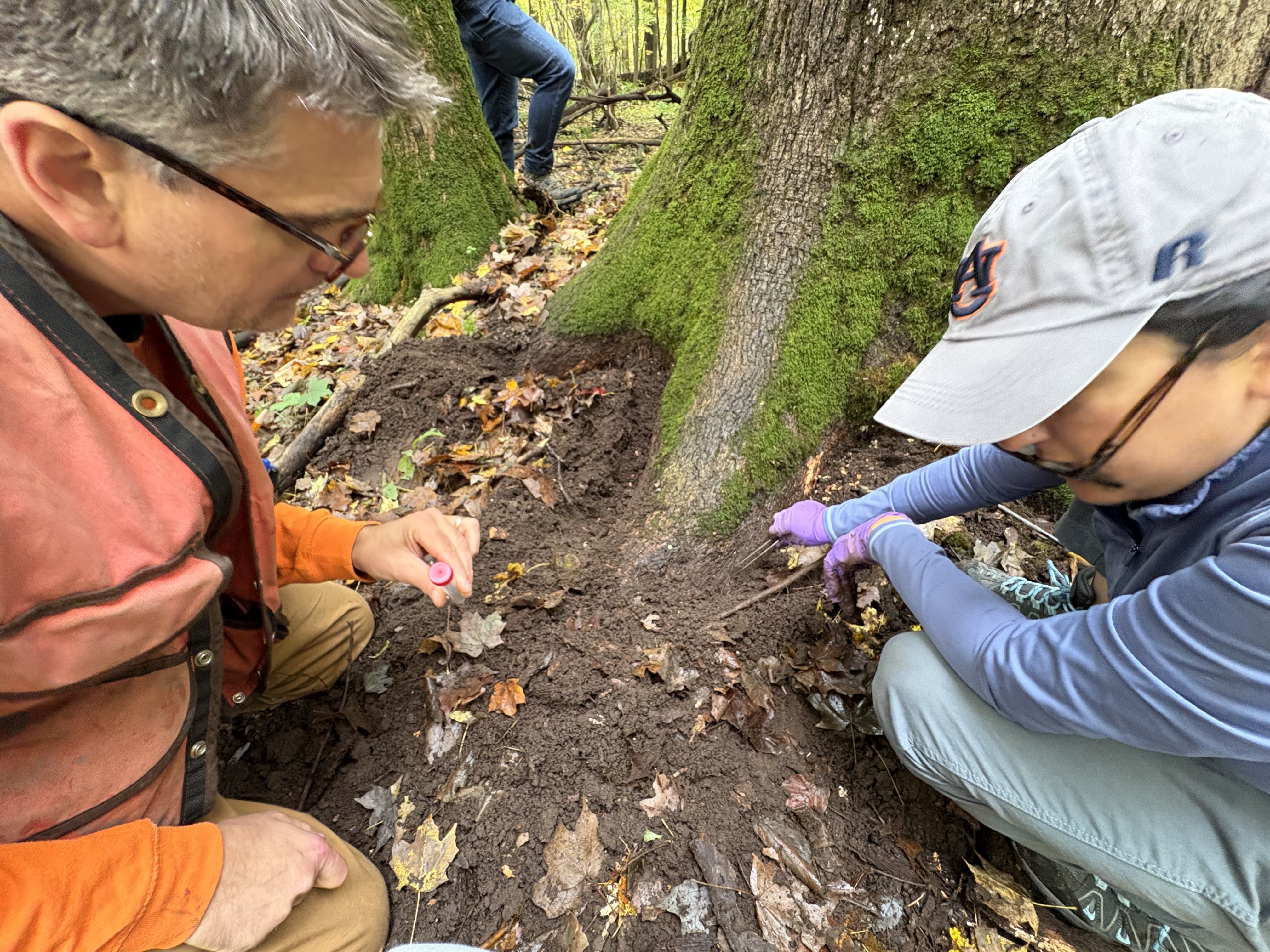
What also points towards this landscape being oak savanna are historical documents that Christin and team found that told the story of Chief Weesaw. Weesaw and his band inhabited land just north of Newton Woods, and included villages, gardens, ceremonial and burial grounds. Additionally, there was a foot travel path that went along the Dowagiac River through Newton Woods. Chief Weesaw used the area just west of Newton Woods for sugar maple production, and Christin’s team suspects he managed Newton Woods as oak savanna so that it could be used for hunting.
"One of the biggest takeaways from the project is that Newton Woods tells a much richer history than simply being an ‘old-growth’ forest. Currently, it is registered as a National Landmark and ‘one of Michigan’s last remaining old growth forests’. To be old growth, the forest would have had to have been untouched by people, but our research shows the landscape has experienced centuries of human interaction – from Indigenous stewardship and resource management to later settlement, harvesting, and land use. Rather than diminishing its significance, understanding that history paints a much deeper, more meaningful, and more real picture of Newton Woods," said Christin.
Christin hopes to publish her research findings, install interpretive signage, and create a story map for Newton Woods, so that the broader community may have access to this information. Additionally, she hopes that this project will inspire others to do similar research moving forward. "I hope this work helps people appreciate the incredible ecological and cultural history of Newton Woods, and allows them to think about forests in a different way when entering them."