Grafting lambs: An opportunity to increase flock productivity
 Print
Print Email
EmailThis article discusses how to successfully graft lambs unto another ewe.
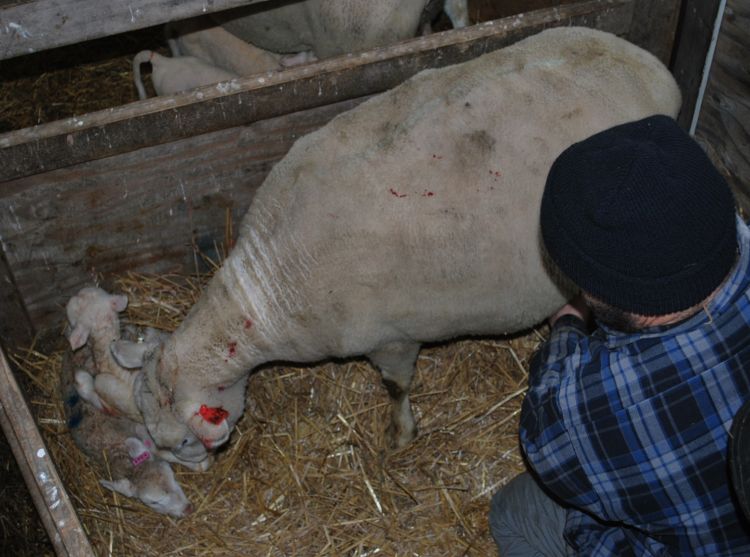
Grafting is the process of fostering a lamb onto an ewe other than its biological mother after assessing milk/colostrum production in ewes and matching lambs to supply. Grafting lambs is an effective means of efficiently raising “extra” or “bonus” lambs and maximizing flock productivity. It is also a vastly underutilized technique for many reasons. One is simply a lack of know-how. Another is a lack of milk/colostrum in ewes due to chronic disease, such as ovine progressive pneumonia (OPP) and/or because of undernutrition. In addition, the opportunities for matching graftee lambs to surrogate ewes can be few and far between unless the birth period is concentrated. In well-managed flocks that are free of OPP, it is possible to eliminate artificial rearing by grafting and still produce a 200% weaned lamb crop. The concept is simple, but executing this matching process is an acquired skill. Critical aspects to focus on are assessing milk supply, lamb demand, lamb vigor and maternal bond.
Predicting milk yield
Future milk yield can be estimated by colostrum yield at birth. This can often be approximated by palpating an udder, but it is best to milk a potential surrogate udder at least partially to estimate yield. This must be done quickly after birth, so it may be better to guess rather than obtain an accurate assessment, as bonding success is time-dependent. A crude estimate is that 120 cc (approximately 1/2 cup) of colostrum at each milking will support an average-sized lamb (10 lbs.). Milk production, especially in early lactation, is a function of litter size. The underlying explanation for this phenomenon is that the total placental mass of larger litters will always be greater than smaller litters. And it is the mass of the placenta that determines mammary development in late gestation. The placenta produces hormones that support mammary growth; hence the larger the placental mass, the greater the extent of mammary growth. This is, in effect, Mother Nature’s way of matching maternal milk production to litter size, so use this information when predicting milk yield. For example, a ewe carrying triplets that had two large lambs die at birth and one large live lamb will likely have abundant milk to spare and may well be able to support two graftees.
Assessing lamb milk demand
Lamb milk demand is assessed by lamb size. A large lamb will have proportionally higher nutritional demands than a small lamb. For example, in my own flock, a small Romanov or Florida native-sired lamb will have lower nutrient needs than a large Dorset or Ile de France lamb. Lambs can be fostered onto ewes of a different breed, but lamb size needs to be matched to milk supply.
Lamb vigor and its assessment
Lamb vigor can be quite variable. Try to match vigor when possible within a litter. Lamb vigor is highly related to lamb temperature, and chilled lambs quickly loose vigor and become lethargic. Vigor will usually improve by feeding and warming lambs and often increases as the lamb recovers from the birth process. Grafting will not work if the graftee lacks suckling drive, so it is necessary to warm and feed a weak lamb to increase its vigor before attempting to graft the lamb on a surrogate. Placing a lethargic, chilled lamb and a vigorous, strong lamb together will never work, as the mother will only take an active interest in the active lamb and will commonly ignore the lethargic lamb. If your only opportunity is to graft into an established litter, you should choose an especially vigorous lamb with a strong suckling drive.
Assessing and enhancing the maternal bond
Maternal bond strength is a function of time after birth. You can usually mix/match entire litters within 10 minutes of birth. Bonding becomes established in as little as 10 minutes, but this timing is not precise and can be elastic, extending up to an hour or longer in some cases. After establishment, bonding is very difficult to disrupt. However, ewes vary greatly in their receptivity; some may be receptive for two hours following birth, while others learn the number and smell of their lambs very quickly (10 minutes or less).
If bonding is constantly being disrupted by several ewes lambing together at the same time and lambs and moms constantly mixing, the receptive period will be longer. If an ewe lambs in isolation, bonding will establish quickly. A receptive ewe will quickly lick the new lambs. Bonding can be enhanced by milking the ewe, which stimulates the release of oxytocin, a hormone that strengthens maternal bonding. The colostrum can also be used as a bonding agent, as ewes will recognize the smell of their own colostrum. Ewes will also recognize the smell of their fetal fluids (amniotic and allantoic fluid) from their own offspring, so rubbing a graftee with the newborn and fetal fluids of a surrogate mom will help her bond to it.
Ewe restraint techniques to prevent lamb rejection
In cases where ewe receptivity is weak, providing some degree of ewe restraint can allow for a successful bond. These techniques can be applied to grafting or any time bonding is weak, which can occur any time a lamb becomes separated from its mom during the first few hours following birth. Securing an ewe with a halter and enough lead to prevent her from turning around can often be enough to encourage bonding. It is imperative to use a halter with no risk of choking, along with use of a lead that can be tied to the top rail of a lambing pen panel. The lead should be tied to the top rail near the water source. The concept is to provide enough lead to allow drinking and feeding, but not enough to allow the ewe to butt lambs or run in circles in the pen. The amount of lead may need to be decreased in cases when the ewe is showing more intense rejection behavior. The lead can then be lengthened as rejection behavior subsides and should be removed a few hours after it is clear that all lambs are able to nurse successfully. The time needed to accomplish this may be as short as two hours or as long as two days.
As discussed below, lambs may need to be supported nutritionally during this period by tube feeding to maintain suckling drive. In cases in which rejection behavior is strong, watch for opportunities to graft onto a new, more receptive surrogate. Also, if the period is long, it may be prudent to consider use of an ewe stanchion. These devices can be placed within a lamb pen or can be used to replace a panel of a lambing pen. This author rarely finds them necessary, but others report success using stanchions. Michigan State University Extension recommends reserving their use for situations when rejection behavior is more intense (when a halter is needed for more than 24 hours). Finally, it is wise to keep grafted lambs in the lambing pen at least 24 hours after lead removal to continue to provide the tight quarters necessary to ensure and strengthen bonding.
Grafting process
When creating a new litter, the process starts when an ewe or several ewes give birth. You quickly assess how many lambs are born, how much milk is present and then quickly mix/match lambs from the other litters, or bring in graftees that you have been holding in anticipation of a matching opportunity. I take foreign lambs and rub them with the ewe’s own lambs (dead or alive lambs) or apply afterbirth. Another biological fluid that works wonders to stimulate bonding is colostrum from the surrogate ewe. The concept here is to try to make all of the litter smell the same, so apply bonding fluids to all of the litter you are introducing to a surrogate ewe. Colostrum is often a precious fluid, so use it sparingly (perhaps 20 mL to drip on a lamb’s head and back). If the surrogate ewe has given birth within 30 minutes of the grafting process, these techniques work well. But if the surrogate lambed more than 30 minutes ago or even up to two hours, it is possible to trick an ewe into thinking that she has given birth again, thus making it easier to introduce a graftee. Birth can be simulated simply by performing a vaginal exam using an OB glove. Do not attempt this much beyond a two-hour period post-birth because the cervix will have closed and the vagina will have lost its elasticity.
Grafting into an established litter is less successful than when creating a new litter near the time of birth. There are times when this might be the only option, however, and it is worth attempting if the graftee has a strong sucking drive. An example might be when an ewe has triplets when no other ewes have lambed within several hours, only half of the ewe’s udder is functional, and all the lambs are very strong and vigorous. Let’s assume you have two or three ewes that had single lambs within 12-16 hours earlier. If two of the ewes have lots of milk, then graft the two stronger triplets onto those ewes. Put a secure halter on the recipient ewes (see restraint section above for details), milk them, tube the graftee with the surrogate ewe’s milk and apply some of the milk to it. It helps to feed the ewe at this time to distract her.
Ewes will vary in how much they protest the new lamb. Some ewes will accept the new lamb within six hours, others may take 48 hours. You may need to support the lamb by stomach tube feeding during this period or hold the ewe temporarily to allow suckling. Bonding success is indicated by successful feeding, which in turn, is evident by monitoring gut fill of the lamb. It is easy to tell if a lamb has fed successfully, as it will have a distended belly full of milk. A newborn lamb requires 10% of its weight in colostrum over a 24-hour period, but never give more than an eight-hour dose at one time.
Stomach tube feeding may seem daunting at first, but it is a simple procedure. The first thing to be certain of is that the lamb is fully warm (above 102.5 degrees Fahrenheit). Cold lambs will not have a normal swallow/suckle reflex, and it is possible to place the tube into the trachea instead of the esophagus under these conditions, which can be fatal if milk enters the lungs. This risk is virtually eliminated if the lamb is warm and the tube is applied slowly yet firmly to the back of the mouth, allowing the lamb to effectively swallow the tip of the tube.
If a bonding situation is not working, it is common for another opportunity to come up during the process, and you can move to the new opportunity. Perhaps an ewe just lambed with one stillborn lamb. It is quite possible that the new ewe may accept the older lamb after smearing the lamb with uterine fluids and colostrum. I have had success placing the graftee under the older living lamb of the surrogate ewe to hold it down momentarily while I remove the stillborn lamb. It is not uncommon for this trick to work, as the ewe comes over and licks the new lamb and then, voila!, the graftee suddenly pops up from underneath and the ewe thinks the graftee is the stillborn lamb risen from the dead. The ewe commonly associates the older graftee with her own lamb now and forgets about the dead lamb.
Grafting has many advantages to artificial rearing, but it is a learned skill and not always feasible. Grafting is preferred to artificial rearing, as it allows the lamb to grow on mother’s milk and keeps a productive ewe from getting too fat with the loss of one or more lambs. Artificial rearing is necessary if no grafting options exist. Generally speaking, you can support graftees in a warmed area and feed them colostrum for approx. 36-48 hours before it becomes necessary to resort to artificial rearing. During this holding period, the graftees should be fed via stomach tube and not a via a rubber nipple, as it is very difficult to retrain a lamb to suckle on a ewe if it has already learned how to suckle on a rubber nipple.
Grafting is a great way to increase flock productivity by reducing or eliminating the need to artificially rear lambs. Artificial rearing is expensive in terms of milk replacer and management time. Large flocks will gain some efficiency in artificial rearing, given the larger volume of lambs to rear, however the training labor necessary to get lambs to suckle in an artificial rearing system can be large. The labor involved in grafting may be less, but skill and experience may limit its application in some farms. Grafting opportunities will increase dramatically if the flock is well fed in late pregnancy, allowing abundant colostrum production. In addition, elimination of ovine progressive pneumonia (OPP) in a flock will increase maternal milk significantly, allowing for more grafting opportunities and reducing the need for artificial rearing.