What the vine told us: Post-Great Lakes Expo reflections on smarter viticulture in Michigan
 Print
Print Email
EmailRethinking cold-climate vineyard management through grower-driven innovation.
Reflections from the 2025 Great Lakes Expo: A viticultural perspective
Following the Grape Session at the 2025 Great Lakes Fruit, Vegetable and Farm Market Expo, held Dec. 9–11 in Grand Rapids, Michigan, and the many conversations and exchanges with growers, this article emerges as a reflection on the themes, concerns and opportunities raised throughout those discussions.
Cold-climate viticulture, particularly in regions like Michigan, is increasingly vulnerable to climatic instability, shallow-sandy soils and compressed growing seasons. Despite this, many vineyard management strategies continue to rely on uniform practices inherited from warmer climates, often neglecting the biological complexity of the grapevine. This article argues for a shift toward a physiology-based framework that emphasizes developmental timing as core elements of vineyard decision-making.
Drawing from foundational work and recent grapevine-specific modeling, including extensive studies conducted in Michigan in the last 20 years, this perspective proposes a future in which viticulture is guided not only by external outputs but by the internal signals of the plant itself. Such a transition demands understanding by the growers the research data already available, new data collection priorities, long-term experimentation, and a cultural rethinking of how vines are managed. The reward is a smarter, more adaptive vineyard model that aligns with the biology of the vine.
Cold-climate viticulture and the legacy of warm-region practices
Viticulture in cold-climate regions faces a growing set of challenges that make conventional vineyard management increasingly unsustainable. In Michigan, for instance, producers must contend with frost-prone springs, irregular rainfall patterns and short growing seasons. Yet much of the current viticultural paradigm remains anchored in approaches developed in Mediterranean or Californian climates, regions with longer seasons, more predictable weather and deeper soils.
For instance, pruning schedules in many cold-climate vineyards are still determined by fixed winter timelines that were developed for regions with long, dry dormancy periods, such as California’s Central Valley, where labor can be more predictably deployed and frost is less of a concern. These rigid systems often fail in places like Michigan, where late-spring frosts and erratic winter temperatures demand more responsive, physiology-informed timing.
Similarly, yield targets and canopy management practices, including standardized shoot thinning or leaf removal protocols, are often copied from Mediterranean systems without accounting for the fundamentally different dynamics of carbohydrate storage and bud viability in vines grown under shorter seasons. In Vitis vinifera grown in warm climates, reserves can be replenished well into autumn; but in Michigan’s cultivars, early frost or leaf senescence limits this window, making each source–sink decision critical.
My work on several cultivars has shown that over-reliance on these imported practices can lead to a mismatch between crop load and reserve status, ultimately reducing winter survival and the capacity for consistent budbreak in the following season. Yet these outdated paradigms persist, in part because they are easier to schedule and scale, but ease should never substitute for ecological fit.
The grapevine as an active physiological system
The grapevine, especially under stress, must be treated not as a machine to be tuned, but as a living system that regulates itself through complex physiological processes. Root-shoot interactions, hormonal feedback loops and carbohydrate allocation strategies are central to how vines respond to their environment. Yet these dynamics are rarely foregrounded in the practical decision-making processes of many vineyards. Critical interventions such as pruning, thinning and irrigation are often applied based on calendars, labor constraints or production goals rather than an understanding of the vine's internal state.
The foundation of a physiology-based viticulture model lies in recognizing that the vine is not passive. It communicates. Root systems send signals to shoots based on water and nutrient availability. Shoots, in turn, influence root development through hormonal outputs. Recent research has shown that models incorporating cultivar-specific physiological traits, especially those that account for transpiration patterns and xylem hydraulic conductance, can dramatically improve predictions of vine performance under stress. These findings highlight a simple but powerful truth: vines behave differently because they are built differently, and these differences must guide our management strategies.
Pruning, the most common and influential vineyard intervention, provides a compelling example. While typically viewed as a structural or labor-management task, pruning is in fact a profound physiological disruption. It alters hormonal gradients, particularly auxin and cytokinin balance, redirects carbohydrate reserves and reshapes the vine’s developmental trajectory for at least two seasons. In this context there are a plethora of demonstration also from Michigan: pruning treatments significantly alter source–sink dynamics, with measurable impacts on berry composition, sugar accumulation and even canopy architecture in cultivars like Riesling, Chardonnay and Cabernet franc. These physiological shifts are not confined to the same season.
There is a multi-seasonal effect of pruning and canopy management, particularly the ability of early interventions to modulate carbohydrate reserves, a key determinant of winter survival and bud viability. When vines are over-cropped or pruned too severely without regard to stored reserves, winter injury and uneven budbreak become more likely. Yet most vineyard management systems still fail to understand reserve status as a guiding input, treating it instead as a post-hoc observation.
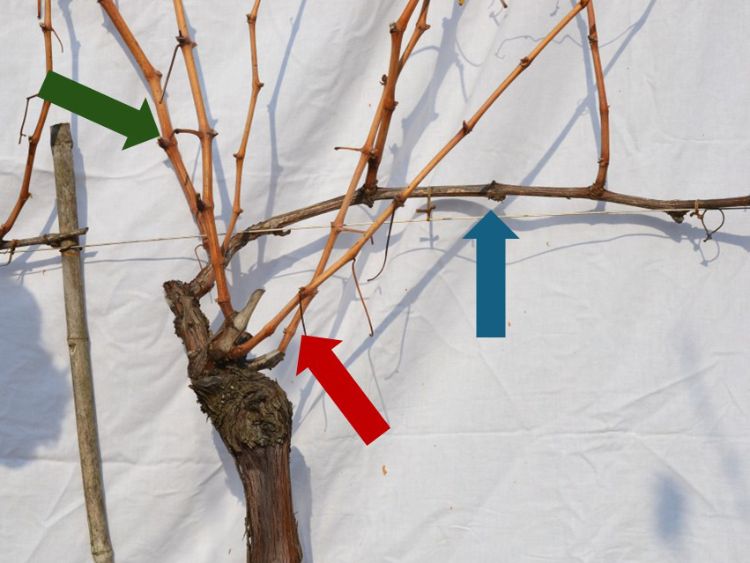
Here is an example: In many Michigan vineyards, routine winter pruning has increasingly relied on large-diameter cuts using loppers and saws, often as a response to time constraints, illusory efficiency, labor availability, pruning mistakes from previous years or perceived vine overgrowth. While “maybe” efficient in the short term, this practice carries significant physiological and pathological consequences. Large cuts disrupt the natural architecture of the vine and the vascular continuity that supports long-term shoot–root communication.
Moreover, such cuts remove substantial portions of permanent wood where carbohydrate reserves are stored, particularly in older cordons and trunks, reserves that are critical for early spring growth, budbreak and cold acclimation. The repeated use of large cuts initiates a cycle of decline: wounds serve as open gateways for trunk pathogens such as Eutypa lata, which exploit exposed xylem tissue and lead to chronic vine deterioration.
Over time, this pruning approach weakens the vine’s regenerative capacity, accelerates canopy ageing and results in widespread vine decline, especially under Michigan’s cold and wet spring conditions. This decline is often misattributed to climate or cultivar sensitivity, when it is rooted in pruning strategies that ignore both vine physiology and disease ecology (Figure 1).
Toward a physiology-first vineyard model for resilient viticulture
In cold-climate viticulture, timing is not a luxury, it is a necessity. In environments where the risk of winter and spring frost is high, pruning decisions must align with vine physiology, not with convenience. Michigan trials show that delaying pruning can effectively stagger budbreak and reduce spring frost damage by several degrees, without compromising fruit set or quality. Despite this, many Michigan vineyards continue to prune early for labor efficiency, exposing vines to avoidable frost risks.
Root-shoot balance, another key pillar of plant physiology, is often overlooked in vineyard models. The Michigan State University Extension viticulture team demonstrated that training systems and shoot thinning not only affect light exposure and airflow but also trigger compensatory growth via hormonal and hydraulic responses. Canopy manipulation experiments underscore that even subtle changes in vine structure can have deep consequences for carbohydrate movement and hormonal balance.
The broader challenge, however, remains cultural. Why, despite decades of evidence, is vine physiology still treated as a theoretical domain rather than an operational one? One reason is the lack of long-term, systems-based trials that prioritize physiological metrics, bud differentiation timing, reserve replenishment, cold acclimation, over purely enological endpoints like Brix or cluster weight. The Michigan State University Extension viticulture team has argued for years that vineyards should be monitored like dynamic ecosystems with attention paid to carbohydrate trends throughout the growing season and into dormancy. But the industry remains slow to support such approach.
Education and extension are essential to making this transition. Vineyard managers and consultants need better access to decision-support tools that interpret vine physiology in real time, tools that integrate shoot maturity, root-zone data, and bud readiness into actionable insights. My team has piloted new remote sensing methods to estimate vine stress and phenological timing, but widespread deployment depends on shifting cultural priorities in how vineyards define and measure success.
Ultimately, the physiology model of viticulture is more than a technical alternative. It is a philosophical reorientation. It treats the vine as an active collaborator, one whose internal cues must be read, not overridden. This approach is particularly well suited to cold-climate systems, where the cost of mistimed interventions is high and the margins for error are narrow. Michigan viticulture, with its history of innovation and adaptive growers, is uniquely positioned to lead this transition.