2026 Michigan Hop Management Guide now available
 Print
Print Email
EmailUpdated management reference available for Michigan hop growers through Michigan State University Extension.
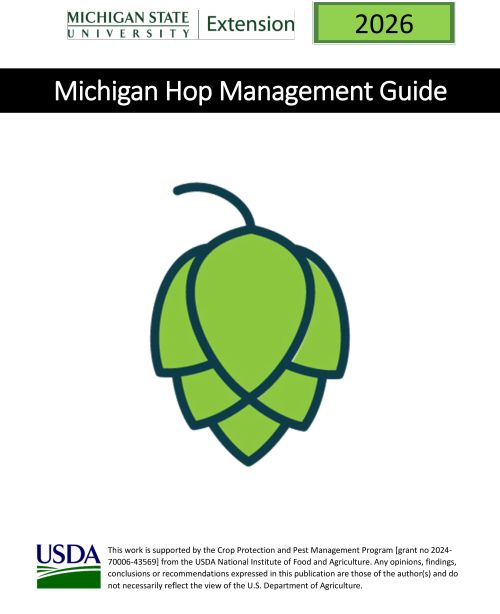
To assist hop growers in making pesticide and nutrient management decisions, the “Michigan Hop Management Guide” has been updated and is available for free through Michigan State University Extension. The guide includes an updated list of registered pesticides, nutrient management recommendations and seasonal pest occurrence and management activities.
Please note the following when using the Michigan Hop Management Guide.
Using the hop management guide
Information presented here does not supersede the label directions. To protect yourself, others and the environment, always read the label before applying any pesticide. Although efforts have been made to check the accuracy of information presented, it is the responsibility of the person using this information to verify that it is correct by reading the corresponding pesticide label in its entirety before using the product. The efficacies of products listed have not always been evaluated on hops in Michigan. Reference to commercial products or trade names does not imply endorsement by Michigan State University Extension or bias against those not mentioned.
The information presented here is intended as a guide for Michigan hop growers in selecting pesticides and is for educational purposes only. Labels can change and do change. For current label and MSDS information, visit one of the following free online databases: greenbook.net, cdms.com and agrian.com.
Endangered Species Act impacting pesticide labels
The Environmental Protection Agency (EPA) is changing the way it enforces the Endangered Species Act in respect to pesticide applications. Growers must carefully read all pesticide labels and look for changes in the Directions for Use section, which may now require growers to check the Bulletins Live! Two system to determine if there are any new pesticide use limitations on their farm. These EPA bulletins define geographically specific pesticide use limitations for the protection of threatened and endangered species and their designated critical habitat. If your pesticide label directs you to this website, you are required to follow the pesticide use limitation(s) found on your label and in the Bulletins Live! Two system for your intended application area, pesticide product and application month. You may not see any geographically specific use limitations for the product you are applying even if your label directed you to this website. Growers should keep a copy of the bulletin with their pesticide records.
Learn more by visiting EPA Endangered Species Protection Bulletins and contact the Michigan Department of Agriculture and Rural Development with questions at MDA-Info@Michigan.gov.
Exporter note
The U.S. Hop Industry Plant Protection Committee has actively sought harmonization of pesticide regulatory standards (maximum residue levels or MRLs) in key customer countries for the past three decades. As U.S. hops are exported worldwide, ensuring consistent regulatory standards between the U.S. and export customers avoids trade issues and interruption of shipments. Some countries do not allow application of certain plant protection products or have lower MRLs than in the U.S. If you export hops, you will need to comply with international MRLs.
Export restrictions apply to pesticides included in this guide. Growers planning to export their hops should carefully and often review the Hop MRL Tracking Chart and contact info@usahops.org for more assistance.
Stay in touch
MSU Extension will host the Hop Chat Series starting in May. Registration will open soon. To stay in touch including program announcements and timely management information, please sign up to receive MSU Extension’s Hop & Barley Production Newsletter, and follow the Michigan State University Hops News Facebook page
This work is supported by the Crop Protection and Pest Management Program [grant no 2024-70006-43569] from the USDA National Institute of Food and Agriculture. Any opinions, findings, conclusions or recommendations expressed in this publication are those of the author(s) and do not necessarily reflect the view of the U.S. Department of Agriculture.