


How to price freezer beef
 Print
Print Email
EmailSpreadsheet tools help beef and dairy producers set prices when selling grain-fed and grass-fed beef carcasses.
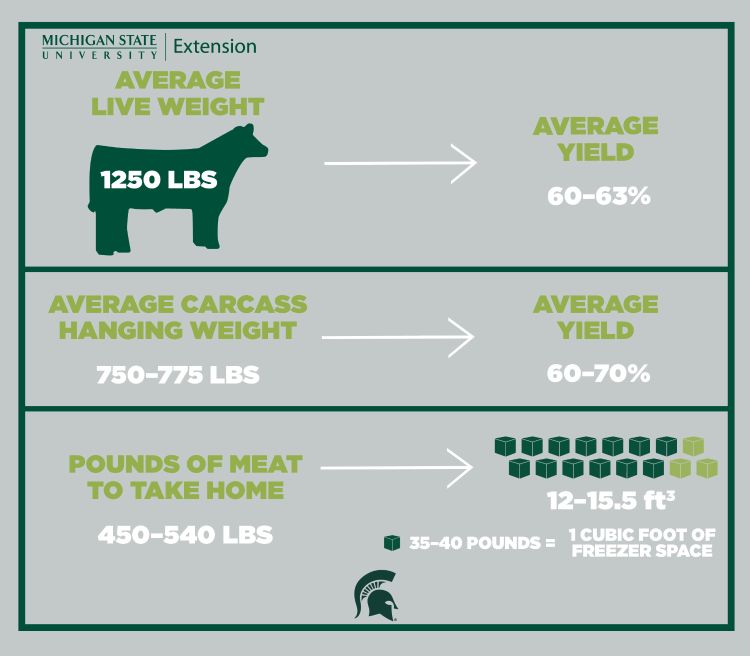
Production costs and market prices for cattle fluctuate from year to year, month to month, and even week to week. As a cattle producer, it is imperative to know what your breakeven selling price is for finishing beef cattle. As a freezer beef customer, understanding the costs that contribute to selling freezer beef is important so you can compare local freezer beef prices versus retail beef prices found in the store as you shop for the best deal. Michigan State University Extension and the University of Wisconsin-Madison Extension teamed up to create Excel spreadsheet tools for pricing grain-fed or grass-fed freezer beef.
In the Grain-Fed Freezer Beef Pricing Worksheet and the Grass-Fed Freezer Beef Pricing Worksheet, cattle production costs such as animal, feed, transportation and market, yardage including labor, and other miscellaneous costs can be accounted for to determine the total cost of raising this animal for freezer beef. To compute these input costs for freezer beef cattle, consider using the Feedlot Enterprise Budget Tool from Michigan State University (MSU) Extension.
After identifying the cost of production for raising the animal, it’s time to determine the sale price for the animal being sold for freezer beef. The agreed sale price is determined by both the seller and the buyer. For the producer selling the freezer beef, make sure the agreed sale price covers your input costs for producing the animal. Usually, the agreed sale price is cheaper than retail store bought beef, equating to a savings for the customer.
Let’s work through an example.
It costs a beef producer $3,065 to produce a grain-fed steer weighing 1,400 pounds live weight. After slaughter, approximately 62% to 64% of that weight remains on the carcass for beef-type cattle, and 57% to 60% for dairy-type cattle, which is called the dressing percentage. The dressing percentage for a grass-fed steer would more likely be between 50% and 60%.
With a 63% dressing percentage in this example, the carcass weight of this steer equates to 882 pounds. If the agreed price between the seller and the buyer happens to be $3.80 per pound on a carcass basis, the carcass value totals $3,351.60. Notice at this agreed price the beef producer can recover their input costs and earn an extra $286.60 for selling the steer to the customer for freezer beef. The breakeven price for the beef producer to earn $0 extra would be $3.73 per pound.
The spreadsheet tool has a fascinating feature, where a live weight price can be calculated to demonstrate how this agreed price compares with current live market prices at the livestock auction. However, the calculations aren’t finished yet, as we have to factor in the processing costs to determine the final retail price. This is where the customer buying the freezer beef will want to pay close attention.
The beef carcass is made up of meat, fat and bone. The retail product weight available for take-home after carcass fabrication will be less than the carcass weight due to the removal of excess bone and trimmed fat. The percentage of the retail product weight left from the carcass is called the carcass yield. Carcass yield will vary depending on the cutting instructions provided to the processor.
In our example, we received a 68% carcass yield based on the cutting instructions, leaving 600 pounds of retail product weight. There are costs associated with processing such as slaughter and cutting, wrapping, freezing, etc. For our example, slaughter cost was $125 per animal and processing and packaging cost $1 per pound of carcass weight for a total of $1,007.
Therefore, the final total cost to the customer buying the freezer beef equals the carcass value plus the processing costs ($3,351.60 + $1,007.00 = $4,358.60). The final retail price for the freezer beef equals $7.95 per pound ($4,358.60 ÷ 600 pounds), which can be used for comparison with retail beef prices in the store.
The spreadsheet tool provides helpful notes and links to resources to determine current pricing of retail beef. Another great feature of the spreadsheet tool is that it calculates a savings value that can be shared with the customer for buying freezer beef compared with beef from the store. This makes for a great marketing sales pitch.
If you have questions or are looking for more information on the freezer beef spreadsheet tools, reach out to the MSU Extension beef team or Jerad Jaborek, MSU Extension beef feedlot educator. For other beef cattle production related inquires, check out the MSU Extension Beef website.