Internationally recognized plant ecophysiologist William Hammond joins MSU
 Print
Print Email
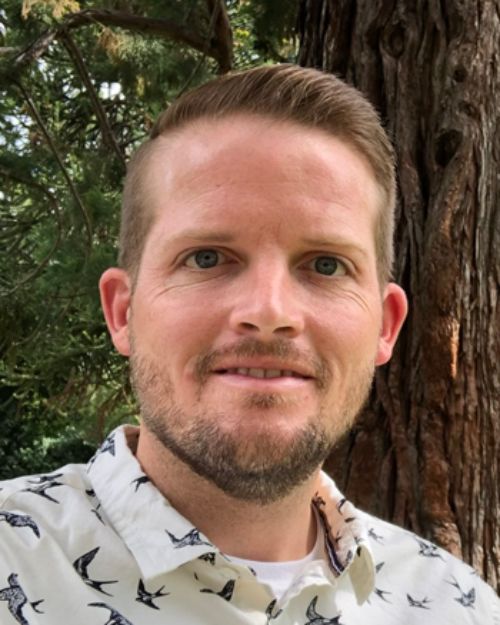
EmailThe Plant Resilience Institute welcomes William (Bill) Hammond to its faculty, advancing research on climate resilience, forest health, and the future of Earth's ecosystems.
As rising temperatures and increasingly frequent drought reshape forests and agricultural landscapes, understanding the how and why driving climate-induced plant mortality is critical.
The Michigan State University Plant Resilience Institute (PRI) will strengthen its leadership in this vital area by welcoming William (Bill) M. Hammond as a new assistant professor beginning in August 2027.
An internationally recognized plant ecophysiologist, Hammond’s research incorporates fundamental plant biology, global change ecology, and imaging sensors to measure plant resilience in a changing climate.
“All plants eventually die,” Hammond said. “But predicting the death of cells, organs, and organisms from climate-induced plant mortality remains a grand challenge.”
Hammond helped pioneer the emerging field of spectral ecophysiology, which joins plant physiology, ecology, and the development of remote tools to detect plant dysfunction and mortality, even before visible symptoms appear.
“My lab studies both the external drivers and internal mechanisms that determine when plants stop living and start dying,” Hammond said. “We use advanced sensor technologies to detect the various ways plants can dysfunction, de-structure, and die, which I call 'necrodiversity.' This framework for understanding plant mortality across scales is meant to improve our ability to predict which plants will be the most resilient to future climate extremes.”
In particular, Hammond focuses on understanding the fate of Earth's historical forests—those dominated by large, old trees that have survived centuries to millennia of severe weather events.
“The largest and oldest trees often punch well above their weight, contributing significantly more to ecosystem services than their juniors,” Hammond said. “Learning how these ancient trees have survived so many disturbances could prove vital in understanding what drives plant resilience for centuries to come.”
PRI Director Seung Yon (Sue) Rhee said Hammond’s addition to the institute will bring exciting new approaches to plant resilience research.
“Bill is an outstanding scientist who has quickly established himself as an international leader in plant ecophysiology,” Rhee said. “His work combines cutting-edge physiology with large-scale ecological questions, and that integrative perspective makes him an outstanding addition to PRI. We're delighted to welcome him to our faculty.”
Hammond will also hold joint appointments in the Department of Forestry and the Department of Plant Biology.
“Bill’s innovative research and teaching on plant ecophysiology, especially tree responses to drought and heat stress, provide critical expertise to adapt to changes in precipitation and temperature,” Department of Forestry Chairperson Richard Kobe said. “I am especially excited Bill is coming to MSU with affiliations in PRI and the Department of Plant Biology. Collaboration across disciplines can help ensure forests and other plant communities can be managed for resilience in the face of novel environmental stresses.”
“Bill's research beautifully connects molecular and physiological mechanisms with whole-plant and ecosystem biology,” Department of Plant Biology Chairperson Andrea Case said. “His commitment to mentorship and interdisciplinary science will enrich the MSU community and provide unique opportunities for students and collaborators alike.”
At MSU, Hammond plans to collaborate with researchers across campus to better understand how plants respond to environmental stress and develop new strategies for improving the resilience of forests, agricultural crops, and natural ecosystems in an increasingly variable climate.
“MSU is uniquely positioned to tackle some of the most crucial biological questions of our time,” Hammond said. “The opportunity to work across the Plant Resilience Institute, Forestry, and Plant Biology creates an environment where we can make discoveries from individual cells up to globally distributed ecosystems.”