Japanese beetle control for fruit orchards and vineyards
 Print
Print Email
EmailFruit growers have several strategies to manage Japanese beetle, with Perimeter sprays showing promise in recent trials.
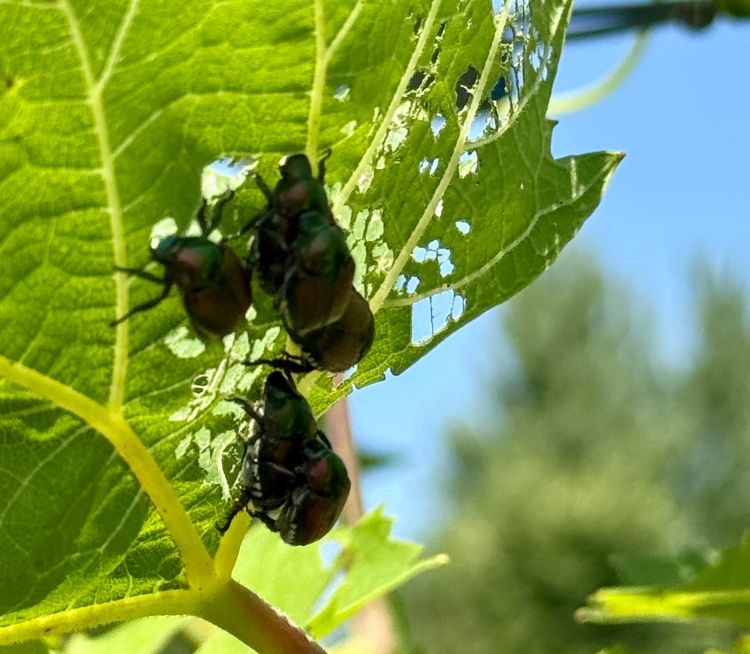
Every summer, Japanese beetles emerge from the ground and begin their search for leaves to feed on, making their characteristic skeletonized damage. Early July brings questions from growers asking what to do about this. There are various approaches to consider depending on the type of farming and how quickly you want to reduce Japanese beetle populations.
The first question to ask is, “Does the damage warrant the expense of a treatment?”
If the beetles are only causing a low level of damage to leaves, most plants can withstand some leaf loss. A treatment might be needed for young plants that are trying to establish, plants that are ripening a heavy crop load or if there is very high leaf damage. Blueberry growers aim to stop Japanese beetles from damaging fruit or being present during machine harvest. In vineyards with a crop, an action threshold of 30% leaf loss can be used, but there are no set thresholds for tree fruit crops.
There are two approaches to controlling Japanese beetle: aiming at the larvae in soil (benefit seen next year) or aiming at the canopy to control the adult beetles. In some cases, targeting both may be needed.
Targeting the larvae in soil
Aiming for the grub or larval stage of a Japanese beetle population can suppress the population locally. Japanese beetles prefer to lay their eggs in mown grass where there is some soil moisture, so areas like this tend to be a source of beetles coming to the fruit crops. There are various approaches to reducing this source population, including biological and chemical tactics.
Nematodes are a biological control that can be sprayed onto grassy areas, targeting the young grubs. Apply these using a weed sprayer approach, without a filter, to areas where egglaying is focused. Application before rain is a good approach to ensure the nematodes are washed into the soil. Heterorhabditis bacteriophora is an effective species that can help suppress Japanese beetle populations when timed for application when the grubs are in the soil, such as in August, to reduce emergence next summer.
Milky spore is another biological approach for targeting the larvae in grassy areas, but results have been mixed in northern regions due to our climate.
Applying a soil insecticide to grassy areas has also been shown to reduce beetle populations the following year. Admire Pro is one such option that is registered for many crops. This approach is most effective when applied just before egglaying starts so that young larvae are controlled. Timing would be in late June to mid-July, depending on the location in Michigan.
Targeting adult beetles
Traps are an effective way to attract Japanese beetles, but you don’t want to attract them to your crop, so monitoring traps should be placed away from crop fields. Mass trapping is one organic approach, but it can be quite costly to have the high density of traps needed and to service them. Additionally, traps can be highly attractive and might just attract new beetles to your farm. Some growers have put traps over their fish ponds just above the water level and cut the bottoms off, providing the fish with food and preventing the buildup of beetles in the traps.
Fast knockdown of adult beetles can be achieved with insecticides applied to the crop canopy, with the neonicotinoids such as Admire Pro and Assail causing rapid control. Since they are systemic, these pesticides are absorbed into the leaves and are protected from wash-off. Many of the insecticides that need to be ingested to work are also effective against these beetles because they consume so much leaf area. For fast knockdown, pyrethroid insecticides are quickly effective, but they are also likely to have shorter residual activity during the summer heat and UV experienced in July. Bifenthrin (Brigade, etc.) is one of the pyrethroids with less susceptibility to this environmental breakdown.
For Japanese beetles entering from outside the orchard or vineyard, recent research by the Guédot Lab at the University of Wisconsin shows that a perimeter spray of Sevin every 10-15 days until emergence ends can reduce the time and cost of spraying by up to 88% while maintaining control comparable to a full cover program. Perimeter sprays may also be useful for other pests that enter through or aggregate along crop edges and could provide an easier approach to reducing the impacts of Japanese beetles.
Due to the long emergence of Japanese beetles, a follow-up treatment may be needed. If other insect pests are being controlled in mid-summer, product selection could be adjusted to control both types with one application, thereby reducing costs.
Japanese beetle management starts with examining whether management is worth its cost based on the products needed and the risk to the crop. Consult Bulletin E-154 “Michigan Fruit Management Guide” from Michigan State University Extension to see labeled products that have been tested in Michigan conditions.
Reference to commercial products or trade names does not imply endorsement by MSU Extension or bias against those not mentioned.
This work is supported by the Crop Protection and Pest Management Program (grant no 2024-70006-43569) from the USDA National Institute of Food and Agriculture. Any opinions, findings, conclusions, or recommendations expressed in this publication are those of the author(s) and do not necessarily reflect the view of the U.S. Department of Agriculture.