Kaela Panicucci successfully defended her master’s thesis in Plant Breeding, Genetics, and Biotechnology (PBGB)
 Print
Print Email
EmailKaela’s work addresses a major bottleneck in potato improvement by advancing diploid breeding, which ultimately impacts their ability to hybridize
Congratulations to Kaela Panicucci, who successfully defended her master’s thesis in Plant Breeding, Genetics, and Biotechnology (PBGB) on Friday 23 March is now on the job market!
Kaela’s academic journey has been a steady climb to the top!
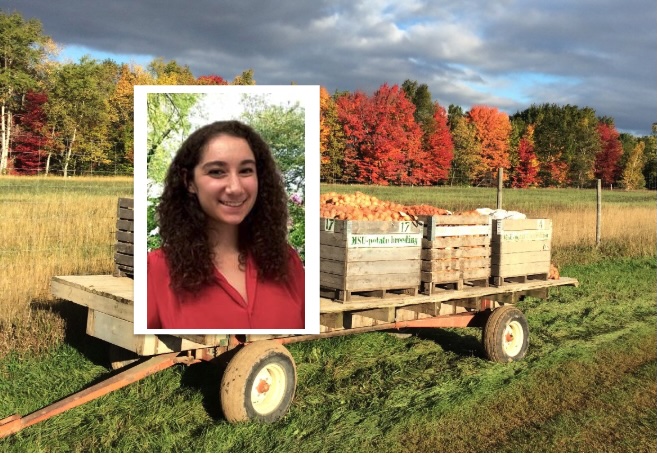
Kaela came to MSU with a BS in Biochemistry from Villanova University in Pennsylvania. During graduate student recruitment, Dr Douches invited Kaela for an interview. "What really sold me was talking with his grad students who all spoke very highly of him and his program, so that’s what ultimately convinced me to join his lab.”
The work Kaela has done here helps tackle a real bottleneck in crop improvement (especially for potatoes of course) by combining genetics, breeding, and practical agriculture. “It advances our knowledge of a complex trait in diploid potato and can help in shifting potato breeding more firmly in the diploid direction.” Diploid breeding, Kaela said, offers a lot of advantages over traditional tetraploid potato breeding, which has made very little progress over the last century as compared to other staple crops due to the genetic complexity of polyploidy. "Self-incompatibility and infertility have been major barriers in diploid breeding, so with the identification of QTL related to these traits, this can help make selection and molecular breeding of diploid lines much more efficient."
As she looks ahead, Kaela says the potato breeding and genetics program has been very rewarding. "I really enjoy how we utilize both traditional breeding methods, as well as more modern biotechnology techniques, creating a bridge between farming and scientific innovations."