Livestock odor basics
 Print
 Email
Understanding livestock odor: What it is, what causes it and how we smell it.

What is odor?
Have you ever held your nose and hurried away from a pungent smell, only to wonder what an odor actually is or why it triggers such a strong reaction? At its most basic level, an odor is a chemical signal. When we smell something, our nose is detecting volatile molecules suspended in the air. These molecules bind to olfactory cells in our nasal cavity, sending an immediate message to the brain that translates those chemicals into a perception, like the scent of flowers, fresh bread or livestock manure.
Historically, the human sense of smell evolved as a vital survival mechanism. Our ancestors relied on their noses to identify potential dangers in the natural environment long before they could be seen. For instance, the smell of decaying animal flesh serves as a warning signal, as it often harbors harmful microorganisms or parasites. Similarly, the rotten egg smell of hydrogen sulfide helped early humans identify hazardous environments like stagnant swamps or geothermal vents. Over time, our brains became hardwired to recognize these specific chemical signatures as offensive to ensure we stayed away from things that could make us sick.
In the modern era, however, the link between a bad smell and actual physical danger has become less straightforward. While some synthetic toxic substances have no smell at all, other harmless compounds can produce an overwhelming stench. This creates a challenge in livestock management. While the odors produced on a farm are a natural byproduct of biology, they often trigger these deep-seated, evolutionary danger responses in neighbors and community members, leading to discomfort or concern even when no immediate health threat is present.
Distinguishing between scent and odor
In livestock management, it is crucial to distinguish between the intrinsic smell of the animals and the odors generated by farming activities. Every living creature has a natural scent, much like the smell of a pine tree, which is typically noticeable only when in close proximity. In most cases, these natural animal scents are not what neighbors or communities characterize as a nuisance. They are simply part of the rural landscape and rarely travel far enough or persist long enough to cause annoyance.
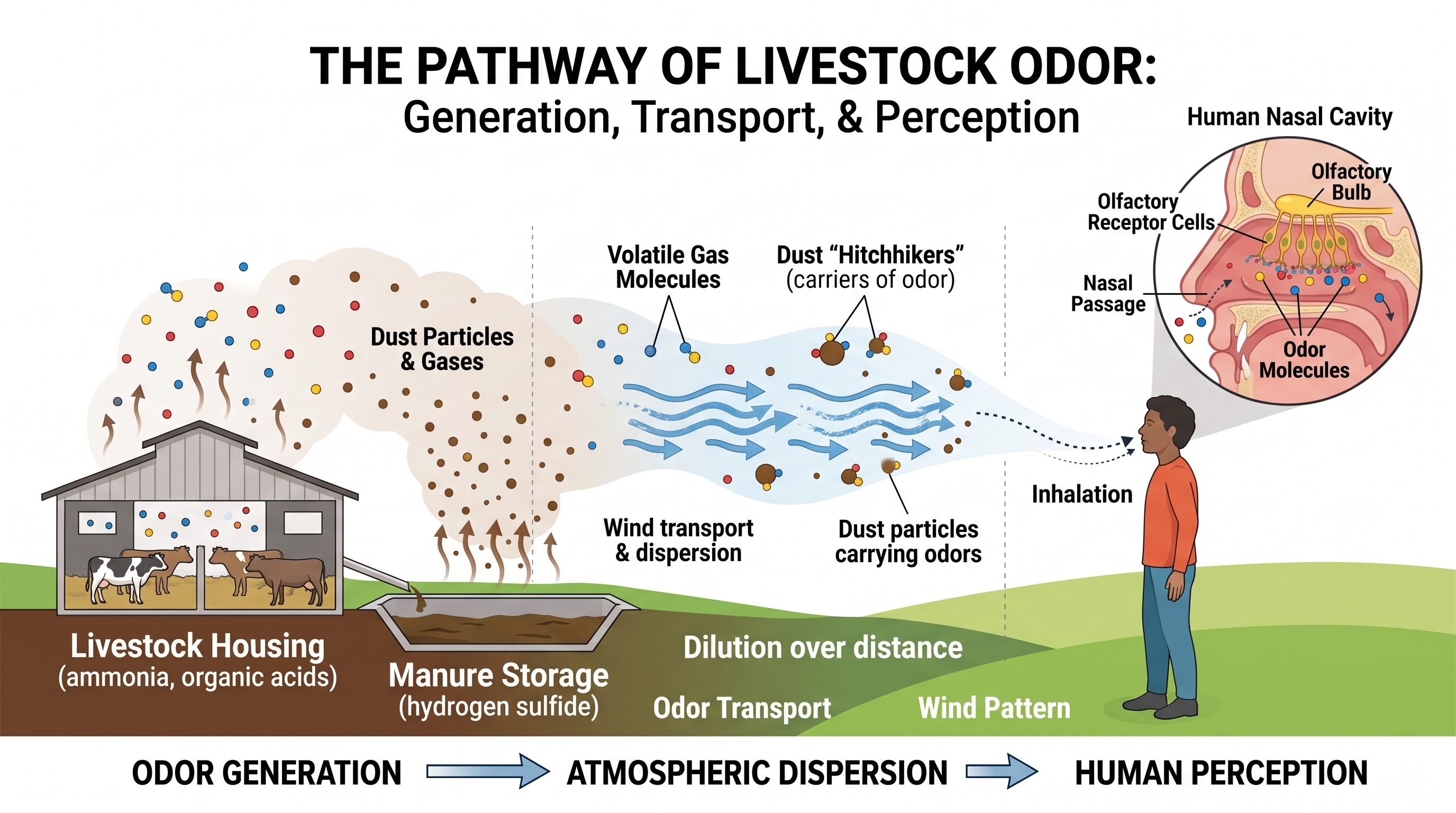
The concerns surrounding livestock odor generally focus on different sources: manure handling, housing ventilation and feed storage. These management-related odors are far more intense because they result from the concentrated breakdown of organic matter. Unlike the subtle scent of a live animal, these odor-causing compounds can be transported by the wind well beyond the farm’s boundary.
The chemical makeup of livestock odor
Livestock odor is not the result of a single specific compound; rather, it is a complex mixture. Researchers have identified hundreds to over 400 different odor-causing compounds in livestock facilities, including sulfur compounds, ammonia, organic acids, alcohols, aldehydes, indoles and phenols. While some of these chemicals exist purely as gases, many others also attach themselves to dust particles.
Among these many compounds, a few stand out as the primary culprits for malodor. Hydrogen sulfide is perhaps the most notorious, recognized by its distinct rotten-egg smell. A product of bacterial decomposition of sulfur-containing organics, it is detectable even at extremely low concentrations. Another common contributor is ammonia, which has a sharp, medicinal smell. Interestingly, some of the strongest odors in nature share the same chemical foundations as those found on a farm. For example, (E)-2-butene-1-thiol, the primary compound in skunk spray, is also often found in manure storage.
The intensity of these smells often depends on their chemical structure and concentration. For instance, acetic acid provides the familiar, relatively mild scent of vinegar. However, other organic acids produced during manure decomposition can be far more offensive to the human nose. Because our olfactory system is so sensitive, some compounds can be smelled at extremely low concentrations. These compounds are said to have a low odor threshold. As a result, even a trace amount of a strong sulfur compound can dominate the overall odor profile of a facility, even when other, less-intense gases are present at much higher concentrations. For instance, in many livestock operations, acetic acid and ethanol are among the most abundant odor‑causing compounds by concentration; however, they are generally not the primary drivers of objectionable livestock odor.
How do we perceive odors?
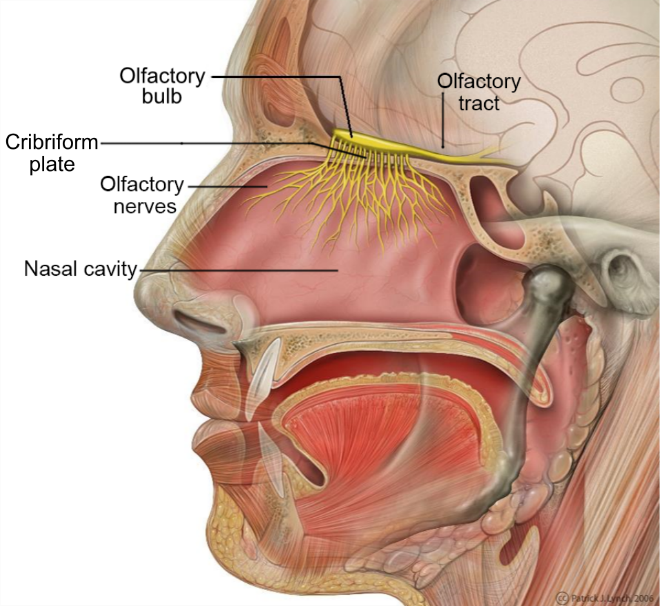
Humans have an exceptionally strong sense of smell and have been reported to be capable of distinguishing over 80 million different odors. This ability is attributed to the human olfactory system, which is located in the upper back part of the nasal cavity and connects directly to the brain (Figure 1). Humans have about 400 different types of functional odor receptors, each tuned to detect specific types of chemical features. Most odors are sensed not by a single receptor, but by unique combinations of multiple receptors, allowing the brain to identify and differentiate a wide range of smells.
Odor perception is a highly complex process and often behaves in non‑linear ways. For a single odorous compound, perceived odor intensity is not always directly proportional to its concentration, as small increases at lower concentrations can sometimes lead to noticeable differences in smell, while larger changes at higher concentrations may have little additional effect. Similar non‑linear behavior occurs with odor mixtures, where multiple odor‑causing compounds can interact. In some cases, these compounds reinforce one another and intensify the overall odor, while in other cases they may partially mask or reduce the perceived odor. Interestingly, certain compounds may smell pleasant at low concentrations but become unpleasant or offensive as their concentration increases.
Differences in odor perception among individuals are also common. Some people are more sensitive to odors than others, and even when smelling the same source, such as blue cheese, people may perceive the odor differently. In addition, repeated exposure to an odor can reduce a person’s sensitivity over time, a phenomenon known as odor adaptation or nose blindness. This helps explain why livestock caretakers often react less negatively to livestock odors than visitors or neighbors who are not regularly exposed. Certain odor-causing compounds, including hydrogen sulfide (H2S), can further reduce a person’s ability to detect odors after exposure. Importantly, this reduced sensitivity can create safety concerns because people may no longer recognize the presence of potentially hazardous gases. As a result, smell should never be relied upon to determine whether H2S exposure is safe.
The role of airborne particles
While odors are often thought of as gases, airborne particles (dust) also play an important role in how smells travel and persist. In livestock facilities, these particles range from larger pieces of feed and bedding to fine particles and droplets originating from manure. Odor‑causing compounds can attach to these particles, allowing them to act as physical carriers or hitchhikers for odor. Because particles move and behave differently in the environment than gas molecules, they add complexity to how odors are transported from a facility to nearby neighbors or communities.
One of the most important characteristics of particle‑associated odors is their persistence. Unlike gases, which typically dilute and disperse in the atmosphere, particles can settle on surfaces such as clothing, vehicles and equipment. This helps explain why a person may continue to smell like a farm long after leaving a barn, or why odors may linger inside a home even after wind conditions change. In this way, particles can act as tiny, slow-release odor reservoirs that keep the odor active long after the initial gas plume has passed.
Particle size strongly influences how far odor can travel. Larger particles, often originating from feed, bedding, or soil, tend to settle out of the air quickly. In contrast, fine particles, many of which are associated with feces, can remain suspended in the air for long periods and be transported much farther downwind. These fine particles can carry concentrated amounts of odor‑causing compounds and contribute disproportionately to off‑site odor impacts. In addition, once inhaled, fine particles may be trapped by mucus or nasal hairs in the nasal cavity, where they continue to release odor‑causing compounds directly to the olfactory receptors. This can result in a more prolonged or intensified perception of odor.
Takeaway messages
- Odor is a chemical signal created when volatile compounds bind to approximately 400 types of functional odor receptors in the human nasal cavity.
- Humans are biologically programmed to perceive certain compounds such as hydrogen sulfide as unpleasant. This response evolved as a survival mechanism to help avoid potentially harmful or unhealthy environments.
- Livestock odor is a complex mixture of various compounds. A higher concentration of an odor-causing compound does not always mean its greater odor impact than others.
- Airborne particles can serve as hitchhikers for odor‑causing compounds. Unlike gases, particles can settle on surfaces, where they slowly release odors over time. This can cause odors to persist even after the odorous gas plume has passed.
- Human response to odor is not always proportional to chemical concentration. Factors such as odor adaptation (where sensitivity decreases with continuous exposure) help explain why livestock caretakers may perceive odors differently than neighbors.