


Planning for drought stressed corn silage
 Print
Print Email
EmailHot, dry weather conditions can damage corn and potentially cause toxic nitrate levels in corn silage.
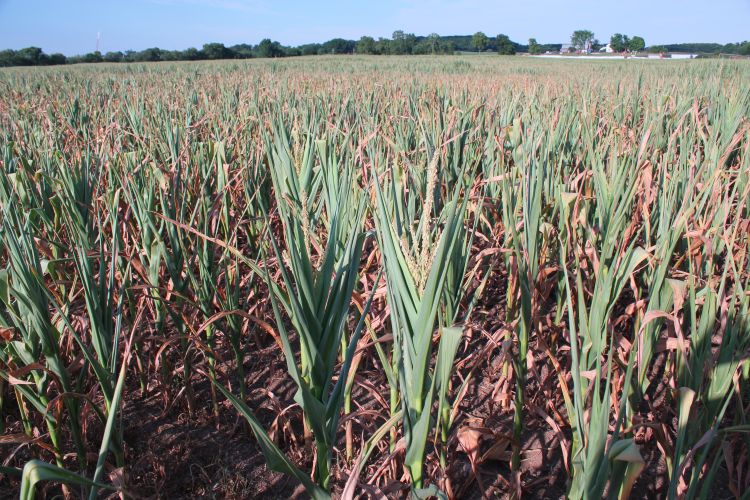
With corn silage harvest in full swing, livestock producers should be aware that prolonged moisture stress, high temperatures and low humidity during this year’s growing season may have led to elevated nitrate levels.
Nitrate accumulation is the major concern
Producers making plans to harvest corn silage due to drought damage should be aware of major issues associated with nitrate accumulation in the plants. This increase in nitrates is most significant following the late season rainfall events over Michigan. Corn that has received higher amounts of nitrogen fertilizer and manure application prior to drought conditions setting in, typically higher yield potential corn, will be more prone to excess nitrate in harvested corn silage.
As corn plants recover with those first rains after a drought, nitrates are taken up at levels greater than they can assimilate. This causes nitrate concentrations to spike in the plant to levels that can be toxic to livestock. This is especially important if farmers are feeding green-chopped corn or corn silage. To minimize risk, generally wait two weeks before harvesting the silage.
Ensiling corn silage will reduce the amount of nitrates in the plant materials by one-third to one-half during the ensiling process. However, even with corn silage stored in bunker silos for several weeks, it is impossible to accurately predict levels of nitrates in drought-stressed corn silage. Nitrate levels should always be tested before the silage is fed to make sure rations are balanced to stay below nitrate toxicity thresholds for the type of livestock.
What conditions lead to increased nitrates?
Prior to chopping corn silage, evaluate these conditions to determine potential for nitrate toxicity.
- Heavy nitrogen fertilization or manure application. The more nitrogen that is available, the greater the potential for increased nitrate accumulation.
- Cloudy, cool weather will increase the potential for nitrates due to reduced activity by enzymes that convert nitrate into amino acids and, later, proteins.
- Deficiencies of nutrients such as phosphorus, potassium, molybdenum and manganese increase the concentrations of nitrate. Root uptake of nitrate continues, but growth is limited causing nitrates to accumulate.
- Rainfall after prolonged moisture stress just prior to harvest can increase the amount of nitrates in plant materials. To minimize risk, generally wait two weeks before harvesting the silage.
- Frost damage on all corn, including droughty corn, can have elevated levels of nitrates if harvested two to six days following a heavy frost. Silages following heavy frost conditions should be tested and treated the same as drought-stressed corn silage.
Harvest recommendations
Corn silage should be harvested at normal recommended moisture levels, regardless of growing conditions (see Table 1). Drought can affect the whole plant moisture content. When drought slows plant growth and delays maturity, the moisture content will be higher than suggested by the appearance of the crop. When a drought occurs at the end of the season, moisture levels may be lower than normal. Even though drought-damaged corn may appear dryer than normal, whole plant samples are the only sure-fire way to know the current moisture levels of the crop.
Table 1. Recommended moisture levels for corn silage structures.
|
Silo type |
Recommended moisture content (%) |
|---|---|
|
Upright silo |
63-68 |
|
Upright "oxygen-limiting" silos |
55-60 |
|
Horizontal silos |
65-70 |
|
Bag silos |
60-70 |
Source: PennState Extension: From Harvest to Feed: Understanding Silage Management
Harvest height is typically set at 4 inches. Increasing cutting height to improve nutritive silage quality is usually not profitable since the improvement in quality rarely offsets the yield loss. The exception to this is when nitrates are high. Increasing cutting height up to 10-18 inches is an effective method for reducing forage nitrate content because corn stem bases are where plants accumulate the most nitrate.Corn silage samples can be submitted to many different labs to determine nitrate content of your plant materials. Follow specific submittal recommendations from the lab you are using. Nitrate test strips do not replace a lab test but can be used to quickly give you an idea of where the nitrate levels are in your harvest. For more information on how to use nitrate strips, check out this article from South Dakota State Extension.
What are safe nitrate levels?
Acute problems associated with high nitrate levels in corn silage include potentially rapid death of animals from asphyxiation when nitrate toxicity prevents blood from carrying oxygen to tissues. Nitrate toxicity can also be chronic, causing reduced animal performance and abortions.
When in doubt about potential nitrates in forages, always sample and test affected feedstuffs before feeding them. Be aware that testing laboratories may report nitrates as total nitrate, nitrate-nitrogen, or potassium nitrate and in units of ppm or percentage. Be sure to use the correct toxicity thresholds for the units reported on your test. High-nitrate forages can sometimes be fed safely in a total mixed ration if they are diluted with other feedstuffs. Work with your nutritionist and veterinarian to make sure rations are safe.
Table 2. Nitrate-nitrogen and nitrate levels and feeding recommendations.
|
Nitrate nitrogen NO3-N (ppm) |
NO3 (ppm) |
Feeding recommendation |
|---|---|---|
|
Less than 1,150 |
Less than 5,000 |
Typically safe for cattle. Be careful with more sensitive stock such as pregnant and young animals as levels reach the threshold |
|
1,150-2,300 |
5,000-10,000 |
Limit feed to less than 50 percent of the ration dry matter in pregnant animals. Dilute silage with other feed sources and slowly introduce into their diet. |
|
Greater than 2,300 |
Greater than 10,000 |
Toxic, do not feed. |
Source: University of Kentucky Bulletin ID-217: Forage-related Disorders in Cattle: Nitrate Poisoning