


Making every cluster count: Crop adjustment for Michigan wine grapes
 Print
Print Email
EmailCluster thinning for reliable ripening in Michigan vineyards.
The question every grower asks, “Should I thin my vines?” is one of the most difficult questions Michigan wine-grape growers face. No grower enjoys walking through a vineyard and seeing healthy clusters lying on the ground, but every wine region of the world performs cluster thinning. Every removed cluster represents potential yield, months of vineyard work and fruit that will never reach the winery. However, in Michigan, the question is often partly rhetorical. The answer is: Yes, when the crop exceeds the vine’s capacity to mature it, the vines should be thinned.
For Michigan, the reason begins with dormant pruning. In Michigan, pruning establishes the vine’s potential crop, but it does not always establish the final number of clusters that the vine should carry to harvest. Growers commonly retain additional buds to compensate for uncertain winter injury, uneven bud survival, variable bud fruitfulness and possible spring frost damage. Under Michigan growing conditions, dormant pruning commonly retains approximately twice the number of buds required to achieve the target crop for a given cultivar, planting density and training system. This strategy is necessary in a cold climate, but it also means that vines frequently enter the growing season with more shoots and clusters than they can fully mature. A vineyard may appear well pruned in March but become clearly overcropped by July.
Once fruit set is complete and the crop becomes visible, the grower must answer a more useful question: Does this vine have enough healthy, functional canopy and enough favorable weather remaining to mature all the fruit it is carrying? As you will see later from data collected in Michigan, the answer is no. Leaving every cluster on the vine does not preserve crop value. It distributes the vine’s available resources among too many competing clusters. The result may be delayed or uneven sugar accumulation, retention of excessive acidity, limited color development in red cultivars, delayed flavor evolution and a greater risk that harvest will be determined by autumn weather, disease or frost rather than by fruit maturity. The clusters on the ground may not be visually satisfying, but they represent a deliberate investment in the maturity, uniformity and value of the fruit remaining on the vine.
Cluster thinning is not a guarantee of higher Brix
Cluster thinning is the selective removal of grape clusters to adjust the amount of fruit carried by the vine. The objective is to establish a crop that has a realistic opportunity to reach the desired maturity under the conditions of a particular cultivar, vineyard site, canopy and growing season. This distinction is important because cluster thinning does not automatically increase soluble solids at harvest. Research conducted across different cultivars and wine regions has shown that fruit composition improvements are most likely when thinning corrects a true condition of overcropping. A vine that is already capable of maturing its crop may show little response to cluster thinning. Removing fruit from such a vine may reduce vineyard revenue without producing a meaningful improvement in fruit or wine quality.
The practical objective is therefore straightforward: Remove enough fruit to correct excessive crop levels, but do not remove fruit simply because a lower yield is assumed to produce better wine. The relationship between crop level and fruit quality is not unlimited. Reducing a clearly excessive crop can improve ripening. Continuing to remove fruit after the crop has reached an appropriate level may provide little additional benefit.
What does full maturity mean?
Fruit maturity is often discussed only in terms of soluble solids, or Brix. Brix is important, but it represents only one component of grape maturity. Technological maturity includes soluble solids, potential alcohol, juice pH, titratable acidity and the relationship between sugars and organic acids. For red cultivars, maturity also includes anthocyanin accumulation, skin and seed development, tannin characteristics and the reduction of excessively green, bitter or astringent flavors. Aromatic maturity involves the development of cultivar-specific flavors and aroma precursors and the decline of immature or excessively herbaceous characteristics. These changes do not always occur at the same rate as sugar accumulation. Fruit health must also be considered. Grapes cannot be described as fully mature if cluster rot, berry splitting, sour rot or other deterioration forces an early harvest. A management practice that allows fruit to remain healthy on the vine until the desired harvest date may be as valuable as one that directly increases sugar concentration.
Cluster thinning should therefore be evaluated by asking whether it helps the vineyard reach the desired combination of sugar, acidity, color, flavor, uniformity and fruit health before the effective end of the Michigan ripening season.
When is cluster thinning most likely to be beneficial?
Cluster thinning is most valuable when there is evidence that the crop exceeds the vine’s capacity to mature it. This situation may occur after a winter with high bud survival, particularly when additional buds were retained during pruning as insurance against cold injury. If most of those buds survive and produce fruitful shoots, the potential crop can be substantially higher than expected.
Excessive crop levels may also develop in cultivars with high bud fruitfulness, large clusters or two or more clusters on many shoots. Even a normally cropped vineyard can become functionally overcropped if the canopy is weakened by drought, disease, nutrient deficiency, hail or other stress.
The need for crop adjustment becomes more evident when a high estimated yield is accompanied by weak shoots, a dense or declining canopy, delayed veraison, uneven berry coloration or a history of insufficient maturity at harvest.
Seasonal conditions are equally important. A crop that can mature during a warm year with a long autumn may remain delayed during a cooler year with limited heat accumulation after veraison. Cluster thinning therefore has value as a risk-management tool in Michigan. A cultivar that ripens consistently at a particular site may require little or no thinning in a favorable season. The same cultivar carrying the same crop may require adjustment during a cooler year, after canopy damage or when veraison begins later than normal. Cluster thinning is less likely to improve maturity when crop level is moderate, the canopy is healthy and functional, veraison is uniform and post-veraison conditions are favorable. Cluster number per shoot can help identify potential overcropping, but it should not be used as the only decision rule. One cluster of a large-clustered cultivar (e.g. Vidal blanc or Blaufränkisch) may represent a greater fruit demand than two small clusters of another cultivar (e.g. Marquette or Pinot noir). A strong, healthy shoot may also support more fruit than a short or damaged shoot. The final decision should integrate cluster number, expected cluster weight, shoot vigor, canopy condition, cultivar, vineyard history, seasonal weather and winery maturity targets.
When should clusters be removed?
Cluster thinning can be performed from after fruit set through veraison. The most appropriate timing depends on whether the primary objective is to correct total crop level, improve fruit uniformity or remove delayed clusters. Thinning shortly after fruit set reduces crop demand early and gives the remaining fruit more time to respond. However, final berry set and cluster weight may still be uncertain. An early crop estimate can be inaccurate when fruit set is variable or when berry growth differs substantially from the historical average. The period between fruit set and veraison is often the most practical time for the main crop adjustment. By this stage, cluster number and approximate cluster size are clearer, crop estimates are more reliable, and growers can evaluate shoot growth, canopy condition and seasonal progress before most ripening has occurred. Thinning at veraison allows growers to identify clusters that are clearly behind the rest of the crop. Late-set clusters, green clusters, poorly exposed fruit and clusters carried by weak shoots can be removed selectively.
This timing is particularly useful when the main objective is to improve ripening uniformity. However, the vine has already invested carbohydrates, water and nutrients in fruit that will be removed, and less time remains for the treatment to influence the ripening of the retained clusters.
In variable Michigan vineyards, a two-stage approach may provide the greatest precision. Obvious excess crop can be removed after fruit set or during lag phase. The block can then be reassessed at veraison, when delayed or poorly positioned clusters can be identified more easily. This approach reduces the risk of removing too much fruit early while still allowing the grower to correct uneven ripening before harvest.
Which clusters should be removed?
Cluster thinning should be selective rather than random. Clusters carried on short, weak, damaged or poorly positioned shoots should receive the highest priority for removal. When a shoot carries more fruit than it appears capable of supporting, the distal or less-developed cluster is generally removed first. Late-set clusters and clusters that remain visibly green after most of the block has entered veraison are also strong candidates for removal. These clusters may not reach the same level of maturity as the primary crop by the intended harvest date.
Clusters buried inside a dense canopy may remain cooler, more shaded and more susceptible to poor air movement and disease. Crowded clusters touching one another may also increase the risk of berry damage and rot. Small clusters should not automatically be removed. A small cluster that is developmentally advanced and carried by a healthy shoot may contribute more valuable fruit than a larger but delayed cluster. The preferred clusters to retain are uniformly developed, appropriately positioned in the fruit zone, carried by healthy shoots and free from significant disease or physical injury. A uniform crop of similar developmental age is generally more valuable to the winery than the same total yield composed of fully mature, partially mature and delayed fruit.
What Michigan research tells us
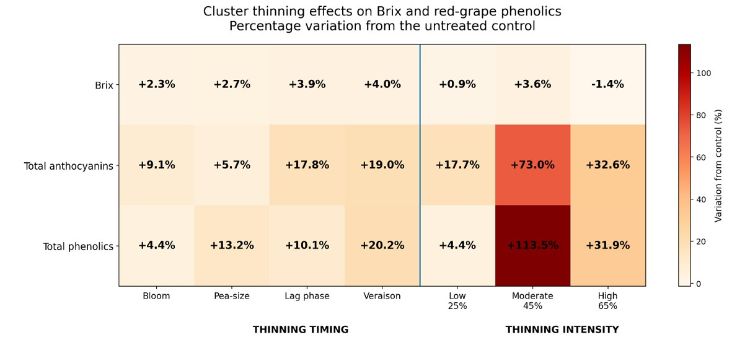
Michigan research demonstrates why growers should not expect the same response to cluster thinning every year. A large dataset generated by the Viticulture Research Team in the Department of Horticulture at Michigan State University from 2010 to 2024 in collaboration with SW and NW vineyards and wineries is synthesized in the heat map presented in Figure 1.
Across thinning timings, Brix increase ranged from approximately 2.3% when thinning was performed at bloom to about 4.0% when thinning was performed at veraison. Thinning at pea-size and lag phase increased Brix by approximately 2.7% and 3.9%, respectively. The response of Brix to thinning intensity was also limited. Low-intensity thinning, corresponding to approximately 25% crop removal, increased Brix by less than 1%. Moderate thinning, corresponding to approximately 45% removal, increased Brix by approximately 3.6%. High-intensity thinning, corresponding to approximately 65% removal, produced a slight reduction in Brix of approximately 1.4%.
These results reinforce an important practical point: more severe crop removal does not necessarily produce higher soluble solids. Moderate thinning appears more likely to improve sugar accumulation when vines are overcropped, while very light thinning may not provide an additional ripening benefit. The effects on anthocyanins were substantially greater than the effects on Brix. Thinning at bloom and pea-size increased total anthocyanins by approximately 9.1% and 5.7%, respectively. Later thinning produced stronger responses, with increases of approximately 17.8% at lag phase and 19.0% at veraison. The intensity comparison showed a similarly strong but non-linear response. Low-intensity thinning increased total anthocyanins by approximately 17.7%, moderate thinning increased them by approximately 73%, and high-intensity thinning increased them by approximately 32.6%. Total phenolics also responded more strongly than Brix. Thinning at bloom increased total phenolics by approximately 4.4%. Increases of approximately 13.2%, 10.1% and 20.2% were observed at pea-size, lag phase and veraison, respectively. The intensity comparison showed an increase of approximately 4.4% following low thinning, 113.5% following moderate thinning and 31.9% following high thinning. As with anthocyanins, the largest response occurred with moderate rather than severe crop removal.
The heat-map synthesis therefore indicates that cluster thinning affects phenolic maturity more strongly than technological maturity. Changes in Brix were relatively small, whereas changes in anthocyanins and total phenolics were frequently much larger.
This distinction is especially important for Michigan red wine cultivars. A grower may conclude that a treatment was ineffective if Brix does not increase substantially. However, the same treatment may improve color development, phenolic concentration and the coordination of sugar and phenolic maturity. The timing results also suggest that thinning during lag phase or veraison may produce a stronger phenolic response than thinning earlier in the season. Later thinning allows growers to identify delayed clusters and remove fruit that is unlikely to reach the same maturity as the primary crop.
The most important conclusions are that cluster thinning has a relatively modest effect on Brix, a potentially much larger effect on phenolic development and a non-linear response to treatment severity. Moderate thinning generally produced stronger responses than either light or severe thinning. These results lead to one of the most important conclusions for Michigan growers: Cluster thinning provides its greatest benefit when it corrects a condition of overcropping and when the season does not give the vine enough time or heat to compensate before harvest.
In a favorable year, a moderately high crop may still reach the desired maturity. In a cool or shortened season, the same crop may remain delayed at harvest. Cluster thinning should therefore be viewed as a seasonal and vineyard-specific decision rather than a treatment that produces the same response every year.
Cluster thinning and fruit-zone leaf removal are not interchangeable
Cluster thinning and fruit-zone leaf removal influence ripening through different mechanisms. Cluster thinning reduces the amount of fruit the vine must mature. Its principal role is to correct excessive crop levels and improve uniformity when delayed clusters are selectively removed. Fruit-zone leaf removal primarily changes the environment surrounding the clusters. Removing basal leaves around the fruit increases light penetration, improves air movement and drying, modifies berry temperature and may improve spray penetration.
In red cultivars, improved fruit exposure can increase anthocyanin accumulation and influence other light-responsive phenolic compounds. It may also help reduce some of the characteristics associated with heavily shaded fruit. The two practices can therefore be complementary. A vine may carry too much fruit even when its clusters are well exposed. Conversely, a vine carrying an appropriate crop may still have fruit hidden inside a dense canopy. When excessive crop and poor exposure occur together, cluster thinning alone addresses only part of the problem. Removing fruit will not fully correct a shaded, humid fruit zone. Similarly, exposing clusters will not correct a crop level that is too high for the vine and the season. Fruit-zone leaf removal should focus on improving cluster exposure without unnecessarily reducing the healthy upper canopy. Excessive removal of functional leaves can reduce the photosynthetic capacity needed to mature the remaining crop.
A practical Michigan decision process
The cluster-thinning decision begins before pruning. Growers should evaluate winter bud survival and adjust retained bud numbers according to the level and uniformity of injury. Leaving additional buds is appropriate insurance when winter damage is possible, but those buds should not automatically become the final crop.
After budbreak, shoot thinning should be used to remove unwanted, non-positioned and weak shoots. This operation improves canopy organization and may reduce crop level before individual clusters are removed.
After fruit set, growers should estimate crop by counting clusters on representative vines and multiplying cluster number by the historical average cluster weight for the cultivar and block. The estimate should be adjusted when fruit set or berry growth differs visibly from normal. The condition of the canopy should be evaluated at the same time. Shoot growth, canopy density, disease symptoms, water stress, fruit exposure and the proportion of weak shoots all influence the vine’s ability to support the developing crop. The winery target must also be clearly defined. A crop level appropriate for sparkling wine or an early-harvest style may not be appropriate for a red wine requiring greater color, tannin and flavor maturity. Vineyard and winery personnel should agree on the expected harvest window, desired soluble solids, pH, acidity, color, fruit condition and intended wine style before the final crop adjustment is made.
When thinning is required, the first pass should focus on weak shoots, delayed clusters and crowded or poorly positioned fruit. The block should then be reassessed before additional clusters are removed. At veraison, growers should compare the development of retained clusters. Any fruit that remains clearly behind the primary crop should be evaluated for removal, particularly when the harvest window is expected to be short.
After harvest, growers should record yield, cluster number, average cluster weight, soluble solids, pH, titratable acidity, fruit rot and harvest date. For red cultivars, color or anthocyanin measurements can provide additional information. Over several seasons, these records allow cluster thinning to become a repeatable decision based on block performance rather than an annual discussion based only on the amount of visible fruit.
Situations where growers should be cautious
A visually large crop is not proof that vines are overcropped. Large vines with healthy, functional canopies may be capable of maturing substantial yields. Conversely, a crop that appears moderate may be excessive on weak or damaged vines.
Lower yield should not automatically be equated with higher quality. Research does not support an unlimited inverse relationship between yield and fruit quality. Quality may improve when thinning corrects a real limitation. Once an appropriate crop level has been reached, additional fruit removal may provide little benefit. Uniform thinning across an uneven vineyard block should also be avoided. Frost pockets, weak areas, wet soils, drought-prone sections and vigorous areas may require different levels of crop adjustment. Applying the same thinning percentage to every vine can leave weak vines with too much fruit and strong vines with too little.
Growers should also avoid waiting until harvest sampling to determine whether the crop is uneven. A block average of 22 Brix may contain fruit at 24 Brix mixed with delayed fruit at 18 or 19 Brix.
Separate sampling of advanced and delayed clusters near veraison provides a clearer picture of vineyard uniformity and can guide selective thinning. Finally, thinning decisions should not be based exclusively on the current appearance of the crop. The expected harvest date, cultivar sensitivity, canopy health, disease risk and likely post-veraison weather should also be considered.
The economic question: Can I afford to remove this fruit?
Cluster thinning has two immediate costs: the labor required to remove fruit and the revenue lost through reduced yield. These costs must be compared with the potential value of reaching maturity standards, avoiding price penalties, improving red-wine color, reducing harvest sorting, increasing fruit uniformity and lowering the risk that a portion of immature fruit will delay the entire harvest.
Removing clusters can also reduce crowding in the fruit zone and make harvesting more efficient. When delayed or diseased clusters are removed before harvest, less sorting may be required in the vineyard or at the winery.
The economic value of cluster thinning is greatest when the untreated crop is unlikely to meet the required maturity or fruit-health standard. Removing fruit from a vineyard that is already likely to reach its target is less likely to recover the cost of the treatment. For this reason, the decision cannot be separated from the market. The vineyard manager must know the winery’s expectations and whether maturity, uniformity and fruit condition are rewarded sufficiently to justify the reduction in yield. The cost of thinning is visible immediately because the clusters are on the ground. The potential cost of not thinning is less visible, but it may appear later as delayed harvest, immature flavors, weak color, excessive acidity, disease losses or lower fruit value.
For Michigan growers, the question “Should I thin my vines?” begins with the realities of cool-climate vineyard management. Dormant pruning frequently retains a margin of buds to protect yield against winter injury, uneven bud survival and spring frost. That is a necessary strategy, but it also means that pruning cannot always establish the final crop. Once the season reveals actual bud survival, shoot number, fruitfulness, canopy condition and weather, the crop must be reassessed.
The answer is therefore: Yes, cluster thinning is necessary, especially when the vine is carrying more fruit than it can fully and uniformly mature.
However, cluster thinning should not be treated as an automatic operation or as a guaranteed method for increasing Brix. Its greatest value occurs when it corrects a genuinely excessive crop, removes delayed fruit and protects maturity during cool or shortened seasons. Michigan research and the broader literature show that cluster thinning generally has a modest effect on Brix but can have a substantially larger effect on anthocyanin and total phenolic development. The response is not proportional to the amount of fruit removed. Moderate thinning generally produces stronger and more consistent benefits than either light or severe thinning.
Fruit-zone leaf removal may have a more consistent influence on anthocyanins and phenolics than cluster thinning alone, while the combination of appropriate crop adjustment and fruit exposure can improve ripening uniformity and the coordination between sugar and phenolic development.
The best decision integrates crop level, canopy condition, cultivar, vineyard site, seasonal weather and winery objectives.
The purpose of cluster thinning is not to place grapes on the ground. It is to ensure that the clusters remaining on the vine have a realistic opportunity to become the fruit the grower and winery intended to produce.