Making high residue work in regenerative farming: How to reduce risks and protect yield
 Print
Print Email
EmailWhile regenerative practices aim to improve soil, water, nutrient cycling and biodiversity, they also come with challenges. Learn key insights on how to navigate and implement these different principles.
In February 2026, Michigan State University Extension partnered with the MSU Center for Regenerative Agriculture to offer a special webinar series on regenerative agriculture. These sessions brought together farmers, educators and landowners who are interested in healthier soils, stronger farms and more resilient rural communities.
The series introduced six key principles that guide regenerative agriculture. These principles focus on living roots in the soil, minimizing soil disturbance, increasing plant diversity, integrating livestock, and understanding your unique farm context. One important message from the series was clear: regenerative agriculture is not “one size fits all.” Every farm is different. Climate, soil type, crops, livestock and personal goals all matter. The goal of the webinar series was not to tell farmers exactly what to do, but to share ideas, examples and research to help guide decisions.
Rewards and risks of residue
Crop residue—the stalks, leaves and stems left after harvest—is a key part of regenerative agriculture. It helps protect soil, improve water retention and build organic matter over time. However, managing residue requires balancing benefits with challenges during planting and crop establishment.
In Michigan and other regions with cool, wet springs, residue can slow soil warming and delay crop emergence. Heavy residue can interfere with seed placement and limit seed-to-soil contact, resulting in uneven stands. In addition, high-residue environments can create favorable conditions for pests such as slugs and voles. These tradeoffs highlight the need for careful, planned, adaptive management.
Lessons from the field
Marc Hasenick, of Hasenick Brother Farmers in Springport, Michigan, shared lessons learned from his transition from conventional tillage to a no-till, cover crop-based system starting in 2012. By 2016, his operation was “100% no-till and 100% covered,” leading to his current operation, which integrates crops such as corn, soybeans, wheat and canola.
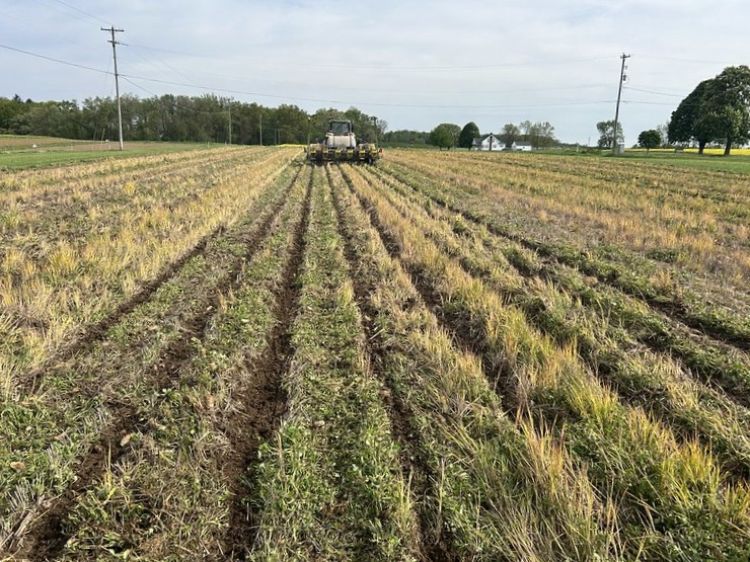
One of the most important lessons is the role of timing. Hasenick noted planting into residue is most successful when the system is either fully green (actively growing) or fully brown (completely terminated). Conditions in between can lead to poor seed placement and uneven emergence. He also emphasized the importance of planter setup. His current system uses row cleaners with “shark teeth” to clear residue from the seed row while leaving residue intact between rows. This targeted approach improves early crop growth while maintaining soil protection.
Hasenick’s planting strategies vary by crop. He often plants soybeans directly into standing rye before termination. For corn, he plants into a diverse mix of living cover crops, clearing only the seed row and leaving the inter-row residue untouched. This approach helps manage moisture and reduces early competition while preserving residue benefits such as erosion control and even reduced deer feeding.
Managing residue has also played a key role in nutrient management strategy. Their cover crop mixes before corn are highly diverse, planted after wheat or canola, and are designed to have stable carbon to nitrogen ratios to reduce nitrogen tie-up. Applying manure to this highly diverse mix in the fall before corn also allows for nutrients to stay in the system by spring. For Hasenick, managing residue in this way has significantly reduced applied nitrogen.
Research insights from KBS
Brooke Wilke, Associate Director of Research at the Long-Term Agroecosystem Research Program (LTAR) at Kellogg Biological Station (KBS), has navigated similiar struggles with residue. Wilke highlighted key pinch points where residue has created both opportunities and risks in the diversified, high residue system—especially during transitions between crops:
Seed placement and emergence: Heavy residue can interfere with planter performance, making it difficult to place seed at the correct depth and close the seed trench. This has reduced stand uniformity and yield potential in their wheat following an uneven spread of soybean residue.
Soil moisture and erosion: Tilled soils at the site have experienced significant erosion and poor crop emergence after heavy rains, while residue-covered no-till soils have maintained soil structure and supported improved establishment.
Pest pressure: High-residue systems may increase risks from pests such as slugs, voles, and seed corn maggots. However, management has mitigated these risks at the research site:
- Maintaining a living cover at planting can reduce slug damage by providing alternative food sources.
- Encouraging beneficial insects (e.g., ground beetles) with residue can reduce pest populations during the growing season.
Practical strategies
Across both on-farm experience and research, several key strategies emerge such as: distribute residue evenly at harvest; adjust planting equipment for high-residue systems; carefully time cover crop termination; and remain flexible in response to weather and field conditions. Incorporating grazing or residue removal to manage excess biomass has also been a helpful tool.
Ultimately, crop residues are both a valuable asset and a management challenge. The goal is not to maximize residue, but to manage it effectively within the entire cropping system. Farmers who take a flexible, systems-based approach can capture the soil health benefits of residue while minimizing risks to crop establishment and yield. Watch the full webinar below to learn more.