Managing muck on Lake St. Clair an ongoing battle
 Print
Print Email
EmailTesting and removal tactics also planned on the algae that notoriously accumulates on southeast Michigan beaches.
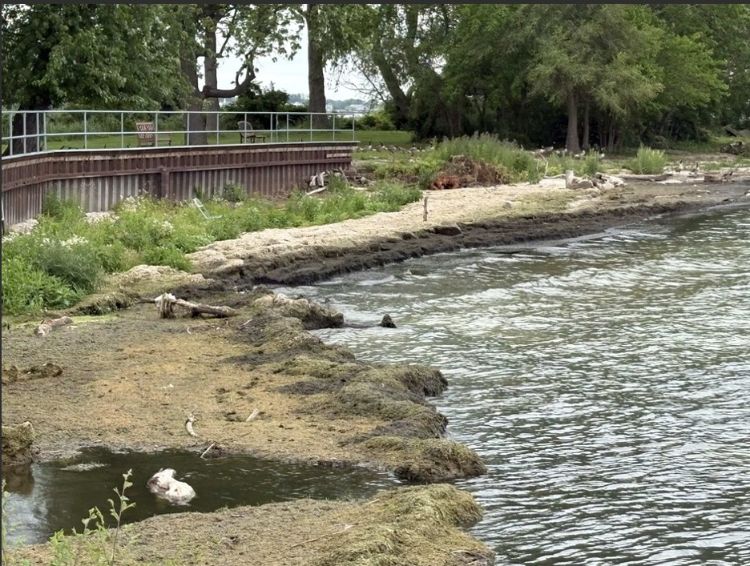
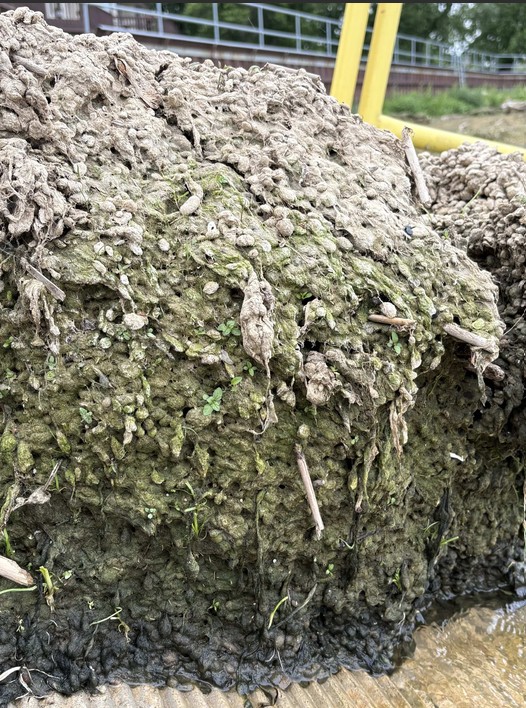
For decades, residents living along the U.S. side of Lake St. Clair have been reporting “muck” accumulating on beaches, especially in Macomb County. The muck is Microseira wollei, a type of cyanobacteria that can form mats. As a benthic algae, Microseira grows near the lake bottom. With the addition of wave action and currents, mats of Microseira are transported to shore and accumulate, making it difficult for people to use boat launches or recreate there. As a type of cyanobacteria, Microseira is also capable of producing toxins that can be harmful to wildlife, people, and pets. A bloom of Microseira is considered a harmful algal bloom (HAB) because of the presence of toxins.
Looking for answers
In 2023, Macomb County and the U.S. Army Corps of Engineers funded a two-year project to study the muck and propose potential management solutions. In 2025, the state legislature provided $800,000 funding for three years of Microseira management in Lake St. Clair (2026-2028). The management will include the removal of algal biomass and monitoring to determine success, including how long it takes the mats to return. Toxin testing of Microseira will also take place at five beach locations in 2027 supported by a Great Lakes Restoration Initiative grant.
What to do if you suspect a harmful algal bloom
Report information online to Michigan.gov/HABs or call EGLE’s Environmental Assistance Center at 800-662-9278. Take clear pictures that show the bloom close up, with a leaf or familiar object to show scale. Get photos of the surroundings, too, and try using your map or camera app to pinpoint the location.
If you suspect a HAB is present, don't touch the water. HABs can cause human health impacts like skin rashes, runny noses, stomach pain, and headaches. Also keep livestock and pets away from the water. If you think a domestic or wild animal is ill or dead because of a HAB, submit one of the forms on the EGLE HABs webpage.
Learn more
You can learn more about the muck in Lake St. Clair through these online resources:
- Lake St. Clair muck update, a talk given by Josh Tellier and Kevin Goodwin of Michigan’s Department of Environment, Great Lakes, and Energy (EGLE) during an April 2026 fishery workshop hosted by Michigan Sea Grant.
- A StoryMap "Microseira wollei in Lake St. Clair" includes photos and maps of the muck.
- A recent fact sheet also describes Microseira wollei and related health risks.
To learn more about harmful algal blooms:
- View this short introduction video from Michigan Sea Grant.
- Visit Michigan Sea Grant HABs 101 resources website.
Michigan Sea Grant helps to foster economic growth and protect Michigan’s coastal, Great Lakes resources through education, research and outreach. A collaborative effort of the University of Michigan and Michigan State University and its MSU Extension, Michigan Sea Grant is part of the NOAA-National Sea Grant network of 34 university-based programs.
This article was prepared by Michigan Sea Grant under award NA24OARX417C0157-T1-01 from the National Oceanic and Atmospheric Administration, U.S. Department of Commerce through the Regents of the University of Michigan. The statement, findings, conclusions, and recommendations are those of the author(s) and do not necessarily reflect the views of the National Oceanic and Atmospheric Administration, the Department of Commerce, or the Regents of the University of Michigan.