Michigan grape scouting report – May 4, 2026
 Print
Print Email
EmailConcise, research-based updates on weather trends, vine development, pest pressure and disease risk. Use these timely insights to guide informed, proactive vineyard management decisions and optimize vine health and productivity.
Welcome to the 2026 Michigan grape growing season
These grape scouting reports are designed to keep growers and industry members informed about seasonal progress, vineyard conditions, and pest and disease dynamics across multiple Michigan locations while also sharing timely announcements and upcoming events.
Over the past several years, the Michigan State University Extension grape team has continuously worked to improve the usefulness and effectiveness of this report, and last season many of you took the time to complete a brief survey to help guide those improvements. Thank you for that feedback. Your responses confirmed that growers most value site‑specific observations, grape development data and practical pest, disease and vineyard management insights.
Based on your input, we have shifted this year to a bi‑weekly reporting schedule, allowing us to deliver more substantial and relevant content rather than repeating similar information week to week. Please know that a large statewide team continues to scout vineyards regularly, and our goal remains to provide clear, timely insights that reflect what is happening across Michigan’s diverse growing regions. We welcome your questions, suggestions and ideas. Your feedback helps shape future reports.
Key takeaways
- Northern Michigan vine development is progressing slowly due to recent cool conditions, as grapes remain dormant to pre-bud swell.
- Southern Michigan has seen several frost and freeze events resulting in damage and loss of primary shoots in many locations.
- Early-season disease risk is increasing in southern Michigan (phomopsis, black rot); protective programs should be in place.
- Insect activity (grape berry moth, gallmakers, leafhopper) has begun; monitor especially in young vineyards.
- Critical management window: early disease protection, shoot thinning (5–12 inches), and pre-season nutrient planning.
Regional weather and seasonal progress
Seven-day forecasts for Michigan grape regions are as follows:
- Southwest Michigan: Benton Harbor, Fennville, Lawton, Watervliet
- Northwest Michigan: Old Mission, Suttons Bay, Traverse City, Leland, Northport
- Tip of the Mitt AVA: Petoskey, Harbor Springs, Charlevoix, East Jordan
Weekly in-season weather updates are provided to the MSU Extension fruit team by Jeff Andresen, PhD, MSU agricultural meteorologist. These reports offer timely insights into weather conditions affecting fruit production across Michigan. You can watch recordings of these agricultural weather outlooks.
Growing degree day (GDD) report
You can track vine development using the MSU Enviroweather Growing Degree Day Map. Visit the Enviroweather site to find your nearest weather station, create a free account, and monitor GDDs daily.
Biweekly GDD summary (base 50 degrees Fahrenheit)
The following table summarizes current GDD accumulation, last week's totals and the biweekly increase for each monitored location across Michigan:
|
Location |
Current GDD (Base 50 F) |
Forecast GDD (Base 50 F) |
Average Annual GDD Accumulation (Base 50 F) |
|---|---|---|---|
|
Southwest Michigan |
327.4 |
355.6 |
~2,700–3,100 (typical ≈ 2,900) |
|
Northwest Michigan |
97.8 |
104.3 |
~2,200–2,500 GDD (typical ≈ 2,350) |
|
Tip of the Mitt AVA |
97.9 |
105.6 |
~1,900–2,200 GDD (typical ≈ 2,050) |
Vine development
Southwest and southeast Michigan
In locations not damaged by the spring frosts and freezes, juice grapes and early hybrid wine grapes are at approximately 3–6 inches of shoot growth, with clusters separating and beginning to elongate. Late hybrid and vinifera cultivars are generally between first leaf and about 1 inch of shoot growth. For much of April, early bud break varieties were up to 14 days ahead of long-term averages for development. However, the recent stretch of cool weather has slowed development. These conditions are expected to persist through the weekend, slowing development closer to in line with the long-term averages.
In southwest Michigan, grape growers experienced a significant freeze on April 7 with low temperatures in the mid-20s causing sporadic damage to low lying areas. Only juice grapes and very early hybrids were advanced enough to be injured at that time. Primary bud damage levels of 0–90% were observed, depending on location. A second frost event on May 2 saw temperatures in the upper 20s. At this time, most grapes have green tissue. Once again, low lying areas had the most damage with some locations seeing over 75% primary shoot loss, but others were untouched. Secondary shoots have begun growth in areas damaged by the April freeze. Locations damaged by the May frost are still assessing the levels of damage.
In the southeast part of the state, juice grapes are getting into shoot elongation in the warmer areas close to the Ohio border and hitting bud burst in cooler parts of the region. Hybrid wine grapes in the Romeo area are between full swell (Petite Pearl) and bud burst (Marquette).
Northwest Michigan
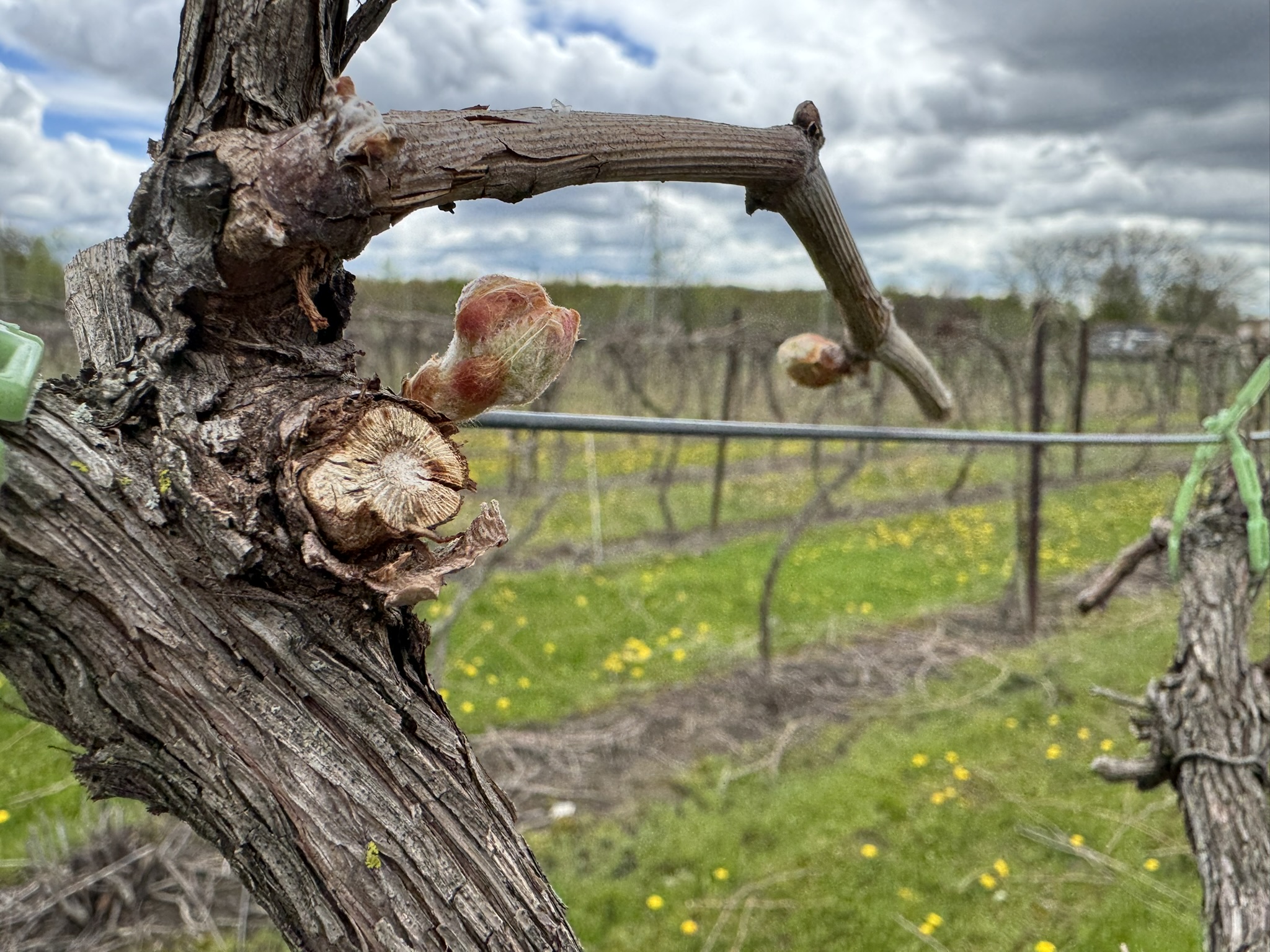
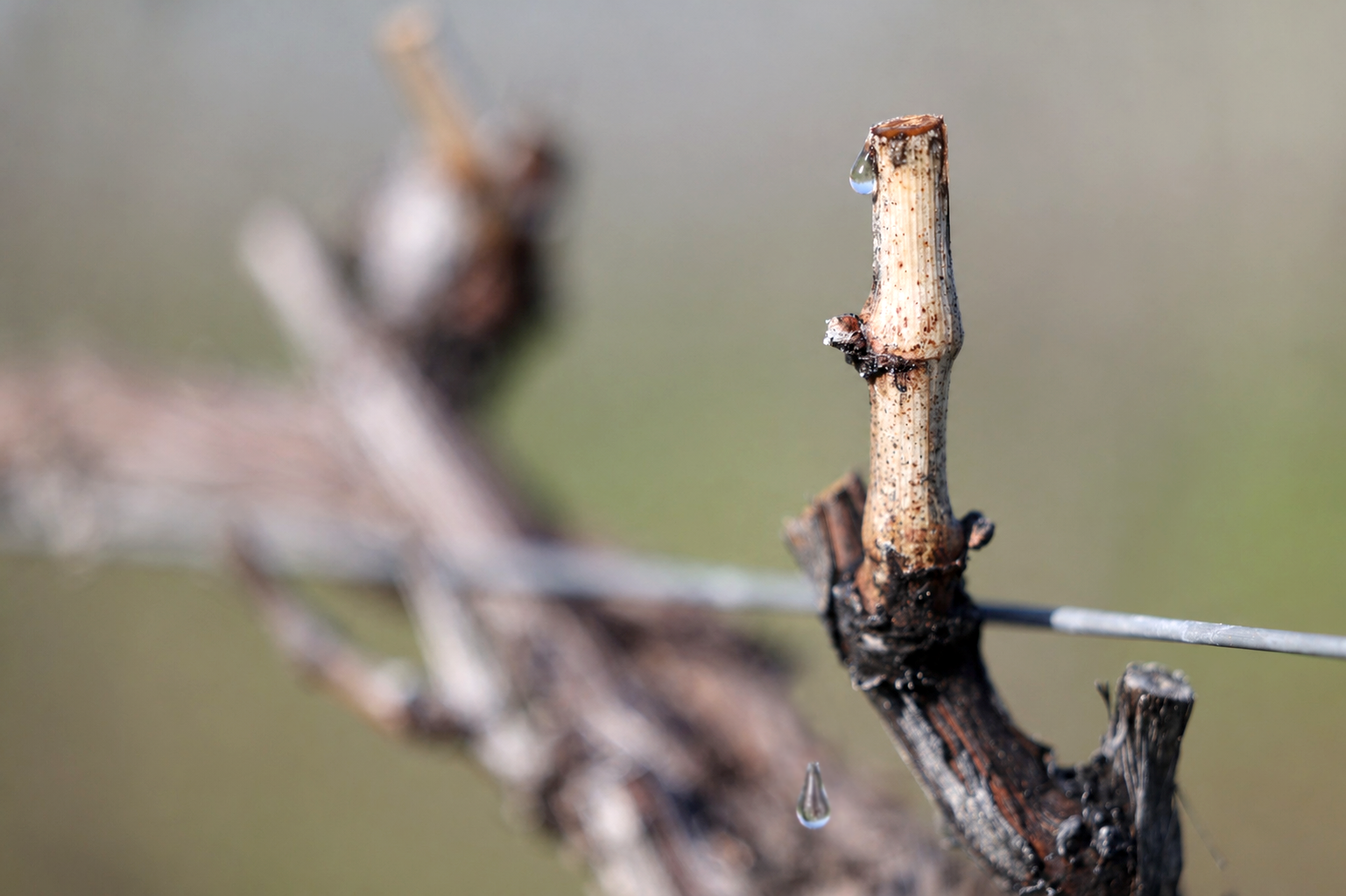
Most Vitis vinifera cultivars remain in the dormant stage with no visible bud swell or bud break. Sap flow, or “bleeding,” has begun in some pruned vines, indicating vines are transitioning out of dormancy. The recent cool temperatures have slowed vine development and are likely to delay bud swell and bud break. Under warmer conditions, bud break would typically be expected within seven to 10 days, but current weather patterns may push this timeline further. Continued monitoring is recommended as conditions change.
Tip of the Mitt
In the Tip of the Mitt region, both vinifera and hybrid cultivars are largely still dormant due to cooler temperatures. Similar to northwest Michigan, no significant bud swell has been observed in vinifera cultivars. However, hybrid varieties, which tend to de-acclimate from winter quicker, may begin showing earlier signs of development as temperatures gradually increase. The recent cool weather has delayed progress, but as conditions warm, hybrids are expected to advance toward bud swell and bud break sooner than vinifera. Close monitoring is recommended over the coming days.
For reference, see MSU Extension’s grape growth stages chart.
Viticulture
Early-season nutrient management should be guided by recent soil test results and prior-year petiole analyses. These tools provide essential information on nutrient availability and help inform fertilizer decisions as vines transition from dormancy to active growth.
In southern Michigan, where vines have reached early shoot development, nitrogen applications may begin using split applications to support growth while avoiding excessive vigor. Consider micronutrients such as zinc and boron to support early shoot and reproductive development. Monitor potassium and magnesium levels in vineyards with known deficiencies.
In northwest Michigan and Tip of the Mitt regions, vines remain dormant or are approaching bud swell. Delay nitrogen applications until active growth is established. This period is well suited for reviewing soil test results, finalizing fertility programs, and preparing for timely nutrient applications.
Nitrogen management remains critical across all regions. Excessive nitrogen can result in overly vigorous growth, delayed phenology and reduced fruit quality, while insufficient nitrogen may limit vine growth and yield potential. Balanced applications, guided by analytical data, are essential.
Canopy and crop management
In southern vineyards, shoot thinning is expected to begin within the next one to two weeks, depending on site and cultivar. Early canopy management decisions, including shoot thinning and initial crop load adjustments, should be based on vine vigor and uniformity. In northern regions, these practices will follow as vine development progresses and should be planned accordingly.
Soil health
Maintaining soil health remains an important component of vineyard management. Practices such as cover cropping, maintaining organic matter and minimizing soil compaction contribute to improved soil structure, water availability and nutrient uptake throughout the growing season.
For more detailed guidance on shoot thinning and early-season vineyard practices, please refer to the article “Early season vineyard management.”
Pest management
Diseases
During this time of the year, the primary diseases of concern for grape growers are phomopsis cane and leaf spot, black rot, anthracnose, downy mildew and powdery mildew. Additional details on pre-bloom fungicide options and the influence of rainfall on disease spread can be found in the article “Early season vineyard management.”
Except for powdery mildew, these spring disease infections typically require rain events. It only takes 0.1 inches of rain above 50 F to trigger a possible infection for black rot. Viticultural practices that reduce canopy wetness, such as irrigation timing, leaf removal and weed management, can reduce many of these diseases in a vineyard. For true fungal diseases, DMIs (FRAC 3), QoIs (FRAC 11), captan (M4) and EBDCs (FRAC M3, i.e., mancozeb) are effective for phomopsis, black rot and anthracnose. Effective systemic fungicides for downy mildew include products in FRAC codes 4, 11, 21, 40 and 45, as well as phosphorus acid salts and some biologically-based products (e.g., Lifegard). When using fungicides, be careful of phytotoxicity-related issues that may occur in Concord, Niagara and some grape hybrids (e.g., copper-based products).
Insect pests
The first grape berry moth males have been trapped during the last week in southwest Michigan vineyards. These are very early and there are not yet any females to mate with or grapes to lay eggs on. So, this does not require any management activities. We will continue to monitor this as spring develops.
Flea beetle damage to buds has been observed in some vineyard sites in southwest Michigan. We use 2% of buds damaged as an action threshold for this pest. The adult flea beetles lay eggs in the expanding buds. These eggs then turn into larvae that feed on young leaves. As the leaves expand, there will be window-pane types of damage to leaves in the coming weeks. This rarely causes economic damage.
Bud swell is also the key time for applying control treatments for grape erineum mite. Growers in northwest Michigan who have experienced this in recent years should consider a delayed-dormant oil or miticide application. With the predicted cold weather, it would be best to wait until a warmer period with no frost in the forecast if applying an oil treatment.
Weeds
Early-season weed control is important to reduce competition for water and nutrients, particularly in young vineyards. Maintaining a clean undervine strip supports vine establishment and early growth.
Scouting and recordkeeping tools
The growing season is an ideal time to implement efficient scouting, spray planning and recordkeeping systems. The Sustainable Agriculture Management (SAM) Tool, developed for Michigan grape growers, provides a user-friendly platform to support spray and non-spray task management.
Recent updates have improved functionality, including streamlined task planning, easier editing and duplication, improved activity tracking and enhanced communication features. The tool also offers a redesigned mobile interface and supports grower-participatory research.
The SAM Tool is free to use and suitable for vineyards of all sizes. Growers are encouraged to incorporate it into their operations to improve efficiency, organization and decision-making throughout the season.
Personalized onboarding and support are available through the SAM Tool team. For assistance or to schedule a walkthrough, visit the SAM Tool website or contact the team directly at SustainableAg@anr.msu.edu.
Events and announcements
We are pleased to share the upcoming schedule for this season’s P45 Third Thursday events. These sessions are designed to provide timely, field-based insights and practical demonstrations aligned with current vineyard conditions. More details will be shared as the season progresses. We encourage growers and industry members to mark their calendars and plan to attend.
June 18 – Mawby Vineyard | Compost Tea
Join us at Mawby Vineyard for a discussion on compost tea applications and their role in soil health and vineyard management. This session will focus on practical considerations, potential benefits and integration into existing vineyard programs.
July 16 – Northwest Michigan Horticulture Research Center | Sap Analysis
This session will highlight using sap analysis as an in-season tool for monitoring vine nutrient status. Discussion will include interpretation of results and how to incorporate sap data into nutrient management decisions during the growing season.
August 6 – Northwest Michigan Horticulture Research Center | Spray Efficacy Workshop
This workshop will focus on improving spray efficacy in vineyard systems. Timothy Miles, PhD, and Mike Reinke, PhD, will lead discussions on optimizing spray programs, coverage and disease control. The session will also feature demonstrations of drone-based sprayers and newly available autonomous spray technologies. Additional expertise from an invited out-of-state speaker is anticipated.
37th annual Michigan Viticulture Field Day and Enology Experience
Registration is opening soon for the 2026 Michigan Viticulture Field Day and Enology Experience.
The Michigan Viticulture Field Day program will highlight new technologies for grape growers with demonstrations of autonomous and smart spraying systems and electric weeders. Sustainable viticulture practices will also be showcased, such as non-chemical weed management strategies, sheep grazing and the new MSU regenerative and organic demonstration vineyards.
The Michigan Enology Experience will include discussions on innovative winemaking technology, a hands-on tasting workshop and guided tastings of experimental wines from Lake Michigan Vintners and other wineries from southwest Michigan. The day will conclude with a blind comparative wine tasting pitting Lake Michigan Shore wines against international standards.
2026 Dirt to Glass Conference
Registration is now open for the fifth annual Dirt to Glass Conference, taking place Aug. 20–21 in Traverse City, Michigan. Early bird pricing is available for a limited number of registrations.
Register for the 2026 Dirt to Glass Conference
The program features 23 speakers covering vineyard management, winemaking, soil science, vine physiology and wine evaluation, combining Michigan expertise with national and international perspectives. The conference is designed as a working forum with moderated panel discussions focused on practical, vineyard-to-winery decision-making.
Highlighted speakers include:
- Nick Dokoozlian (E. and J. Gallo) – vineyard-to-wine quality benchmarks
- Jacopo Miolo (Simonit and Sirch) – pruning and vine longevity
- Tom Plocher – disease-resistant varieties
- Madeline Triffon – sensory evaluation
- Bruno Basso (MSU) – soil health and site-specific management
The program also features applied sessions on scouting, soil biology and vineyard establishment.
A key focus this year includes collaboration with E. and J. Gallo to pair sensory evaluation of Michigan wines with advanced chemical analysis, supporting improved quality assessment and production strategies.
The conference includes a two-day format:
- Day one (Aug. 20): technical sessions, panel discussions and guided tastings at the Cathedral Barn at Historic Barns Park
- Day two (Aug. 21): field tours of vineyards and wineries with visiting experts
Space is limited. Day two participation requires day one registration.
This work is supported by the Crop Protection and Pest Management Program [grant no 2024-70006-43569] from the USDA National Institute of Food and Agriculture. Any opinions, findings, conclusions, or recommendations expressed in this publication are those of the author(s) and do not necessarily reflect the view of the U.S. Department of Agriculture.