


Michigan soybean on-farm research trials for 2026
 Print
Print Email
EmailSeveral different trials are being conducted on farms across the state to address issues soybean farmers ranked as important to their farms.
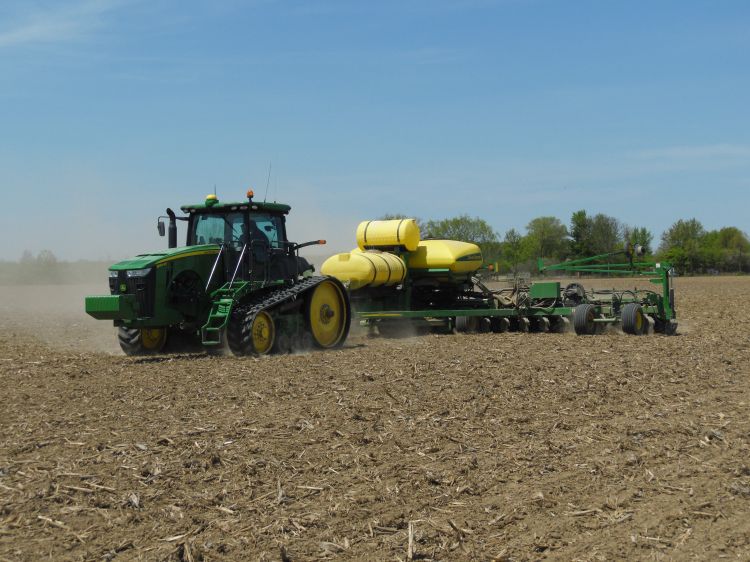
Every year since 2011, Michigan State University Extension has partnered with Michigan Soybean Committee (MSC) to conduct on-farm soybean research across Michigan to answer important production questions. Trial topics are selected each year based on feedback from farmers who attend winter soybean research update meetings. Trials evaluate a wide range of production practices and products and include treatment timings from pre-plant to flowering. In 2025, 12 trials were conducted on 51 fields with the help of 39 Michigan soybean farmers across all major soybean production regions. The success of the program relies on soybean farmers volunteering to host one or more trials on their farms that are of interest to them.
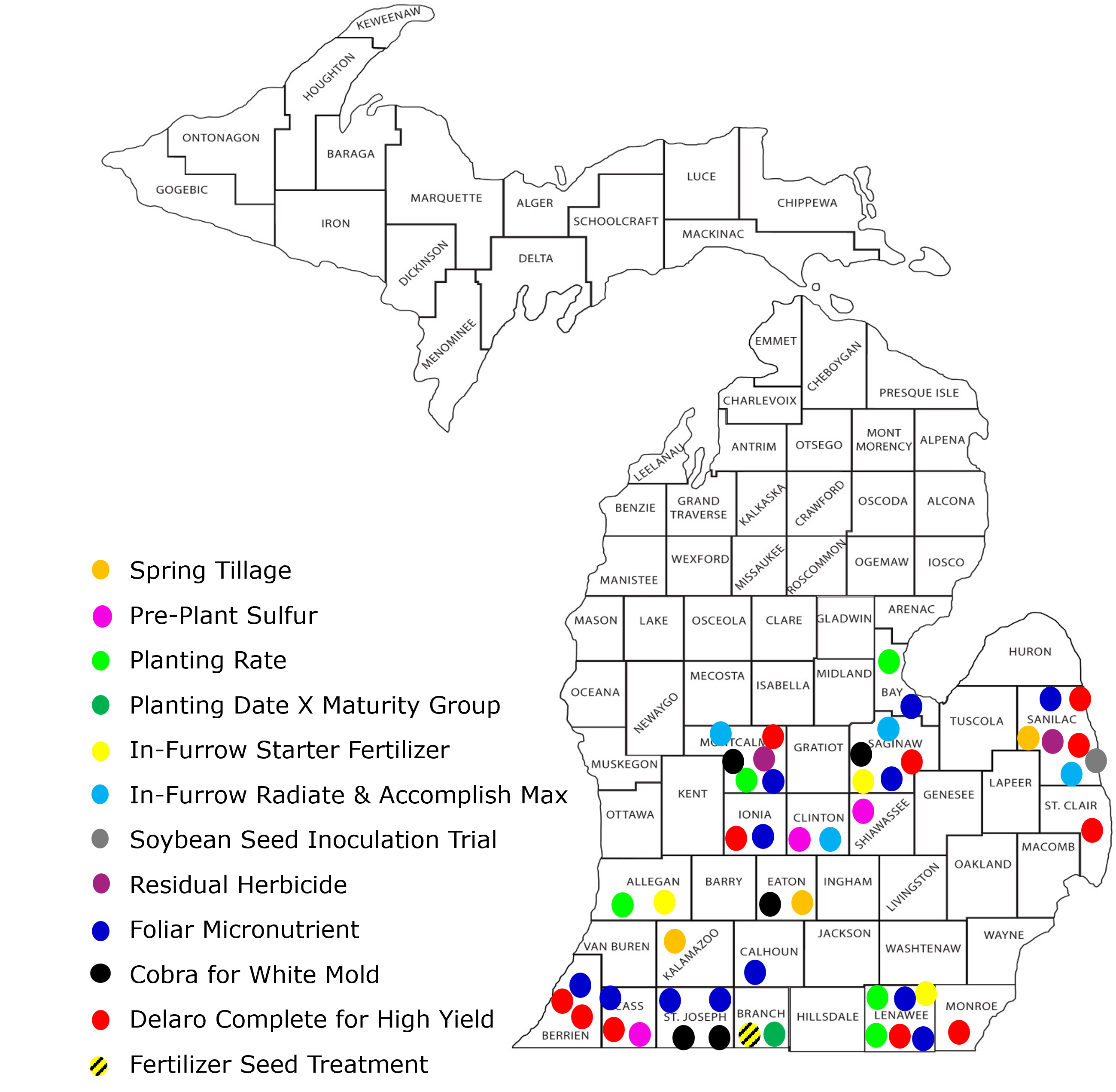
The projects we plan to conduct in 2026 are listed below. All trials will be replicated at least four times and must be oriented perpendicular to any existing tile lines. Detailed protocols for each project are available and should be obtained from Michigan State University (MSU) Extension soybean educator Eric Anderson (269-359-0565 or eander32@msu.edu), MSU Extension educator Teresa Crook (989-652-3552 or crookter@msu.edu) or MSC research director Mark Seamon (989-245-3100 or mseamon@michigansoybean.org) before conducting the trial.
Download Michigan Soybean On-Farm Research Projects for 2026
Pre-plant sulfur fertilizer
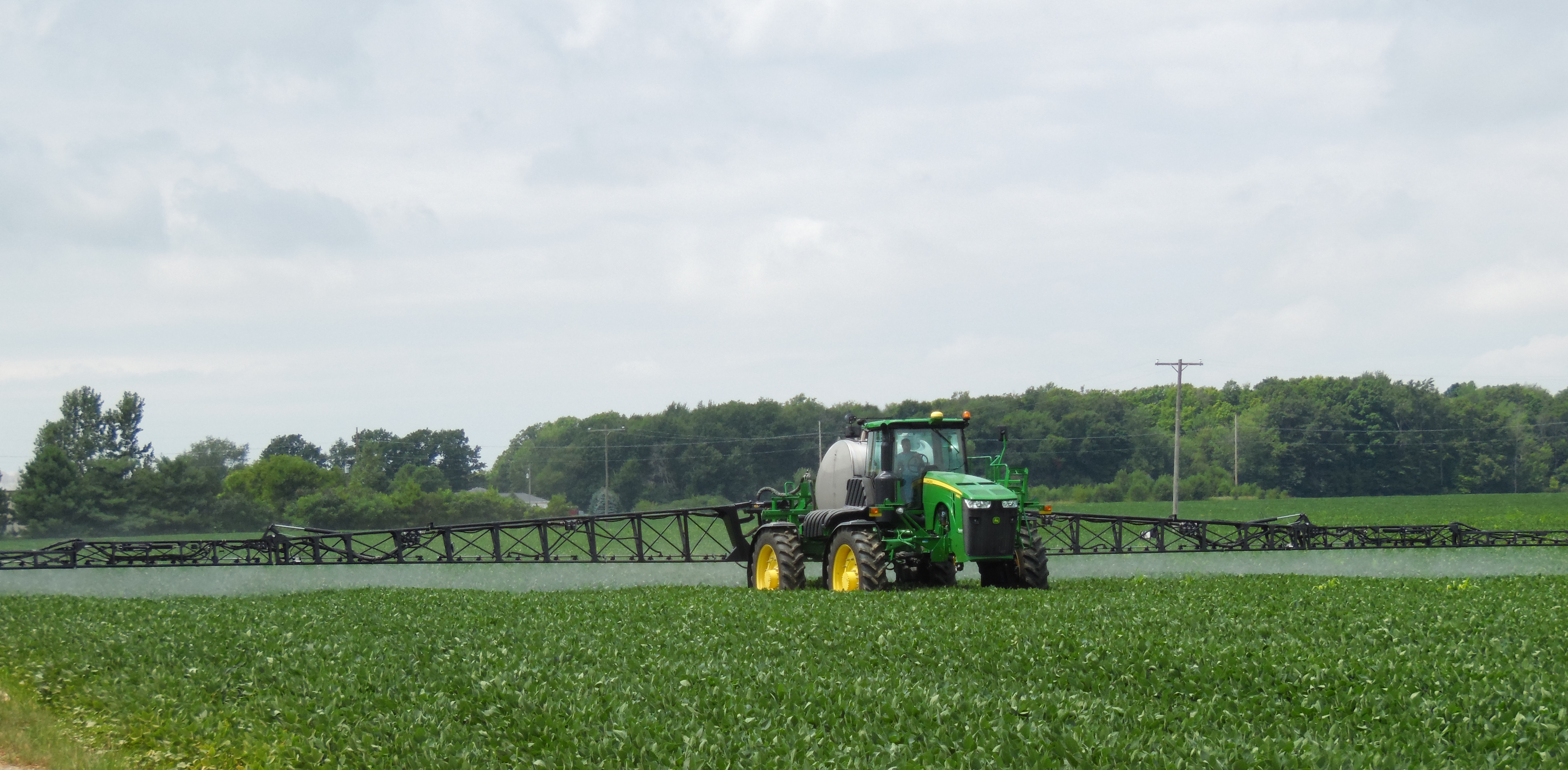
This project will evaluate the impact of sulfur fertilizer applied just prior to planting on soybean yield and income. Choose sites with light-textured soils and low organic matter. The treatments are:
- A broadcast application of 83 pounds per acre (lbs/A) granular ammonium sulfate (AMS, 21-0-0-24S) to supply 20 lbs S per acre applied prior to planting, lightly incorporated. For other application options, consult the trial organizer.
- Non-treated control (no sulfur fertilizer).
Planter box treatment
This project will determine the yield and income benefits of applying BioBoost Soy planter box treatment. The treatments are:
- BioBoost Soy planter box treatment applied at 0.75 ounces (oz) per unit. BioBoost Soy will be supplied by BW Fusion.
- Non-treated control (same seed lot without planter box treatment).
Planting date x seeding rate
This project will provide farmers with the optimum planting date (PD) and seeding rate (SR) for a given field as determined by Agroptimizer, a model developed at UW-Madison from a large nationwide database. The treatments are:
- PD and SR as recommended by the Agroptimizer platform. These recommendations will be based on input you provide along with research data collected over time. Note: Agroptimizer will provide recommendations on other management factors such as row spacing, fungicide use, and nitrogen application which you may choose to follow or ignore as part of the trial.
- PD and SR of your choice.
Planting date x maturity group
This project will measure the effect that planting date (PD) and maturity group (MG) have on soybean yield and income. The treatments will be a combination of the following factors:
- Planting date: In/near the third week of April as weather and soil conditions versus three to four weeks later. If only one PD is feasible, the trial can still be conducted with a late April PD.
- Maturity group: Two varieties that are nearly one full MG different with all other traits being as similar as possible. These could be the longest and shortest MGs you plan to plant.
Seeding rate
This project will identify the optimum agronomic and economic seeding rate for a given planting scenario. Ideally, this will be done with a planting prescription using numerous seeding rates—we will provide you with a prescription .shp file once a field is selected. If planting without a prescription, four replications will be planted with four planting rates—70K, 100K, 130K and 160K seeds per acre.
Deer repellent
This project will determine the efficacy of two applications of M-Pede as a deterrent to deer feeding in soybean and their effect on yield and profitability. The ideal trial field will have good yield potential, a history of moderate deer feeding and the possibility of a trial layout that could be fair to test product performance. The trial will be conducted with alternating treatment strips replicated four to six times. The treatments are:
- Two foliar applications of M-Pede at 25 fluid ounces per acre each applied during early vegetative growth stages. M-Pede will be provided by Gowan Company.
- Non-treated control.
Residual herbicide
This project will evaluate the effect of a residual herbicide applied preemergence (PRE) or postemergence (POST) on soybean yield and income. This trial is especially beneficial to producers who 1) do not plan to apply a residual herbicide prior to soybean emergence (PRE) or 2) will apply a PRE residual herbicide but do not plan to include a residual with their POST herbicide application (layered residual), particularly in fields with late-season flushes of grass and Amaranth (pigweed) species.
- When applying the residual PRE, the two treatments include:
- Tillage or a burndown PRE application only (products selected and provided by the cooperator).
- Tillage or a burndown PRE application (products selected and provided by the cooperator) with a residual herbicide, Boundary (S-metolachlor plus metribuzin) at 1.2–3.6 pints per acre depending on soil type, organic matter and tillage practice (see label). Boundary will be provided by Syngenta.
- When applying the residual POST, the two treatments include tillage or a burndown application PRE (preferably including a residual herbicide), followed by:
- A POST herbicide application only (products selected and provided by the cooperator).
- A POST application tank mixed with a residual herbicide, Dual Magnum (S-metolachlor), prior to R2 at 1.0–2.0 pints per acre depending on soil type and organic matter (see label). Dual Magnum will be provided by Syngenta.
Nexta supply foliar
This project will evaluate the impact on yield and income from an application of Nexta Supply which contains a bacteria that colonizes the plant and converts atmospheric nitrogen (N) into ammonium that can be metabolized by the crop when existing N supplies are depleted. This product has been found to be most beneficial in soybean crops that exceed 65 bushels per acre (bu/A). The treatments are:
- A postemergence herbicide selected by the cooperator tank-mixed with Nexta Supply at 5 oz/A applied between V4 and R1 growth stages. Nexta Supply will be provided by Corteva Agriscience.
- The same postemergence herbicide applied in treatment 1 without Nexta Supply.
Micronutrient foliar
This project will evaluate the effect of MicroStrike Bean, a micronutrient product (2.25% B, 2.25% Zn, 0.75% Mg, 1.25% Mn) on soybean yield and profitability. The treatments are:
- A postemergence herbicide selected by the cooperator tank-mixed with MicroStrike Bean at 1 quart per acre applied between V4 and R1 growth stages. A second optional pass can be made tank-mixed with a fungicide/insecticide application at R2–R3. MicroStrike Bean will be provided by Crop Performance LLC.
- The same postemergence herbicide applied in treatment 1 without MicroStrike Bean.
Cobra herbicide for white mold
This project will evaluate the effect of a single foliar application of Cobra herbicide on soybean yield and income when applied to fields having a history of white mold. The treatments are:
- A postemergence herbicide selected by the cooperator tank-mixed with Cobra herbicide at 6 fluid ounces per acre at or just prior to R1. Cobra will be provided by Valent.
- The same postemergence herbicide applied in treatment 1 without Cobra
Fungicide for high yield
This project will evaluate the effect of a single foliar application of an inexpensive fungicide—Trevo TRZ DRV from Innvictis Crop Care, LLC—on soybean yield and income when applied in environments with no specific expected disease pressure. The treatments are:
- A single foliar application of Trevo TRZ DRV (azoxystrobin plus tetrazonazole) at 12.8 fluid ounces per acre with Adversary adjuvant (spreader, penetrant, drift control agent) at 1 quart per acre made at the R3 growth stage (one 3/16-inch-long pod on any one of the upper four nodes having an unrolled leaf on 50% of plants in the field). Trevo TRZ DRV and Adversary will be provided by Simplot Grower Solutions.
- Non-treated control.
Contact Eric Anderson (269-359-0565 or eander32@msu.edu) with any questions or to sign up for a trial. Products with certain trials have limited quantities and are available on a first-come, first-served basis. Research results from past years are summarized in annual reports accessible at the Michigan Soybean Committee website.