Microdochium patch (pink snow mold) of home lawns and golf courses
 Print
Print Email
EmailMicrodochium patch, commonly known as pink snow mold, is a common low-temperature disease of turfgrass in Michigan.
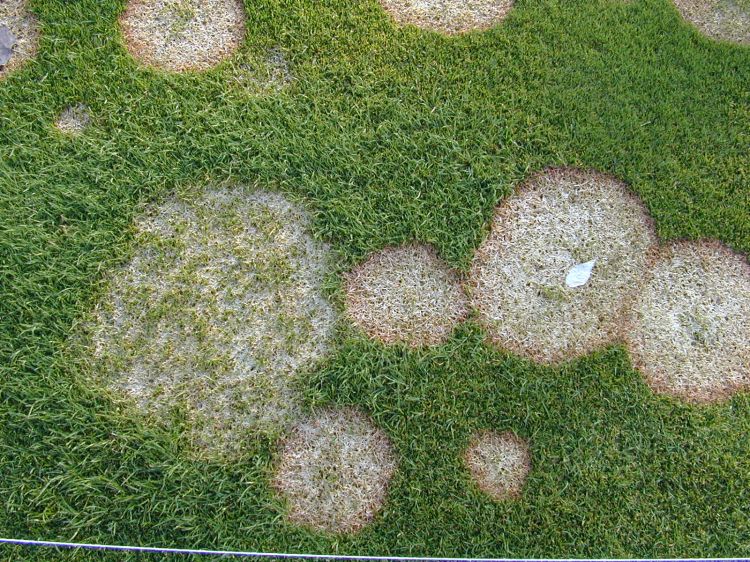
It’s the time of year when we’re thinking less about snow and more about spring and summer weather. Microdochium patch is a major winter turf disease, but damage can occur from spring through early summer. Also known as pink snow mold, because it appears as tan to pale pink patches observed after snow melt, as compared to gray snow mold, which develops white to gray to straw-colored patches (Photo 1). The research community advocates using the name Microdochium patch instead of pink snow mold because this disease does not require snow cover to develop. Microdochium is the Latin genus name of the causal fungal pathogen of the disease, Microdochium nivale. Previously, this disease was also known as Fusarium patch.
Microdochium patch is a major disease of turf in areas with extended periods of cool, wet weather. Symptoms on closely mowed golf course turf appear as tan to salmon-colored circular patches from 1 to several inches in diameter, typically with pink to reddish-brown perimeters. White or pinkish fungal growth can often be seen at the advancing edge of the patch. The center of the patches may contain green grass tissue that has recovered from the disease. Under conducive environmental conditions, patches may grow and coalesce to form larger affected areas.
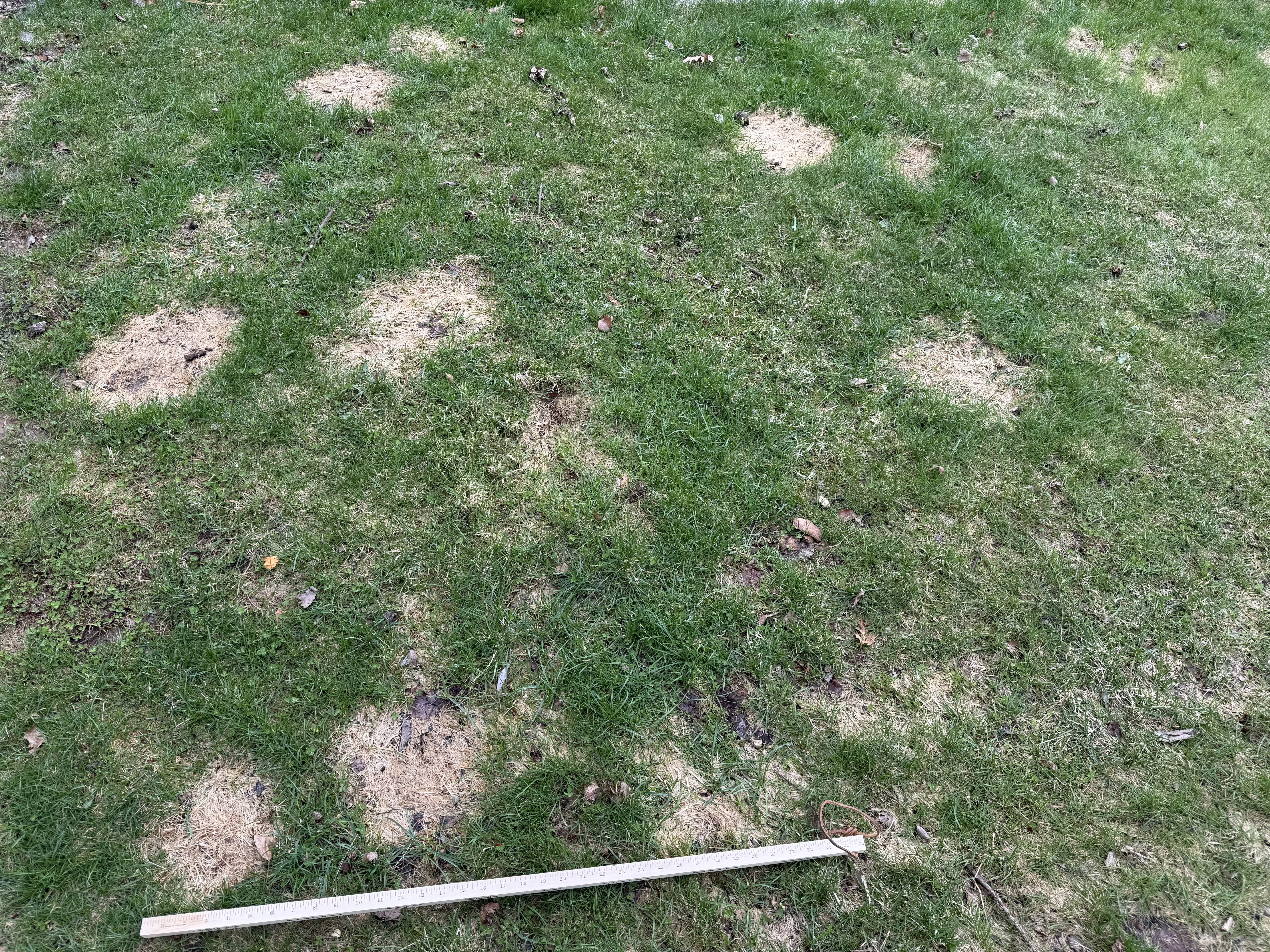
The presence of the pink or reddish-brown rings on the outer edge of the patches is a key identifying characteristic of Microdochium patch and distinguishes it from gray snow mold, which appears as straw-colored patches without distinct borders (Photo 1). Disease symptoms on turf mowed at higher heights, like lawns or sports fields, are generally a smokier brown color than tan and pinkish (Photo 2).
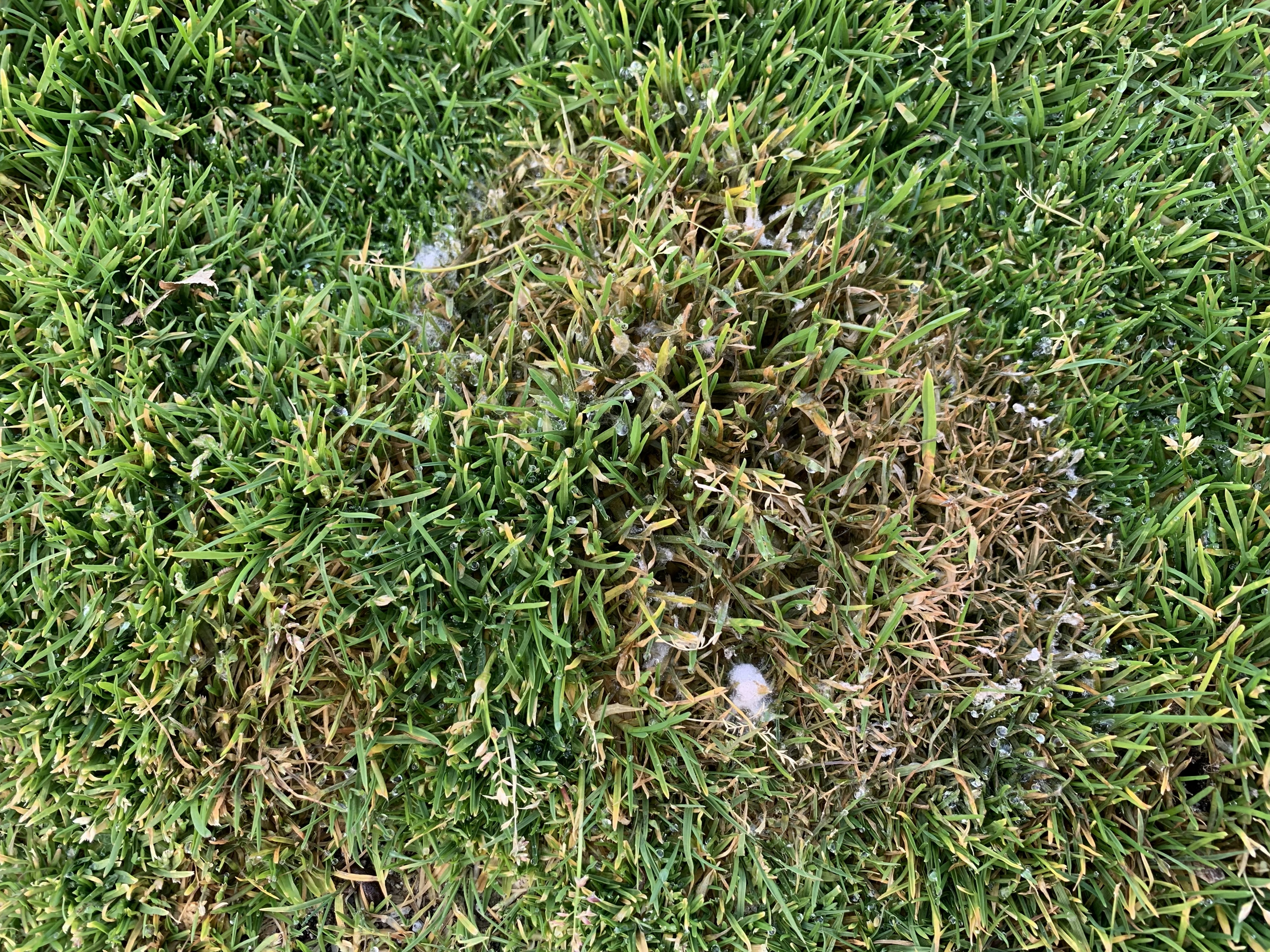
Another common problem from home lawns is dog urine damage; it can appear after snow melts in the spring (Photo 3). Urine damage from your pet friends can be very similar in size to Microdochium patch, but these “patches” do not have distinct borders, variations in color, or fluffy mycelia (Photo 3). Therefore, the proper identification of turf diseases is very important.
Microdochium patch can be found in the same areas where gray snow mold may occur. When it is not infecting the turf, the pathogen can survive as mycelia and spores in the thatch and will actively grow on the grass residue until infection takes place when temperatures are below 60 degrees Fahrenheit (15.5 degrees Celsius). Snow cover is not necessary for infection; cool, wet periods of 32-46 F or 0-8 C, especially those with alternating freeze/thaw cycles, fog and light drizzling rain, are most conducive for disease development and proliferation, making it an important disease in the Pacific Northwest of the United States and Canada, the United Kingdom, and parts of Scandinavia.
In Michigan, Microdochium patch can occur in fall, winter, spring and early summer during the months of September through June, whereas gray snow mold appears in the spring only. All commonly used cool season turfgrasses are susceptible to Microdochium patch, and host resistance has not been reported.
While increasing nitrogen fertilization is recommended for managing many turfgrass diseases, including dollar spot, red thread, rust and Waitea patch, fertility that leads to lush turf growth just before the snow mold season in the fall will make turf more susceptible to Microdochium patch. Therefore, fertilizer applications should be timed accordingly to avoid heavy fall applications before dormancy in Michigan.
In regions with snow cover, nitrogen applications should be scheduled early enough to give the turfgrass a chance to harden off before the snow or frost sets in, or before grass becomes dormant during cold winter periods, rather than forcing the turfgrass to vigorously grow into the winter. For lawns, research from Wang et al. in 2024 shows that fall mowing at a slightly lower height of cut than your normal summer mowing can remove excess foliage and help prevent turf matting, thereby aiding in eliminating a potential "microenvironment" conducive to disease development.
Chemical control strategies for Microdochium patch can be different depending on the climate but are generally not recommended for home lawns. In golf settings, many contact fungicides such as chlorothalonil and mancozeb can be used to manage Microdochium patch where there is no lasting snow cover, but multiple applications may be required (every two to four weeks). Where snow cover persists for three or more months, systemic fungicides must be used in the fall to provide long-lasting protection of the turf. Re-application in the spring may be necessary.
The DMI and dicarboximide fungicides are among some of the systemic fungicides shown to be effective in managing the disease; however, strains of M. nivale resistant to these fungicide chemistries have been reported, according to research from Gourlie and Hsiang in 2017 and 2022. Further research has been conducted using fungicide alternatives for disease management. Repeated applications of iron sulfate and phosphite products have been shown to reduce Microdochium patch severity without snow cover, according to Mattox et al. in 2023; however, these products fail to provide consistent suppression of the disease during extended periods of snow cover, according to research form Koch and Hockemeyer in 2021.
Reference to commercial products or trade names does not imply endorsement by Michigan State University Extension or bias against those not mentioned.