MSU entomologists rediscover beetle species first documented by Spartan scientist more than a century ago
 Print
Print Email
EmailMSU entomologists discovered a species of bark beetle in the Philippines that had not been documented since it was first collected in the early 1900s by Charles Fuller Baker, an MSU alumnus and pioneer entomologist.
More than 100 years after an MSU entomologist collected bark beetles in the Philippines, a new generation of Spartan scientists unknowingly retraced his footsteps.
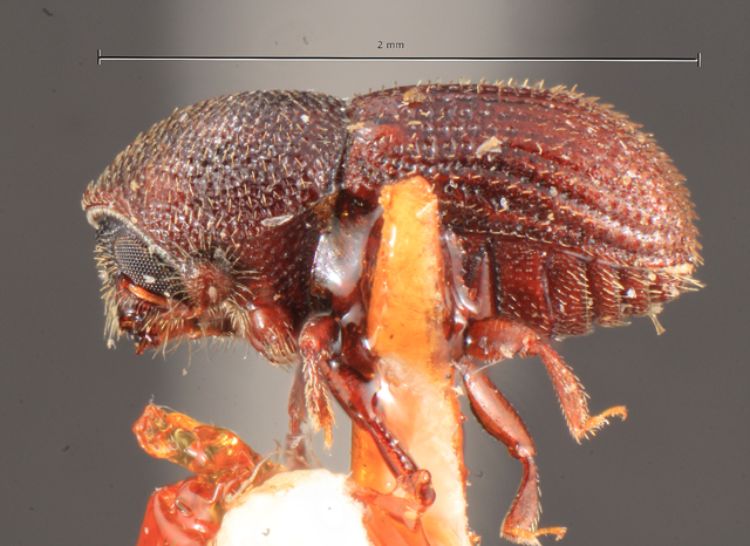
During a biodiversity expedition to the Philippines, Michigan State University entomologists Anthony Cognato and Sarah Smith collected more than 1,000 bark and ambrosia beetles. While identifying the specimens back in East Lansing, they discovered that one of the insects, Eidophelus ater, had not been documented since it was collected by Charles Fuller Baker, an MSU alumnus and pioneering entomologist who worked in the Philippines in the early 1900s.
As director and curator of the A.J. Cook Arthropod Research Collection, Cognato along with Smith, the collection’s manager and curator, recognized a geographic gap in the collection's bark beetle holdings. The Philippines has long been a significant but understudied region for bark beetle research. For much of Cognato's career, collecting insects there was difficult because research permits required local collaborators, and few researchers specialized in beetles.
That changed when Cognato and Smith connected with Dr. Milton Norman Medina of Davao Oriental State University in Mindanao. Medina, whose work focuses on Philippine beetle biodiversity, invited the MSU researchers to collaborate and train his students in bark beetle collection techniques.
The research team collected bark and ambrosia beetles from forests across multiple locations in the Philippines. After returning to MSU, they began the meticulous process of identifying each specimen using scientific literature and reference material from the A.J. Cook Arthropod Research Collection.
"While in the field there is not time or resources to identify most specimens to species with certainty," Cognato said. "So back at our lab at MSU, we spend much time determining the identity of the specimens."
Because bark and ambrosia beetles are extremely small, identification often requires microscopes and, in some cases, DNA analysis.
As researchers compared specimens with historical records and type material, they identified one species as Eidophelus ater. The species' label information ultimately led them to specimens preserved at the Smithsonian's National Museum of Natural History, where they discovered a remarkable connection: the species had last been collected by Baker more than a century earlier.
Researchers collected 1,023 bark and ambrosia beetle specimens representing at least 69 species, 35 genera and 14 tribes. Several species had not been collected in more than 100 years, and the team identified a number of species that appear to be new to science.
For Cognato, the rediscovery of Eidophelus ater was significant not only because it confirms the species still exists, but also because it demonstrates the lasting value of scientific collections and the researchers who built them.
"This discovery makes us connected to the long history of MSU alumni and faculty who have influenced the development of agricultural sciences," Cognato said. "It is a grand feeling to be part of that legacy."
Baker was among the first scientists to collect bark beetles for scientific study in the Philippines. His specimens, many of which represented species new to science, were later preserved in museum collections and continue to support researchers today.