Michigan State University launches an innovative real-world farming competition
 Print
Print Email
EmailMSU-TAPS serves as a powerful bridge between research and practice. Researchers evaluate emerging technologies under real production conditions, while producers gain first-hand insight into how new tools perform in Michigan.
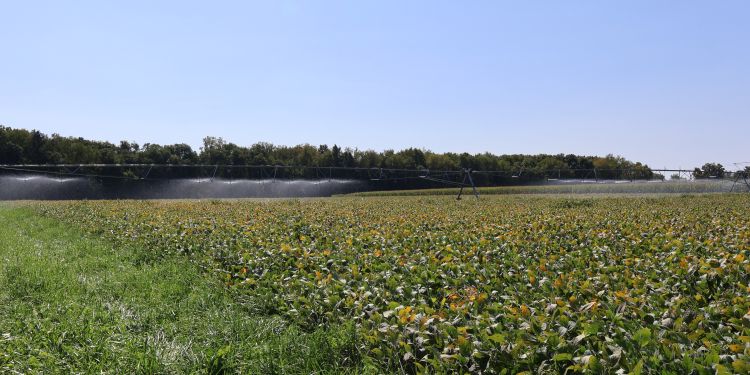
Michigan State University (MSU) Extension is excited to bring the Testing Ag Performance Solutions (TAPS) program to Michigan stakeholders. TAPS is an interactive, real-world farm management competition that challenges participants to make practical, data-driven decisions throughout the growing season — just like they would on their own farms.
Modeled after successful TAPS programs at the University of Nebraska–Lincoln, Colorado State University and Kansas State University, MSU-TAPS allows participants to manage a real field throughout the growing season.
TAPS brings together producers, researchers, industry partners, students and government agencies to test precision agriculture technologies, evaluate management strategies and strengthen decision-making skills in a collaborative setting.
Throughout the season, participants use real-time field data, weather information and production scenarios to guide decisions on irrigation and nitrogen timing and rates, and fungicide applications.
Learn by doing but without the risk
Unlike traditional field days or workshops, TAPS puts you in the driver’s seat. Participants design the management strategies that are then implemented in research plots at MSU’s Kellogg Biological Station. Season-long decisions are implemented in real time on randomized, replicated plots equipped with a variable rate irrigation system capable of fertigation and chemigation, all according to the decisions entered through the online competition portal.
The best part? You focus on making the management decisions — MSU handles field operations.
In this low-risk environment, competitors can experiment with cutting-edge tools to enhance decision-making, including:
- Satellite and drone imagery
- Soil moisture and plant sensors
- Local weather station data
- Irrigation scheduling tools (spreadsheet-based, app-based, etc.)
Participants select their preferred irrigation scheduling method, and MSU will provide and install the necessary equipment. At the end of the season, competitors receive a comprehensive dataset to analyze results and refine future management strategies.
MSU-TAPS
MSU is currently recruiting participants for its first TAPS competition. Participants may compete individually or as teams and will make four management decisions throughout the growing season on corn and soybeans.
The competition will include:
- A spring kick-off lunch meeting to introduce tools and launch the competition
- An in-season summer field day to observe differences in management strategies
- A post-season awards luncheon recognizing top-performing teams
Cash prizes will be awarded in two categories:
- Most input efficient
- Highest yield
Interested in participating?
Sign up for MSU-TAPS Competition
If you would like to learn more about the TAPS model, join the MI Ag Ideas to Grow With webinar on March 5, featuring a University of Nebraska-Lincoln professor who will share insights on how their TAPS program engages nearly 200 participants annually and drives innovation in farm management.
If you have any questions about TAPS, reach out to Angie Gradiz or Younsuk Dong, PhD.