Navigating fall seed orders and free farm hats
 Print
Print Email
EmailSecuring the seed purchases you want at the lowest possible cost.
Have you placed your seed order yet—to secure your free hat? Free hats or other rewards have become synonymous with ordering seed over the decades, and it’s getting to be that time of year when seed companies start visiting farms to secure next year’s corn and soybean orders. What seed you decide to order is a key part of your farm’s profit potential. Every bag of seed you buy needs to perform well on your acres and be at a reasonable price.
To get the most out of your seed order, start with planning ahead and understanding the options.
Evaluating varieties on the farm
The first place you should look to evaluate seed options is on the acres currently planted. You may have some yield numbers as harvest has begun, but if you aren’t in harvest yet, taking early yield estimates helps to determine what hybrids/varieties you want again next year. How and when to take yield estimates is essential. You want to be consistent in the methods used for estimates so that you have accurate, reliable information on each variety.
For corn and soybean estimates, refer to the Michigan State University Extension articles “Estimating corn yield potential” and “Estimating soybean yields prior to harvest.”
Yield is our main performance indicator, but the management it took to get those yields is also important. Each variety comes with expectations based on what we saw in test plots or read in the seed catalog. Consider how those expectations match what happened in-season on your farm. The key is to identify varieties that meet expectations more often without added management.
The varieties or hybrids that require more management (for example, an extra fungicide pass because they are more susceptible to certain disease) often result in additional costs. These costs need to be considered when looking at seed prices. Those additional costs may mean a higher performer doesn’t come back next year if it does not have enough of a yield advantage at harvest.
Evaluate new varieties when opportunities are present
One of the best opportunities to evaluate new varieties is to see them in a test plot. Seed companies and local retailers often have test plots scattered throughout the region. Test plots can give you a visual of how they could perform on your farm.
The next step is to combine what you see at these test plots with third-party research trials. Independent variety and hybrid trials offer unbiased, objective data on performance between seed options. The unbiased nature of third-party trials can be an advantage for farms seeking supporting data in addition to local seed companies or retailer trials.
However, one concern with independent research trials is that not all brands may be included in the trials. That does not mean the research data can’t be helpful. To get the most out of trial data, be sure to compare more than just variety or hybrid numbers when comparing trial information. Look for varieties or hybrids with similar traits or characteristics of other varieties and hybrids you are interested in. That comparison can help indicate what performs well in your area and provide talking points with your seed dealer on comparable options.
For information on variety trial data, visit MSU’s Variety Trial website. Additional trial data can also be found at First Seed Tests.
Seed guides are another helpful resource to identify options for your farm. They offer a one-to-one comparison of both old and new varieties. However, reading a seed guide can be a bit tricky since not every company uses the same rating systems or explanations of plant features.
To aid growers with reading seed guides, MSU Extension published Bulletin E-3430 How to Read a Seed Guide (Corn Edition) and Bulletin E-3431 How to Read a Seed Guide (Soybean Edition).
Also, check out Bulletin E-3545 Optimizing Corn Hybrid Maturity Selection for Maximum Yield and Profit in Michigan and Northern Regions.
Consider early discounts and financing programs
Once you have identified seed options, you want to buy them at the lowest possible cost. Early discounts and financing programs can be helpful to maximize cost savings.
Early order cash discounts may be a one-time offer or continue through fall at reduced rates. Discounts can be based on a percentage of the order or a flat fee per bag. Percentage-based discounts can require minimum quantities, such as the number of bags or acres. Flat fee discounts are often assessed on the amount of bags being ordered.
Often the best cash discounts are offered prior to harvest when cash may be limited. If cash is limited, continue to focus on evaluating varieties and hybrids to identify the best options. You can order swiftly and confidently once cash is available by knowing exactly what you want to buy.
Financing programs can vary as much as the variety options in a seed catalog. Some companies have their own programs. Others may work with a third party, such as John Deere Financial, Rabo AgriFinances LLC or Farmer’s Business Network. Each program may have different interest rates, terms, minimum purchase values and other conditions. However, most financing allows payments at or after harvest.
In years where cash is tight, utilizing financing options may be advantageous over locking up capital that could be used to save on other expenses, especially if zero interest is offered.
Common financing programs include:
- Early 0% interest. A common program offered is 0% interest on early orders, which can be used similarly to early discount programs. The difference is that there may not be any savings on the seed cost itself.
- Deferred financing. Companies may be willing to provide financing and delay the interest charge until a specified due date. Often the date is in fall or sometime after next harvest.
- Fixed APR. Financing programs that use an annual percentage rate (APR) includes an interest rate plus extra fees from the lender. Interest charges begin to incur once the seed order is placed until it is paid off in full.
- Prime. Some financing options are similar to APR but use the prime interest rate instead. Prime is a benchmark rate set by a survey of commercial banks. Prime is currently fixed at 7%.
Interest rates are often the most noticeable difference between financing programs and can impact the total seed purchase (Figure 1).
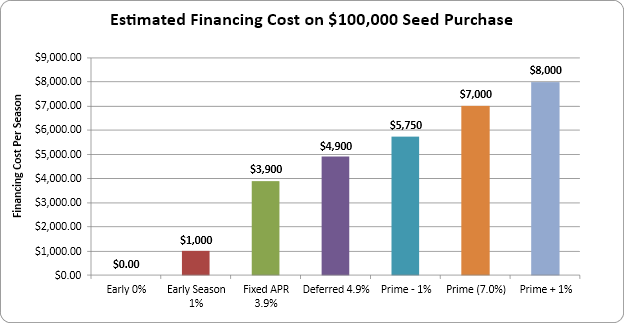
Figure 1 illustrates the importance of factoring interest costs into your farm’s total seed purchase. Depending on the program used for a $100,000 seed purchase, the additional charge for interest can be quite large. Factoring interest costs into your total purchase allows for accurate price per bag comparisons.
Secure the seed and the savings you want early
Ultimately, ordering next year’s seed is an exercise in supply and demand. As newer varieties/hybrids enter the market, there is often less supply of the older varieties/hybrids available. If you know there are older varieties you want back on your farm next year, secure them as soon as possible to maximum savings.
There may also be a limited supply of new varieties/hybrids, which adds pressure to order early. Many seed companies do offer the option to swap out varieties/hybrids after placing an order. When available, the option to swap varieties helps lock in cost savings and allows you to continue investigating new varieties/hybrids for your farm.
As the sales pitches begin, preparation for next year’s seed order should start in the field. Yield estimates and management needs for each variety are key pieces of information. Consider data on new varieties/hybrids and opportunities to see them in the field. As you put your order together, maximize the cost savings by considering early discount and financing programs. Even after placing the order, continue to evaluate on the farm and in the catalog.
These crucial steps will help to ensure your seed order maximizes the profit potential on your farm.