New insecticide option for Colorado potato beetle management
 Print
Print Email
EmailA new insecticide provides effective control of Colorado potato beetle and several other potato pests, offering growers a valuable new tool to incorporate into their resistance management programs.
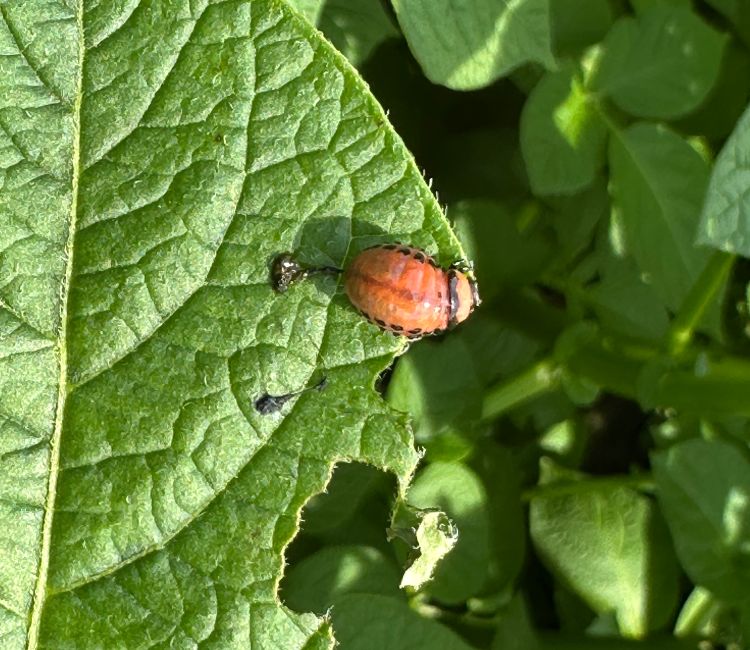
Colorado potato beetles remain one of the most challenging insect pests in potato production. Growers now have access to Zivalgo (isocycloseram, PLINAZOLIN technology), a new foliar insecticide and important new tool for managing Colorado potato beetles.
Zivalgo is a Group 30 insecticide, meaning it controls insects through a different mode of action than other products currently labeled for Colorado potato beetle in potatoes (Table 1). Adding new modes of action is critical for resistance management, as Colorado potato beetle has a long history of developing resistance to insecticides. Rotating insecticide groups throughout the season helps preserve the effectiveness of available products.
Zivalgo provides effective contact control of all Colorado potato beetle life stages and can be used throughout the growing season until 14 days prior to harvest. However, in fields where an at-planting insecticide has already controlled overwintered beetles, Zivalgo is generally best reserved for emerging summer adults, which typically begins in early July in many parts of Michigan (Figure 1). To help protect this new chemistry and slow resistance development, avoid using Zivalgo against overwintered and summer adults in the same season.
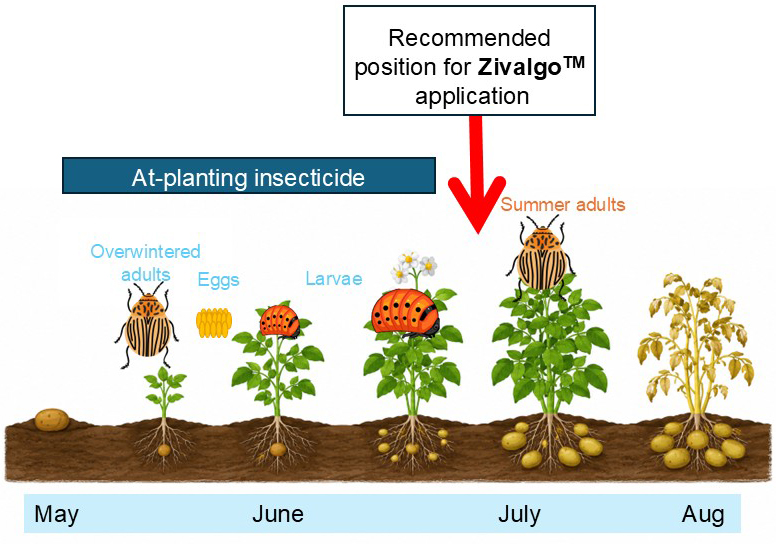
The rate range on the label is 0.7–2 fluid ounces per acre. Michigan State University Extension recommends using the higher labeled rate to maximize control and reduce the number of surviving beetles that could contribute to resistance development. While Zivalgo can be aerially applied, ground application may achieve better results. Group 30 insecticides should not be applied more than three times per Colorado potato beetle generation or within a 30-day treatment window. As with any new insecticide, preserving effectiveness through proper resistance management will be essential to maintaining Zivalgo as a valuable Colorado potato beetle control option for years to come.
This insecticide is toxic to bees; pollinator protection restrictions apply during bloom. Foliar applications in potato are prohibited from the onset of flowering until flowering is complete unless applications are made before 10 a.m., after 3 p.m., or when temperatures at the application site are 50 degrees Fahrenheit or lower. No more than two applications may be made during bloom.
Beyond Colorado potato beetles, Zivalgo can help manage several other important potato pests, including leafhoppers, thrips, European corn borer and flea beetles. This broad spectrum of activity may provide additional value when multiple pests are present in a field. Always check the product label, as recommended application rates differ among pests.
Learn more about potato pest management.
Table 1. Registered insecticides for managing Colorado potato beetles (CPB) and recommended application timing:
|
Treatment window |
Active ingredient |
IRAC MoA group |
Delivery |
Common trade names |
|
Overwintered CPB |
Imidacloprid |
4A |
In Furrow, Seed treatment |
Admire Pro, generics |
|
Overwintered CPB |
Novaluron |
15 |
Foliar |
Rimon (target small larvae) |
|
Overwintered CPB |
Ledprona |
35 |
Foliar |
Calantha (target small larvae) |
|
Overwintered CPB |
Thiamethoxam |
4A |
In Furrow, Seed treatment |
Platinum, Cruiser Maxx Potato |
|
Summer CPB |
Abamectin |
6 |
Foliar |
Agri-Mek, generics |
|
Summer CPB |
Chlorantraniliprole |
28 |
Foliar |
Coragen, Besige |
|
Summer CPB |
Cyantraniliprole |
28 |
Foliar |
Exirel, Minecto Pro |
|
Summer CPB |
Imidacloprid |
4A |
Foliar |
Admire Pro, generics |
|
Summer CPB |
Indoxacarb |
22A |
Foliar |
Steward |
|
Summer CPB |
Isocycloseram |
30 |
Foliar |
Zivalgo |
|
Summer CPB |
Spinetoram |
5 |
Foliar |
Radiant |
|
Summer CPB |
Spinosad |
5 |
Foliar |
Blackhawk, Entrust |
|
Summer CPB |
Thiamethoxam |
4A |
Foliar |
Actara, Endigo ZCX |
|
Summer CPB |
Tolfenpyrad |
21B |
Foliar |
Torac |
Reference to commercial products or trade names does not imply endorsement by MSU Extension or bias against those not mentioned.
This work is supported by the Crop Protection and Pest Management Program (grant no 2024-70006-43569) from the USDA National Institute of Food and Agriculture. Any opinions, findings, conclusions, or recommendations expressed in this publication are those of the author(s) and do not necessarily reflect the view of the U.S. Department of Agriculture.