New Study Shows Urban Growers Rely on Accessible Educational Resources to Adopt Pollinator-Friendly Farming Practices
 Print
Print Email
EmailA recent study found that urban farmers are more likely to implement pollinator management practices when educational and farming support resources are accessible and in preferred formats.
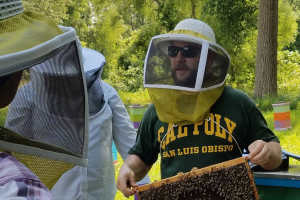
A recent study by MSU entomologists Jen Roedel, Karma Thomas and Zsofia Szendrei found that urban growers' use of pollinator management practices is driven more by access to educational resources, labor and other farming supports than by demographics or the pollination needs of their crops.
Urban farming has expanded across the United States, providing food access, food sovereignty and environmental benefits, particularly in underserved communities. Unlike many conventional farms, urban farms often grow a wide variety of crops in smaller urban spaces, many of which depend on insect pollinators.
However, little was known about what factors influence urban growers' decisions to adopt these practices. Roedel and colleagues sought to better understand how growers access information and what motivates them to implement pollinator management strategies.
The researchers surveyed 74 urban growers and assessed how grower demographics, perceptions, motivations and resource accessibility influenced the adoption of common pollinator management strategies and overall crop richness on farms. They also examined which educational resources urban growers use most frequently.
The study showed that grower demographics, [including] age, gender, farm income, education level and years of agricultural experience, did not significantly influence pollinator management decisions. Instead, access to resources such as labor, funding and land had a stronger influence on whether growers implemented pollinator-supportive practices.
"We found that accessibility to resources (labor, money, land accessibility) and educational resource type drove the implementation of these practices, while there was a disconnect between the importance of pollination for crops grown and using these methods," Roedel said.
The most commonly used educational resources were hard-copy books and field guides, conversations with fellow growers and farmers, online Extension articles, and nonprofit organization resources. The findings also suggest that some pollinator management practices may be adopted more effectively when information is delivered through online materials rather than hard-copy formats.
"This work is especially important for extension educators who work with urban growers who want to implement pollinator management practices,” Roedel said. “It gives examples of which educational resources are most preferred and used."