


No shortcuts to Michigan terroir: Building wine identity from the vineyard up
 Print
Print Email
EmailFrom imitation to identity: Defining Michigan wine through its own vineyards.
Several years ago, Bryan Ulbrich, winemaker at Left Foot Charley, made an important observation: younger wine drinkers often care less about inherited tradition and more about discovery. His message was that Michigan wineries should lean into Michigan’s own terroir instead of chasing European comparisons. Terroir is a French term used to describe how a unique combination of soil, climate, topography and farming practices influences the taste of wine.
That observation brings the Michigan grape and wine industry to a defining question for its future: will Michigan terroir be defined by comparison to other regions, or by the careful understanding of its own vineyards, climate, soils, growers and wines?
The answer cannot come from marketing alone. Terroir cannot be invented by a label, a slogan, a tasting-room story, a dinner in a vineyard or a comparison with Burgundy or Napa Valley. Terroir must be discovered through the long, disciplined work of growers, winemakers, researchers and Extension educators who observe how vineyards perform over time. For Michigan, this is both a challenge and an opportunity. The state does not need to copy older regions. It needs to understand what makes Michigan different: the Great Lakes, latitude, winter risk, cool nights, acidity retention, seasonal variability, disease pressure, soils, slopes and the cultivars that can translate these conditions into distinctive wines. As Erik Orsenna famously reminded us “wine is liquid geography.” For Michigan, the task now is to define that geography with greater precision.
Terroir takes time
In the most mature wine regions of France and Italy, terroir was not defined in one generation, by one research project, or through one marketing campaign. It required centuries of grower observation and decades of formalization. In Burgundy, the concept of the “climat” represents one of the most advanced examples of terroir definition in the world. A “climat” is not simply a vineyard name. It is a precisely delimited vineyard parcel recognized over time for its specific combination of soil, slope, exposure, microclimate, history and wine expression. Many of these vineyard names have been recognized for centuries and were gradually defined through repeated harvests, repeated tastings, repeated comparisons, and repeated economic recognition of the parcels producing distinctive wines. A classic example is Romanée-Conti in Vosne-Romanée, one of Burgundy’s most famous Grand Cru climats. Its identity is not based only on Pinot Noir, but on the precise combination of a delimited vineyard parcel, slope, exposure, limestone-clay soils, drainage, vine history, grower knowledge, specific vineyard management and repeated recognition of wine quality over many generations.
The same logic applies to Piemonte. The Langhe did not become a mature terroir region simply because Nebbiolo was planted there. Growers had to learn, over generations, which slopes, exposures, elevations, and soils could ripen Nebbiolo with balance, structure, and complexity for a Barolo wine. The best sites were recognized first through grower experience and market reputation, then through producer language, vineyard names, maps and eventually formal regulation. Besides a long European history of denominations (e.g. designations, appellations), in Barolo, the Additional Geographical Mentions, or MGA, were officially introduced in 2010, recognizing 181 vineyard sub-areas that could be used on labels. The regulation did not create the differences among sites; it codified differences that growers, winemakers, wine experts and consumers had observed for decades.
An essential lesson for Michigan
A single warm year, cold year, wet year, dry year, or high-disease-pressure season can mislead growers. True terroir knowledge comes from observing how a site performs across many vintages: frost years, wet years, drought years, disease-pressure years, warm harvests, cool harvests and years with different levels of winter injury. Michigan does not need to wait centuries before acting. Modern tools can accelerate the process. Weather stations, GIS mapping, soil surveys, remote sensing, yield maps, fruit chemistry, sensory analysis and long-term vineyard databases can help Michigan learn faster than historical regions were able to learn.
Michigan has already entered a new phase
Michigan has made enormous progress over the last 25 years. The state has moved from broad experimentation toward a more defined cool-climate wine identity. Tourism has increased, consumer recognition has improved, and the industry has developed a clearer concentration around cultivars such as Riesling, Chardonnay, Pinot Noir, Pinot Gris and Cabernet Franc. A recent MSU Extension review of Michigan wine grape acreage described the transition from a region historically dominated by juice grapes and hybrids toward a more specialized wine grape industry. The article reported approximately 3,375 acres of Michigan wine grapes in 2024 and showed that five cultivars now represent the majority of the state’s wine grape acreage, indicating that Michigan has already begun moving from experimentation toward specialization.
An important sign of maturity
Specialization is only the beginning. The next step is to understand where each cultivar performs best, what wine style each site can support and which vineyard practices most consistently improve quality. For Michigan growers, this means asking more precise questions. Which Riesling sites retain acidity while developing aromatic intensity? Which Chardonnay blocks are better suited for sparkling base wine rather than still wine? Which Pinot Noir sites achieve reliable ripening without excessive crop stress or disease pressure? Which Cabernet Franc sites can produce fresh, structured, cool-climate red wines with consistency? Which Pinot Gris vineyards can move beyond commercial reliability and contribute more strongly to regional identity? These questions cannot be answered by reputation alone. They require vineyard records, fruit chemistry, wine evaluation, and grower experience across multiple seasons.
Focusing on flagship cultivars does not diminish the value of minor or emerging cultivars
On the contrary, strong flagship wines create the credibility that allows consumers, sommeliers, buyers and growers to become curious. In mature wine regions, the best-known cultivars often function as the doorway into a broader viticultural identity. Piemonte is a useful example. The international reputation of Barolo and Barbaresco, built around Nebbiolo, did not reduce the importance of other regional varieties. Instead, it created the confidence and curiosity that now allow consumers to pay attention to Timorasso, Nascetta, Freisa, and other more local or rediscovered cultivars. Many people become interested in Timorasso because they already trust the quality culture of Piemonte through Barolo, Barbaresco, Barbera and other established wines.
The same logic applies to Michigan. Building a strong identity around Riesling, Pinot Noir, Chardonnay, Cabernet Franc and Pinot Gris does not mean ignoring Blaufränkisch, Grüner Veltliner, Teroldego or disease-resistant cultivars. Instead, the flagship cultivars can raise the reputation of the entire region. If Michigan earns confidence through excellent Riesling, serious sparkling wine, site-driven Pinot Noir, and well-grown Cabernet Franc, then buyers will be more willing to explore Blaufränkisch, Grüner Veltliner, and other cultivars that express Michigan’s climate and grower skill. A mature region needs both: flagship cultivars that define the main reputation and complementary cultivars that add diversity, discovery and future opportunity. The goal is not to make every cultivar equal in visibility, but to build a quality hierarchy in which the strongest wines lift the credibility of the entire regional portfolio. As Bryan Ulbrich reminded us: “younger wine drinkers often care less about inherited tradition and more about discovery.”
Vineyard work must return to the center
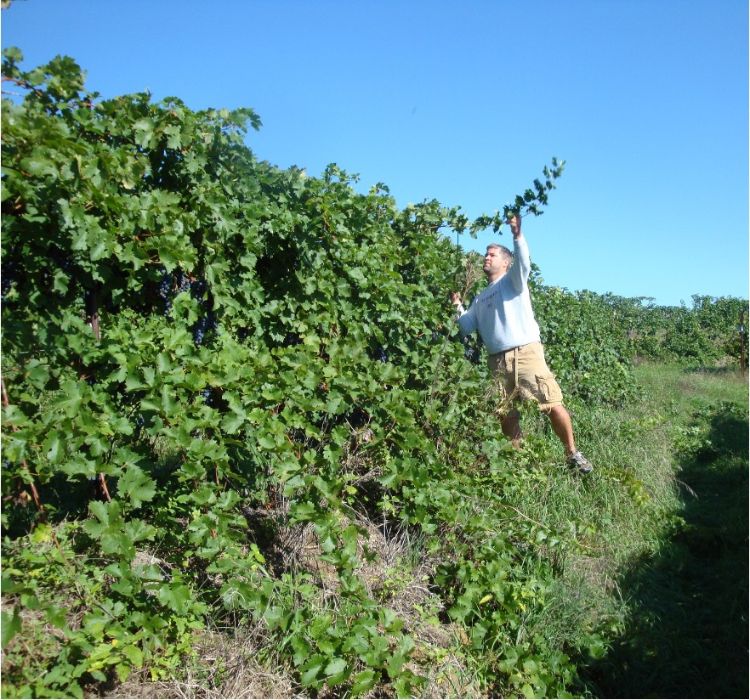
As the Michigan wine industry has grown, something essential has sometimes remained less visible: the daily work inside the vineyard. As wineries expanded, tasting rooms became more important, tourism increased, and regional promotion became more sophisticated, the work of grape growing did not always receive the same attention. But the quality of pruning, canopy management, crop-load adjustment, disease control, harvest decisions, soil management, cover crops and long-term vine balance is what determines whether a region can move from commercial presence to true wine reputation.
This does not diminish the progress Michigan has made. Rather, it clarifies the next step. The industry now needs to bring grape growers and vineyard work back to the center of the conversation. Jean-Michel Comme, reflecting on his work at Château Pontet-Canet, explained that “each place, each row, each soil type has a single personality and that the grower’s task is to understand that personality as well as possible.” A mature wine region is built not only by wineries, brands, and visitors, but by the skill, discipline, and accumulated knowledge of growers working block by block, season by season. For growers, this means that vineyard practices should not be viewed only as production tasks to be mechanized when possible. They are part of regional identity. A well-pruned vine, a balanced crop, an open canopy, a clean fruit zone, a healthy soil and a well-timed harvest are not just technical details. They are the physical foundation of Michigan terroir.
Michigan research shows that terroir is built by management
The idea that Michigan terroir must be built from vineyard evidence is not theoretical. Research work at Michigan State University have already produced concrete examples of how canopy management, crop load, winter risk, rootstock choice, shape fruit quality under Michigan conditions. Quality vineyard management becomes part of terroir when it is repeated, refined and adapted to place over time. Poderi Aldo Conterno, one of the historic Barolo producers of Monforte d’Alba, summarizes this idea well: “What we want to offer is simply the interpretation of a terroir through our deep-rooted beliefs.” This is the key point for Michigan. Terroir is not only soil, climate, slope and cultivar; it is also the accumulated knowledge of growers who learn how to prune, balance, protect, and harvest vines in a way that allows each site to express its potential. One important example is the work on early leaf removal and fruit-zone management research initiated 25 years ago. In cool and humid climates, canopy density strongly affects fruit exposure, cluster temperature, disease pressure, fruit composition and ultimately wine quality. Research done at MSU showed that early defoliation reduced fruit set, reduced cluster compactness, lowered harvest-season cluster rot and positively influenced yield and fruit chemistry. For Michigan growers, the message is direct: site expression is not passive. A vineyard does not express its best potential if the canopy is too dense, the fruit zone remains shaded, or clusters stay compact and disease prone. Terroir is the interaction between place and skilled management. As Lidia Bastianich puts it, “Today’s innovation is the tradition of the future.” For Michigan, this is an important lesson: the practices that may seem new today like early leaf removal, can become tomorrow’s regional tradition if they are repeated, refined, and shared across the industry.
Michigan should not define itself by imitation
Michigan terroir has too often been described by comparison: “like Burgundy,” “like Germany,” “like Piemonte,” or “like another cool-climate region.” These comparisons can be useful for orientation, but they are not enough to define Michigan. Michigan terroir will be defined by what consistently shapes fruit and wine here. The Great Lakes moderate temperatures and influence growing-season conditions and vineyard management. Latitude and cool nights help preserve acidity. Winter injury risk affects cultivar choice, pruning strategy, trunk renewal and vineyard economics. Humid summers increase disease pressure and require disciplined canopy and spray management. Soils, slopes, drainage and aspect influence vine vigor, ripening and disease risk. Seasonal variability makes consistency difficult but also creates the need for more precise site selection and vineyard management. In this sense, Michigan’s challenges are not separate from its terroir. Winter risk, acidity, disease pressure and lake influence are part of the story. The goal is not to hide these realities, but to understand how the best growers and best sites turn them into wines with identity.
André Tchelistcheff, one of the most influential winemakers in American wine history, once warned about the danger of planting a successful cultivar everywhere simply because the market recognizes it. Speaking about California, he observed that because Cabernet Sauvignon was considered the state’s best red wine, it was planted everywhere. His warning is relevant to Michigan today. Cultivar reputation should never replace site suitability. For Michigan, the equivalent lesson is clear. Riesling, Chardonnay, Pinot Noir, Cabernet Franc, hybrids and new disease-resistant cultivars should not be planted because they are convenient or familiar. They should be planted where the site can support quality and where the resulting wine can strengthen the regional identity.
At the beginning of my career at MSU, I often heard a faculty colleague repeat, with a peculiar sense of humor: “If you have a terrible site, just plant Marquette.” The comment was wrong. Marquette can have an important role in cold-climate viticulture, an extensively planted variety in Minnesota, Vermont, Wisconsin, Nebraska and other cold-climate viticulture states. The point is that no cultivar should be used as a substitute for serious site evaluation. A mature wine region does not ask only which grape can survive in a difficult site; it asks which grape can produce fruit that strengthens the reputation of the region.
A practical terroir-learning system for Michigan
The practical goal for Michigan should be to build a structured terroir-learning system. This does not require waiting for perfect data. It requires consistent data. Each important vineyard and region should be evaluated over time for winter survival, frost risk, phenology, yield stability, disease pressure, fruit chemistry, wine sensory profile and economic return. Growers should document not only what was harvested, but how the vineyard performed under the conditions of that specific year. This kind of recordkeeping can be simple at first. Bud survival, pruning weight, shoot density, crop estimate, cluster disease, harvest date, Brix, pH, titratable acidity, yield and wine destination already provide valuable information. Over time, these records become powerful. They help identify which blocks are consistent, which are risky and which require changes in pruning, canopy management, crop level, cultivar, rootstock, or wine style. Technical tastings should also become part of this process. Wines should be compared by site, not only by winery. A Riesling tasting should ask which vineyards produced the best acid balance and aromatic expression. A Pinot Noir tasting should ask which sites consistently achieve phenolic maturity and which sites show recurring limitations. A Cabernet Franc tasting should evaluate whether freshness, structure and aromatic quality are linked to specific sites or management practices. Extension and research programs can then connect these observations to soil, climate, topography, vine physiology and vineyard management. This is how Michigan can accelerate terroir understanding without reducing terroir to marketing.
What this means for Michigan growers
For Michigan growers, the message is positive. The future of the industry will depend on the quality of vineyard decisions made every season. The first priority is to know the site. Growers should understand frost risk, winter injury patterns, soil drainage, vigor potential, disease pressure, and ripening capacity before making major planting or replanting decisions. A site that is excellent for Riesling may not be appropriate for Pinot Noir. A block that struggles with red wine ripening may be better suited to sparkling base wine, aromatic whites, or another cultivar strategy. The second priority is vineyard management.
In Michigan, quality depends on matching crop level to canopy capacity and seasonal conditions. Excessive cropping can delay ripening, reduce flavor development, increase disease risk, and weaken vine reserves. Under-cropping can also create imbalance, excessive vigor, and economic problems. The goal is not simply low yield. The goal is balanced vines that can ripen fruit consistently while maintaining long-term vine health. The third priority is canopy and disease management. In a humid climate, an open, well-managed canopy is not optional. It improves spray penetration, reduces cluster-zone humidity, improves fruit health, and can help achieve more uniform ripening. Disease management is not only about protecting yield; it is part of quality management. The fourth priority is to connect vineyard work to wine evaluation. Growers need feedback from wineries, and wineries need to communicate clearly what fruit characteristics lead to better wines. The relationship between grower and winemaker should not begin at harvest. It should be active throughout the season. The fifth priority is to build regional memory. Michigan growers have already accumulated a great deal of practical knowledge. The next step is to organize that knowledge so it can help the whole industry. Shared benchmarks, field days, technical tastings, vineyard discussions can help growers learn from one another while still protecting individual business information.
No shortcuts, but a clear path forward
Michigan should not take shortcuts to terroir. It should not define itself by imitation, by marketing language, or by isolated success stories. It should define itself through the patient, collective work of understanding vineyards over time. Research and Extension have helped document the evolution of the state’s wine grape industry. Consumers are more open to discovery, and Michigan has a story that is authentic: Great Lakes influence, acidity, winter resilience, grower skill and wines that do not need to imitate anywhere else. The central question is not whether Michigan has terroir. Every vineyard has site characteristics. The real question is whether Michigan is ready to do the long, collective work required to understand which sites produce wines that are distinctive, consistent, and worthy of regional reputation. That work begins in the vineyard. It begins with growers who observe carefully, manage precisely, record honestly, and continue improving year after year. If Michigan brings vineyard work back to the center of its wine story, the state can build a stronger, more mature and more confident wine identity. As the American wine writer Matt Kramer has argued, terroir is ultimately about somewhereness: the ability of a wine to express where it comes from. That idea is especially useful for Michigan. The goal is not to taste like Burgundy, Piemonte or Napa, but to develop wines that clearly and confidently taste like Michigan.