Northwest Michigan fruit update – July 21, 2026
 Print
Print Email
EmailTart cherry harvest is in full swing, and some of the blocks are picking out longer than estimated. Apples are just starting to color.
Weather report
The weather continues to throw everything at us during this harvest season. The daytime temperature yesterday, July 21, was 80 degrees Fahrenheit. Today started warm, and it has gotten windier and colder throughout the day. The NWMHRC Enviroweather station recorded 1.67” of rain overnight of July 20 into July 21. At the NWMHRC, we have accumulated 1938.2GDD base 42 and 1221.7GDD base 50. We are close to our 36-year averages, and those accumulations are as follows: 1897.2GDD base 42 and 1191.8GDD base 50.
Crop report
Growers are harvesting both sweet and tart cherries. Growers have had a lot of logistics to work out this harvest season. In most years, growers harvest sweet cherries and move into tarts, but because of crop load differences in orchards, some growers have bounced back and forth between sweets and tarts. Tart cherry blocks with light crop loads have matured faster than heavier sweet cherry loads. Growers are doing their best to get all the cherries harvested as fast as they are able.
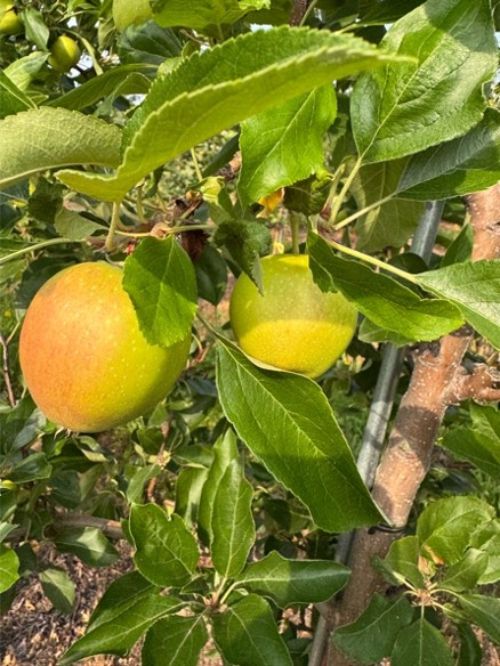
Apples at the station are growing quickly: Galas are at 48 mm and Honeycrisp are at 52 mm. We are starting to see the first color on Gala at the station. Some growers have had to hand thin their apple crop.
Disease report
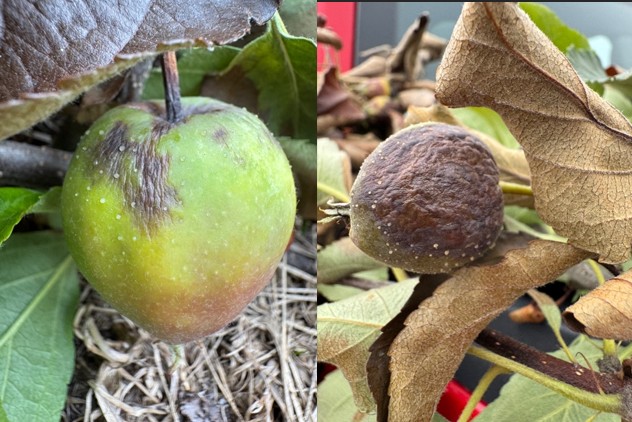
Apple scab. We have had some reports of scab showing up on fruit. However, in most cases, growers did a good job controlling this disease this season.
Fire Blight. We have had many calls of fire blight showing up in orchards across the region. We are going back into the weather records to find out when this disease came into the orchards. We did not have high EIPs during the blossom phase of this disease, and we are hypothesizing that the shoot blight that we are seeing in the orchard now is a result of a trauma event. There have been no shortages of extreme weather this season, and we will go back to try to determine when this trauma event came in to cause this shoot blight. We have seen more strikes than usual for commercial apple blocks, unfortunately. The strikes just started to show up in the last week. We have observed considerable oozing on apple fruits in some regional blocks.
The Sundin lab will be at the NWMHRC on Thursday, and they can take samples back to MSU to test for resistance. Please give me a call if you want your orchard sampled: Nikki at 231-342-4094.
Cherry Leaf Spot. There is some leaf spot showing up on the tops of trees and inside the canopy. We have observed some damage to trees at the station that look like phytotoxicity, as they are on the sides of the canopy in more of a spray pattern than the classic CLS that starts in the tops of trees when we first see yellowing and defoliation. Overall, trees look good for keeping leaves on through the fall. We are rating the CLS efficacy trial at the station on Thursday.
American Brown Rot. We have seen brown rot show up in sweet cherries, but many growers are concerned with the amount of brown rot in tart cherry. We know that sweet cherries are more susceptible to this disease compared with tart cherry, but this year, we are seeing more ABR in tarts than is typical. We hypothesize that growers that relied heavily on a captan program for leaf spot in tarts are running into some trouble with all the rain we have had this season. Captan is best used as a mixing partner for resistance management for ABR.
Growers should use the maximum rates of all fungicides: Merivon (6.7 fl oz / A), Miravis (5.1 fl oz), Tesaris (5.6 fl oz), and Cevya (5 fl oz). Resistance management is extremely important, and these materials need to be tank mixed with a broad-spectrum fungicide, such as Captan or sulfur.
Insect report
Obliquebanded leafroller. We have seen small OBLR larvae in the orchard. These larvae can be shaken from the tree during cherry harvest, and the larvae can end up in tanks. Growers that have had problems in the past need to be controlling these small larvae prior to harvest.
Spotted wing drosophila. 2026 is one of the worst years we have seen for SWD. We have seen many sweet cherry blocks that were infested prior to harvest, particularly when the block is in an area with little air movement or against a woodlot. With the fruit having value this season, growers should be doing all they can to keep out SWD. These rains are a challenge to keep fruit protected from SWD infestation.
We have lots of insecticides that are rated excellent for SWD in sweet and tart cherry: Exeril, Apta (good to excellent), Verdepryn, Entrust, Warrior, Mustang Max. Imidan is not labeled in sweet cherry but can be used in tart cherry; this insecticide is an excellent material against PC. Again, this pest thrives in warm and humid conditions. High humidity also favors SWD population growth, and this pest can have one generation in less than 7D under optimal conditions. Growers need to be actively managing SWD until harvest is over.
Thrips. We do not typically see thrips damage in orchards in northern Michigan, but we have seen them in sweet cherries in recent years. In fact, there have been many reports of thrips damage in fruit crops across the state: blueberry, cherry, apple, and strawberry. We have spent more time talking about thrips on the MSU Fruit Team call this year than any other year in the past. We had a grower report thrips damage to apples last week (picture below).
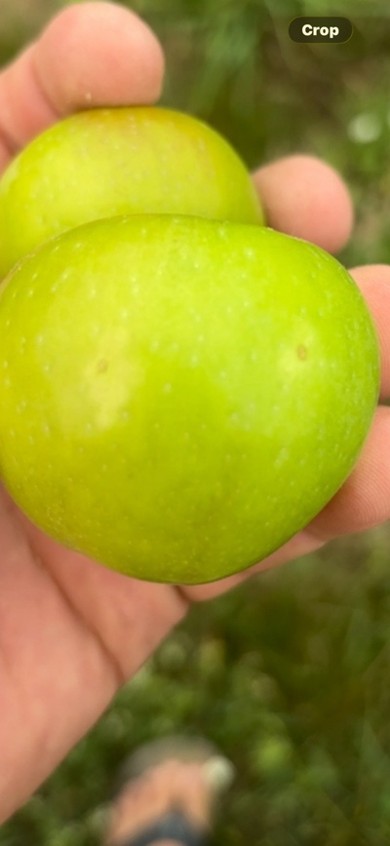
Thrips are small, slender insects with four long, narrow wings fringed with hairs. The western flower thrip is widely distributed throughout the United States. Thrips rasp the surface of the fruit as they feed.
Damage does not occur every year and is difficult to predict. Thrips visit many other flowering plants as well as tree fruits, and if those plants are in bloom at the same time the thrips population will be diluted and there will be less chance of fruit damage.
This work is supported by the Crop Protection and Pest Management Program (grant no 2024-70006-43569) from the USDA National Institute of Food and Agriculture. Any opinions, findings, conclusions, or recommendations expressed in this publication are those of the author(s) and do not necessarily reflect the view of the U.S. Department of Agriculture.